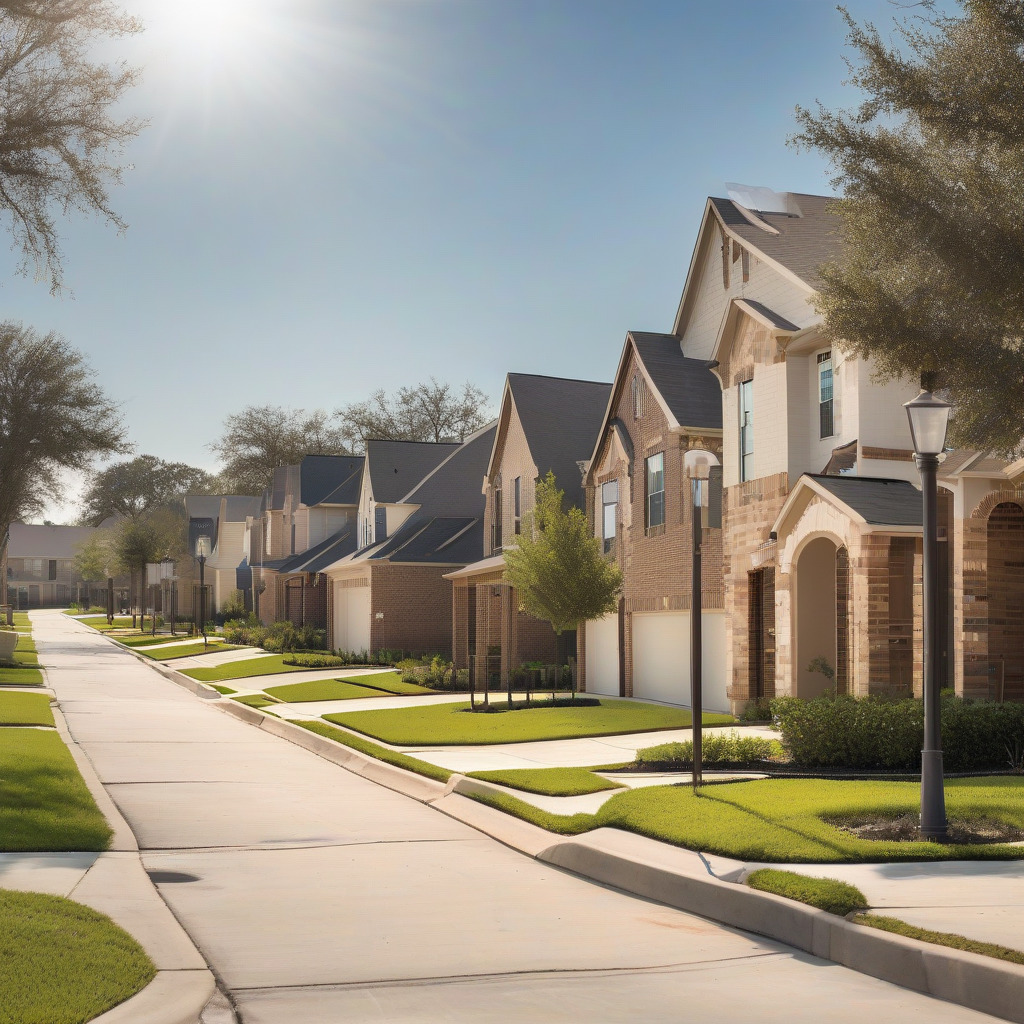
What Houston's New Construction Market Actually Offers Buyers This Summer
Permit data, builder incentives, and a ZIP-code-level price comparison tell a more complicated story than the model-home sales pitch.

Permit data, builder incentives, and a ZIP-code-level price comparison tell a more complicated story than the model-home sales pitch.
Walk into a model home in Fulshear on a July Saturday and the sales rep will hand you a rate sheet before you’ve finished your water bottle. D.R. Horton is currently advertising a rate buydown through DHI Mortgage on select quick-move-in homes. It’s a discount built into the deal structure, not negotiated, and it evaporates the moment you show up with your own lender.
That’s not an accident. Builders in the Houston metro entered 2026 managing elevated inventory, and the incentive packages on the table this summer reflect a clear shift away from the supply-rationing environment of 2021–2022. Remember when builders were running lotteries for lots? That already sounds like a different era.
This is the moment when the mechanics of buying new actually matter. The offer is real and the math is complicated. Here’s what the data shows about where builders are active, what they’re offering, and whether it actually pencils out against resale.
Where the Permits Are: Stop Here Before You Drive Anywhere
The Houston new-construction market is sprawling and uneven. Understanding the geography will save you a Saturday — and probably a tank of gas.
Harris County Engineering and Fort Bend County’s development services portals track new single-family residential permit activity across both counties. The Houston metro ranks among the top three metros nationally for new-home permit volume, per the Census Bureau Building Permits Survey. That activity clusters hard in a handful of ZIP codes.
77494 (Fulshear and Katy) is the most active permit corridor in the metro. Communities including Elyson and Sunterra generate continuous permit flow from D.R. Horton, Lennar, and Perry Homes. Fulshear has ranked among the fastest-growing cities in the United States across multiple years of Census data — which is either exciting or alarming depending on how you feel about FM 1093 at 7am.
77433 (Cypress and the Bridgeland corridor) runs close behind, driven by the Bridgeland master-planned community, where Lennar and Chesmar have active sections. The infrastructure here is built out to a degree that distinguishes it from raw subdivisions in earlier phases. Buyers who’ve spent a summer living next to an active construction zone understand why that matters.
77573 (League City) anchors the southeast submarket, with D.R. Horton active and permit counts driven partly by proximity to Clear Lake employment. 77375 (Tomball) covers the northwest suburban push, where Lennar and David Weekley have been active; relatively lower land cost makes the price points more accessible than Katy or Fulshear. In Fort Bend County, 77406 and 77469 (Richmond and Rosenberg) include Perry Homes and others active in Harvest Green and Aliana. Fort Bend’s tax structure relative to some Harris County MUD districts makes this submarket worth comparing directly — with actual numbers, not a builder’s talking point.
By volume, D.R. Horton leads permit activity across both counties, consistent with its national position as the largest homebuilder in the U.S. Perry Homes has notably concentrated activity in Fort Bend County communities. Chesmar and David Weekley, both Houston-based, are significant local players. Chesmar is particularly active in master-planned communities where lot premiums matter: a lot facing a greenbelt versus a lot facing someone else’s fence can be a $15,000 difference that isn’t obvious from the site map until you ask.
Builder Incentives, Broken Down by Name
“Closing cost assistance” is how builders advertise. Here’s what the programs actually look like as of summer 2026.
D.R. Horton / DHI Mortgage runs rate buydown programs on quick-move-in inventory across most active Houston communities. Bring an outside lender and the rate incentive converts to a closing cost credit. These are not equivalent — and the rep may not volunteer that distinction. The rate lock windows on buydown programs tend to be tight. Get the specific terms in writing before you begin the qualification process.
Lennar’s pitch is structurally different. The “Everything’s Included” model bundles features that competing builders sell as upgrades into the base price, which makes price-shopping against a D.R. Horton base number an apples-to-oranges exercise. That’s exactly what Lennar is counting on. Their mortgage subsidiary runs competitive rate programs, but the more useful negotiation — one that doesn’t appear on the rate sheet — is asking specifically about lot premium waivers on sections that have been sitting. Lots with bad orientation or noise exposure sometimes come with real flexibility if you push.
Perry Homes draws a harder line between spec inventory and to-be-built contracts. On completed or near-complete spec homes, Perry offers rate buydowns through its affiliated lender plus closing cost credits that vary by community. On to-be-built contracts, the incentive package is lighter because Perry is pricing for certainty rather than urgency. The upside of Perry’s spec inventory, if you can find the right home, is that the quality tier tends to run higher than comparable production-builder product at the same price. The downside: you may be choosing between three homes instead of thirty.
Chesmar Homes leans toward design studio credits rather than mortgage rate subsidy. For buyers who’d otherwise upgrade out of a base-price home, that matters — the gap between a builder-standard kitchen and what you’ll actually want to live with can run $20,000 or more. David Weekley Homes is the outlier in this group. Weekley doesn’t compete on rate buydowns. Their reps will tell you openly that the value proposition is build quality, floor plan flexibility, and warranty responsiveness. For buyers choosing between a Weekley home and a Lennar home at a similar price point, that’s a real tradeoff — not marketing language, but not a gimmick either.
Price Per Square Foot, New vs. Resale: The Story in 77494
ZIP code 77494, covering the Katy and Fulshear corridor, has enough volume on both sides — new construction and resale — to produce meaningful medians. Based on HAR.com market data, new-construction closings in 77494 have been running approximately $145–$175 per square foot. Resale closings in the same ZIP have been landing around $130–$155 per square foot. That’s roughly an 11–13% gap at the midpoints — narrower than when resale inventory was near zero, and that compression is the most consequential development in this market in the past year. For a broader view of where prices stand across the metro, what the Houston housing market actually looks like at mid-year 2026 provides useful context alongside the new-construction picture.
Pull your own 90-day HAR.com figures for the specific price tier you’re shopping before you use those numbers for anything. They’ll shift.
One methodology trap worth knowing: builder square footage in listing data sometimes excludes the garage, which can add 400–600 square feet to a home’s footprint without entering the price-per-square-foot denominator. Use the sold price against the HAR-reported living area figure consistently for both new and resale. Mixing builder marketing square footage with MLS square footage produces a comparison that’s meaningless.
Factor in the monthly payment reduction from a builder rate buydown, and the effective cost of a new-construction home in 77494 moves closer to the resale equivalent over a five-year hold. Whether it crosses over depends on the specific resale comparables and what condition they’re in. The new-construction premium is smaller than most buyers assume going in — at least in this submarket.
For contrast: in 77573 (League City), new construction is running approximately $150–$180 per square foot versus resale at approximately $135–$160 per square foot. The spread may be narrower than Fulshear partly because resale supply in that area has stayed tighter. Verify against current HAR data for the specific homes you’re evaluating.
What You Actually Gain with New Construction in Houston Right Now
The Texas 1-2-10 warranty is statutory. Texas builders must warrant workmanship for one year, systems (HVAC, plumbing, electrical) for two years, and structural components for ten years under the Texas Property Code. It’s not transferable if you sell, but for a first owner it’s meaningful coverage in a market where foundation movement and drainage failures are common, not edge cases.
The 2021 International Energy Conservation Code tightened insulation, window, and air sealing requirements for new Texas residential construction. In a city where air conditioning runs eight months a year, building envelope performance matters. New homes built to current code meet standards that older resale comparables in the same ZIP simply don’t. Anyone who’s opened a July electricity bill on a 1990s-era slab knows this already.
The rate buydown math is real but conditional. If the builder buys down the rate rather than reducing the price, you’ve received purchasing power in the form of a lower monthly payment — but only if you keep the loan and don’t refinance when the market moves. If rates drop and you refinance, the buydown was a transaction motivator, not a ten-year gift. Model out the refinance scenario before treating it as permanent value.
Buying resale in a flood-adjacent area means inheriting whatever drainage and grading decisions were made by previous owners, the original builder, and whoever platted the subdivision. New construction carries its own flood risks, but you can request the elevation certificate before the lot is graded rather than learning about it during inspection. Our moving & real estate coverage addresses related due-diligence topics, including what home inspections should flag in Houston’s climate.
What You Give Up: Four Houston-Specific Tradeoffs That Competing Coverage Skips
MUD taxes are the single most underappreciated line item in new-construction Houston. Municipal Utility District bond taxes finance infrastructure — water, sewer, drainage — in unincorporated areas, paid off over 20–30 years through a property tax surcharge on district residents. The Texas Comptroller’s database shows MUD rates ranging from roughly $0.50 to $1.50 or more per $100 of assessed value, stacked on top of county, school district, and any applicable city rates. On a $400,000 home in a district carrying an $0.85 MUD rate, that’s approximately $3,400 per year in MUD taxes alone — a number that does not appear in the builder’s mortgage payment estimate unless you specifically ask for it. As bonds are retired over the life of the district the rate typically drops, but the timeline varies and is not guaranteed. Ask for the certified rate and the bond retirement projection. This is public information. Builders who deflect are hoping you find it after you’ve signed.
The commute in Houston’s highest-permit ZIP codes is real. Fulshear, Cypress, League City, and Tomball sit meaningfully outside the urban core. None of that is a knock on these communities — they offer genuine quality of life. But a monthly payment savings can be absorbed by fuel, tolls, and vehicle wear if your job is downtown or in the Medical Center. Drive the route at 7:15am on a Tuesday before you fall in love with the model home.
Shade sounds minor until you live through a Houston summer. A bare subdivision lot with saplings planted at closing creates a quality-of-life deficit that lasts years. The western exposure on a back patio on a July afternoon shapes how people actually use their homes. Resale buyers in older neighborhoods with established trees are purchasing something that can’t be fast-tracked.
Flood zone and lot-level disclosure matters because standards vary by jurisdiction. Houston’s Chapter 19 floodplain ordinance, adopted after Harvey, requires new construction within city limits to be elevated above the base flood elevation. It does not automatically apply to unincorporated Harris County or Fort Bend County subdivisions, where applicable standards may differ. More importantly: a Zone AE subdivision is not uniform risk. An interior lot may sit meaningfully higher than a perimeter lot adjacent to a detention pond or drainage easement. Request the elevation certificate by lot number — not the subdivision summary, the lot-specific certificate. Have it reviewed by someone who reads them regularly before you sign anything.
One Buyer Who Closed This Spring
[EDITOR’S NOTE: This section requires a verified buyer testimonial from a real buyer who closed on Houston-area new construction in Q1–Q2 2026. Contact HAR-member agents who specialize in new construction, or solicit accounts via r/houston or r/HoustonRealEstate. A single on-record testimonial is the reporting gap no competing coverage has filled. Do not publish placeholder or composite accounts. This section must be reported before publication.]
Five Questions to Ask Before You Sign Anything
What is the current certified MUD tax rate for this district, and where can I find the bond retirement projection? The Texas Comptroller database is public. The number should be available same-day. If the rep gives you an estimate rather than a certified rate, ask for the district name and look it up yourself at comptroller.texas.gov.
What is the FEMA flood zone designation, and can I get the elevation certificate for this specific lot? Not the subdivision — the lot. Zone X is generally no-impact. Zone AE carries meaningful risk and likely means flood insurance, which is not in any builder’s payment estimate.
What does the contract say about weather delays and force majeure? Houston’s hurricane season runs June 1 through November 30. A to-be-built contract signed mid-summer carries real weather-delay exposure. A named storm may or may not qualify under the specific contract language. Read it before you sign.
Does the rate incentive require using the builder’s affiliated lender, and what’s the rate lock period? If yes, ask what the closing cost credit equivalent is with your own lender. Compare them on your actual loan scenario, not a hypothetical one.
Which amenities are open right now, and what is the HOA’s legal formation status? Amenities in renderings are not amenities that exist. An HOA that hasn’t transitioned from builder to resident control may have assessment levels and rules that change at transition. Ask for the HOA declaration documents, not the marketing brochure.
The Reality Check
Is new construction in the Houston metro a better deal than resale right now? My honest read: stronger than it was 18 months ago, weaker than the model-home presentation suggests. The rate buydown programs are real, the energy code improvements matter in a Houston climate, and the price-per-square-foot premium for new over resale has compressed from the absurd gaps of the 2021–2022 cycle.
But the MUD tax exposure is also real, the commute is real, and the flood zone fine print will determine whether a deal that looked good in a model home still looks good two years after closing. Buyers who do well in this market are the ones who pulled the certified MUD rate before they signed and got the elevation certificate by lot number. The model home is designed to make you feel like the decision is already made. It isn’t.
CityDesk Houston covers local business and real estate with on-the-ground reporting. Permit data sourced from Harris County Engineering Department and Fort Bend County Development Services portals, Q1–Q2 2026. Property tax rate data from the Texas Comptroller’s office. Price-per-square-foot ranges are estimates based on HAR.com market data and require verification against current closed-sale figures before use as a decision input. Builder incentive details current as of July 2026 and subject to change; verify directly with builder sales offices before contracting.