How Houston Food Trucks Are Surviving the Summer Heat in 2026
From hour shifts to full hiatus, the business decisions behind making it through June to September on Houston's streets

From hour shifts to full hiatus, the business decisions behind making it through June to September on Houston’s streets
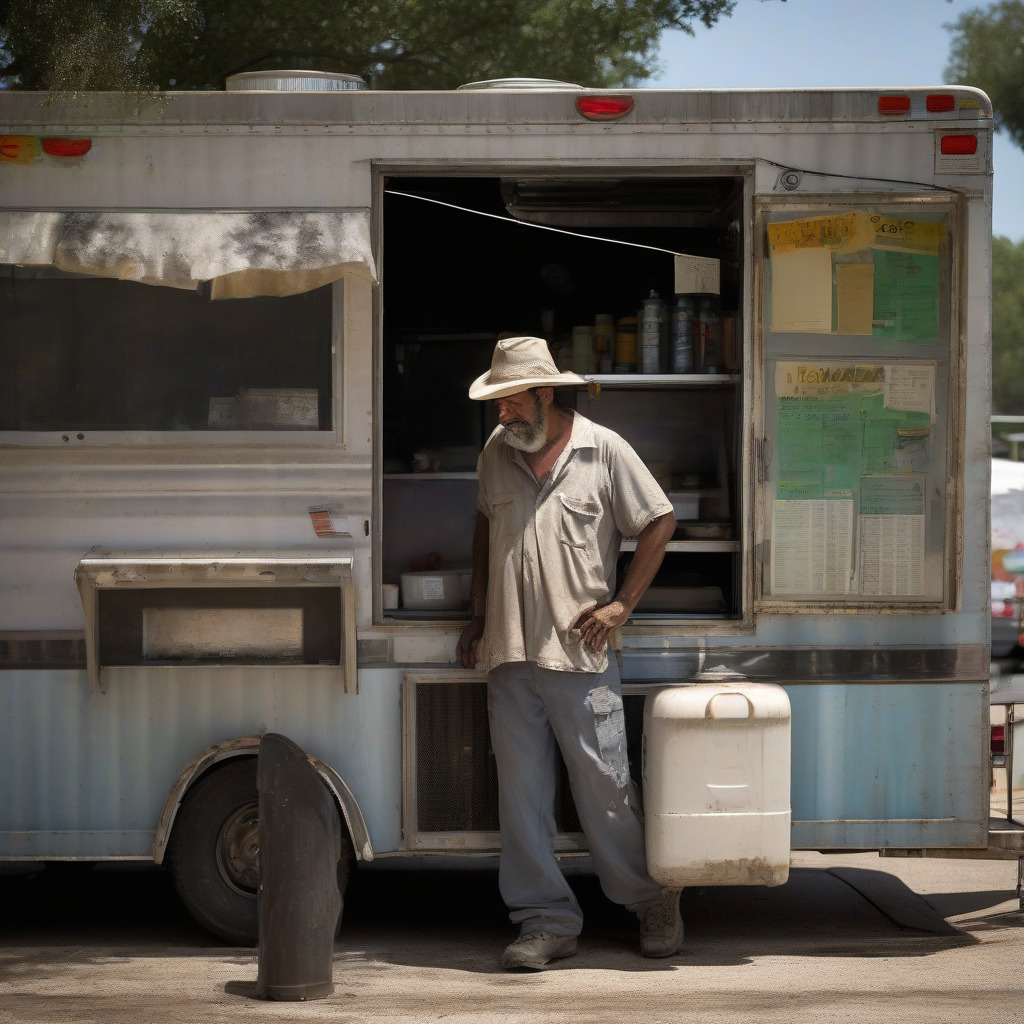
It’s 11:15 a.m. on a Wednesday in late June, and the parking lot off Enclave Parkway in the Energy Corridor is already shimmering. The asphalt is reading close to 140°F at surface level. The air temperature is 97°F, and the heat index—factoring in Gulf Coast humidity sitting near 70 percent—is pushing 109°F. On a morning like this, Marcus Webb, who has operated Caja Fuerte BBQ out of a retrofitted 20-foot trailer for going on six years, is not here. He hasn’t done a weekday lunch shift at this lot since May 15.
“I ran the numbers in April,” Webb said. “By the time you account for diesel, the extra refrigeration load, the fact that half your customers don’t come out anyway when it’s 105 with humidity, you’re not making money. You’re just burning through equipment and your own body.”
Webb’s decision to abandon the Energy Corridor’s midday lunch circuit entirely and shift Caja Fuerte to a Thursday-through-Sunday evening schedule split between EaDo and a shaded spot near the Houston Farmers Market on Airline Drive reflects how most experienced Houston food truck operators adapt when summer arrives. What makes this summer worth examining closely is the convergence of factors tightening around an already difficult business: heat index readings that have hit 115°F in the metro on multiple days this season, diesel prices that have climbed, commissary cold-storage capacity getting stretched, and a newer generation of operators now facing their first or second Houston summer without the experience to manage it.
Some will adapt. Some are already on hiatus. A few are deciding right now whether to come back at all.
The Two-Lever Strategy Most Experienced Operators Use
The trucks that survive Houston summers pull two levers hard: when they operate and where they operate.
The midday Energy Corridor lunch trade—parking lots off Enclave, Eldridge, and Briar Forest, serving the commercial office park belt from roughly 11 a.m. to 2 p.m.—is the first casualty. These locations have little to no shade infrastructure, no permanent customer queuing cover, and a customer base of office workers who, when the heat index clears 105°F, increasingly eat at their desks or walk to an air-conditioned restaurant. The economics don’t work: driving a truck to a spot, running a generator for four hours, and serving 40 customers instead of the usual 90.
The shift is toward evenings and weekends, and toward venues with actual shade or indoor adjacency. Discovery Green’s Thursday evening food truck events draw a customer who has made a deliberate leisure decision and will stand in line with a cold drink in hand. The Houston Farmers Market site on Airline has covered vendor infrastructure. Midtown and Montrose street locations near bars and music venues generate evening foot traffic that doesn’t require customers to stand in direct sun. EaDo, with its mix of sports venue proximity and covered patio restaurant culture, has become a reliable summer corridor for trucks that can park adjacent to existing shade. This kind of hyperlocal venue strategy is exactly what our food & hospitality coverage tracks across the Houston market.
Valentina Reyes operates La Paloma Fría, a Mexican ice cream and paleta truck that, unlike most, actually benefits from summer demand. She still adjusts her schedule around peak heat. “Even I move my hours later. I used to do 10 a.m. starts. Now I don’t open until 1 p.m. and I run until 8 or 9,” she said. “The product sells in heat, but I still have to be the one standing in the truck making it. At 10 a.m. with full sun it’s already miserable.”
The other timing reality that distinguishes Houston from virtually any other major market is the extended season. Dallas gets a genuine cool-down by late September. Phoenix does too. Houston does not. September in Houston regularly posts heat index readings in the high 90s and low 100s. October has its brutal weeks. Operators who plan around a Labor Day finish to adjusted schedules get caught off guard. “I made that mistake my second year,” Webb said. “Started booking Energy Corridor spots for September thinking it was almost fall. Killed me.” It’s the kind of lesson you don’t make twice.
Who Goes Dark and Why
Omotunde “Tunde” Adeyemi operates Jollof & Smoke out of a Gulf Freeway commissary. In mid-June, he scaled back to a Saturday-only schedule after two consecutive weeks of what he describes as negative net operating days. “When I say negative, I mean I spent more in diesel and ice than I grossed on those days,” he said. “It wasn’t even close.” Adeyemi, in his fourth year of operation, knows Houston summers well enough to make the call without significant internal debate. His Saturday schedule is anchored to a private event contract—a weekly corporate picnic at a Memorial-area private park—which gives him a guaranteed minimum against which he can justify running the truck.
Jasmine Cho launched Seoul on Wheels in March 2025, and this is her second summer. She continues operating a weekday schedule three days a week, partly because she hasn’t yet built the event contract base that makes a skeleton schedule economically viable, and partly because she’s still learning which locations hold up under summer conditions. “I don’t have the option to just stop,” she said. “I have commissary fees coming every month. I have the truck payment. So I’m trying to figure out how to adjust without going dark, because going dark means I fall behind on fixed costs.”
Cho’s constraint illustrates a structural reality for newer operators: the fixed costs that underwrite a truck do not flex seasonally. Commissary agreements, truck loans or leases, insurance, and permit fees continue whether the truck is rolling or parked. A veteran with paid-down equipment and an established event book can absorb a reduced-revenue summer very differently than a second-year operator carrying full debt service. That gap is where businesses end.
Pedro Garza has operated Tacos El Camino Real for eight years. He’s one of the more candid voices in Houston’s food truck community on this topic. He took a full two-week pause in late July last year and is planning for the same this summer. “I call it maintenance vacation,” he said. “I tell my regulars I’ll be back in August. But honestly, it’s also because you can only work in a 130-degree metal box for so many days before you start making mistakes. Safety mistakes. It’s not dramatic—it’s just the reality of the physical space.”
That interior temperature figure—130°F—is not exaggeration. A food truck body is essentially a metal enclosure with heat sources inside it. On a 100°F day with full sun, even with ventilation and an evaporative cooler running, interior temperatures in the cooking zone routinely exceed 125°F to 135°F. Mini-split air conditioning units can bring ambient cab temperature down, but they don’t solve the cooking zone problem. Operator health matters here, more than operators tend to say out loud. Heat exhaustion and heat stroke risk are genuine drivers of scheduling decisions, even when operators are reluctant to lead with it.
What June Actually Costs More Than March
The cost premium of a Houston summer operating month over a mild-weather month like March or November is real, specific, and largely invisible to customers. Here’s what it actually adds up to.
Generator diesel consumption under cooling load is the biggest single variable cost. A truck running a standard generator for a four-hour lunch service in March, with no AC and standard refrigeration load, might burn 3 to 4 gallons of diesel—roughly $12 to $16 at current Houston-area prices. The same truck in July, with a mini-split AC pulling additional load and a second refrigeration unit running, can burn 8 to 12 gallons per service. That’s $32 to $48. Add the longer warm-up and cool-down idle period. Operators running two service periods in a day see those numbers double. Across a full operating month of 20 service days, that diesel gap alone runs roughly $400 to $640 in additional fuel cost compared to a mild-weather month.
Refrigeration costs compound the problem. Houston’s Gulf humidity makes evaporative cooling essentially useless for food safety purposes. The ambient dew point is often high enough that swamp coolers can’t achieve meaningful temperature reduction—a fact that surprises operators who moved here from drier markets. Trucks must run compressor-based refrigeration continuously, which increases both electricity and generator load and raises compressor wear risk. Compressor failures in summer—which Garza described as “basically a guarantee at some point if you’re running hard through July and August”—can cost $800 to $2,500 in repair or replacement. And they have a way of arriving on your busiest weekend.
Misting systems for customer queuing areas represent a minor but real line item: hardware costs $200 to $600 for a decent setup, plus ongoing water cost and maintenance. Trucks that operate at venues without existing misting infrastructure and want to keep customers in line during peak heat need to provide their own.
Reyes estimates her summer operating premium at roughly $350 to $450 per month above her spring baseline. That covers diesel, additional refrigeration, and misting equipment. Webb puts his number higher, closer to $500 to $600, because Caja Fuerte’s BBQ operation requires more consistent high-heat cooking equipment running simultaneously with cooling systems. Adeyemi said that on days he operates in summer, his per-day cost premium is roughly $40 to $60 above a comparable spring service day. None of this shows up on the menu board.
The Commissary Cold-Storage Crunch Nobody Talks About
Houston food truck operators are required by Texas DSHS regulation to operate from a licensed commissary kitchen—a commercial facility where trucks can prep food, store product, clean equipment, and dump gray water. This is not optional, and it is enforced. What the commissary requirement creates in summer is a secondary bottleneck that has received essentially no coverage at the city or national level.
Cold-storage capacity at Houston commissary kitchens is finite. Licensed facilities dot the metro—concentrated in areas like the East End, near the Heights, and in southwest Houston—and during summer, the squeeze gets real. Operators are storing more product off-truck because keeping it on a parked truck overnight in 90°F ambient air is a food safety problem. “In March I can put my prep in the walk-in and there’s room,” Reyes said. “In July I’m negotiating for shelf space. There are weeks I’ve had to call two facilities to find cold-storage space for my weekend prep.”
Commissary baseline fees in the Houston market run roughly $300 to $600 per month depending on the facility, the storage included, and whether the operator is also paying for prep kitchen time. Summer demand pressure has, according to multiple operators, pushed some facilities to prioritize existing account holders over new inquiries. At least one operator reported being offered a higher rate for additional cold-storage in peak summer months. Whether that’s a market responding to scarcity or opportunism is probably a matter of perspective.
The commissary dynamic also affects scheduling. If a truck’s commissary does prep on certain days, or if shared walk-in space has limited availability, that constrains when the truck can load and launch. For operators already trying to compress into an evening-and-weekend schedule, commissary scheduling conflicts in summer can cost service days. This is a Houston-specific structural issue. Markets where trucks have more latitude to self-store, or where the humidity and temperature don’t make on-truck overnight cold storage as risky, don’t face the same squeeze. Houston’s combination of strict commissary requirements and extreme summer conditions creates a crunch that operators manage individually and quietly.
Food Safety When the Heat Fights Every Cold System You Have
The regulatory standard is clear. Texas DSHS and the Houston Health Department require food trucks to maintain cold-holding temperatures at or below 41°F for all potentially hazardous foods. That standard does not flex for summer. What changes is how hard every cold-holding system on the truck works to meet it, and how much faster it fails if something goes wrong.
“Temperature abuse”—the regulatory term for food spending too long above 41°F—becomes a more acute risk when ambient temperatures are fighting your refrigeration equipment. A compressor running at capacity on a 105°F day has less thermal margin than the same unit on a 70°F day. A door opened and closed during a busy service lets in a pulse of hot, humid air that a summer-stressed system takes longer to recover from than a spring-stressed one. The margin for error shrinks exactly when service volume makes errors most likely.
Experienced operators compensate through specific practices: smaller batch prep that limits the volume of food exposed at any one time, pre-chilling serving vessels and containers, running dedicated line coolers in addition to main refrigeration, and being more aggressive about pulling product that has been in the service line for more than an hour during peak heat. “I throw away more in July than I do in April. Intentionally,” Garza said. “That’s the cost of not having a food safety incident.”
The City of Houston Health Department maintains inspection records accessible through public records requests. Summer-month inspection outcomes relative to spring months would reveal whether seasonal violation patterns exist. What operators describe from experience is that experienced trucks manage the margin carefully and know what the inspectors look for. The trucks most at risk for summer violations are newer operators who haven’t calibrated their equipment and practices to Houston’s specific conditions. The operator who assumes a refrigeration unit that worked fine in spring will perform the same in July is not accounting for the additional load.
Cho acknowledged this directly. “My first summer, last year, I had one day where my line cooler got to 44°F and I didn’t catch it fast enough,” she said. “I didn’t get cited, but I pulled the product. It scared me into being more careful.” She’s since added a dedicated digital thermometer with an alert threshold set at 43°F—two degrees of warning margin before the legal limit. That’s the kind of thing you learn the hard way or you learn from someone who did.
Permits, Park Rules, and the Location Squeeze
Houston’s lack of a general zoning code offers food trucks a genuine competitive advantage relative to peer cities in normal seasons. Trucks can operate in a wide variety of locations with fewer land-use restrictions. Summer’s location strategy runs directly into a permitting patchwork that narrows the good spots more than most operators anticipated when they started.
The baseline Mobile Food Vendor permit from the Houston Health Department costs in the range of $200 to $400 annually. That permit covers street and private-lot operation generally. Operating at Buffalo Bayou Park, Discovery Green, Hermann Park, or any Houston Parks and Recreation Department venue requires a separate Parks permit—advance application, fees, and in the case of popular venues like Discovery Green, a competitive review for event-anchored spots.
TxDOT right-of-way rules further limit the high-traffic frontage road locations that look appealing on a map. Operating on or within the right-of-way of a state highway—common on Houston’s feeder roads—requires a separate TxDOT permit and compliance with setback rules. This effectively eliminates a significant share of the high-visibility spots trucks might otherwise target. Operators shifting toward suburban locations to find shade infrastructure or different customer demographics encounter an additional layer of Harris County regulations, which apply outside Houston city limits and add another permit relationship to manage.
The practical effect in summer is clear. The venues most attractive for summer operation—shaded, evening-oriented, with covered infrastructure—are also the most permit-constrained. Discovery Green evening slots fill quickly. The Houston Farmers Market on Airline accommodates a limited number of trucks. Operators who don’t secure those positions early find themselves competing for second-tier venues that are more exposed and less trafficked. “Everyone figures out by their second summer that the good summer spots are gone by February,” Garza said. “You lock in the venue relationship in the off-season or you’re in a parking lot in August wondering why nobody’s coming.” By that point, the lesson’s already cost you.
What Demand Actually Does From March to July
Multiple operators described a revenue drop of 30 to 50 percent between a strong spring week and a comparable July week at the same location type. The pattern isn’t uniform, though. Trucks at shaded evening venues or at established weekend event bookings see smaller demand declines because the customer showing up has made a deliberate, weather-aware choice. The truck parked in an office-park lot at midday on a Tuesday sees the sharpest drop, because its customer base is entirely convenience-driven and an air-conditioned restaurant 200 feet away becomes the obvious alternative at 107°F. You can’t really blame the customer.
Garza shared a specific comparison from last summer: a strong March Friday at his regular EaDo location grossed approximately $1,800. A comparable Friday in July at the same location came in at $980. “Before you account for the higher diesel, the extra ice, any equipment issues,” he said. “The cost goes up and the revenue goes down at the same time. That’s why it gets bad fast.” That math—costs rising while revenue falls—is the core of why summer breaks operators who aren’t prepared for it.
The customer daypart shift is also structural, not just weather-driven. The office-park lunch customer—the core revenue base for many Houston trucks during mild weather—largely disappears in summer regardless of schedule. The conditions that made outdoor lunch desirable are gone. The evening leisure customer, who drives to a venue specifically to be outdoors with food and drinks, is more heat-tolerant but requires the truck to be at the right venue, at the right time, with the right permit. That customer also tends to spend more per visit. But there are fewer service windows per week where they’re accessible.
Reyes, whose paleta and ice cream product is a summer-demand business, is the exception that shows the rule. Even her revenue patterns shift: her spring customer is often a family or individual who discovers her truck; her summer customer is a repeat buyer who seeks her out specifically because of the product category. Her gross revenue is higher in summer than spring. But her operating cost premium and the physical difficulty of running a summer schedule mean her net margin doesn’t improve proportionately. “People think I’m killing it in summer because everyone wants ice cream. And the sales are good. But the costs are also up, and I’m just a lot more exhausted. It’s not as great as it looks from the outside.” It never is.
What the Operators Who Stay Open Have Figured Out
The trucks operating through Houston’s full summer have made specific, often expensive, infrastructure and scheduling investments that distinguish them from trucks that struggle or pause. None of it is magic. It’s just accumulated pain turned into systems.
The single most-cited equipment investment is mini-split installation—a ductless AC unit added to the truck’s cab or service area. A basic mini-split installation on a food truck costs $1,500 to $3,500 depending on BTU capacity and installation complexity. It doesn’t solve the cooking zone heat problem, but it makes the operator’s working environment survivable for multi-hour service windows and reduces heat exhaustion risk meaningfully. Garza installed one in year three. “It changed everything about whether I could actually work in July,” he said. “It’s not comfortable. It’s survivable.” That distinction matters when you’re the one standing in the truck.
Early commissary cold-storage agreements lock in capacity before peak summer demand. Operators who negotiate their cold-storage arrangement in spring, and clarify what space is guaranteed versus shared, avoid the July scramble for refrigerated shelf space. This is the operational equivalent of the venue permit lesson—the time to solve it is before you need it.
Smaller, high-margin menus in summer reduce both prep volume, waste risk, and line complexity. Several operators described cutting their full-season menu by 20 to 30 percent for summer. They keep the highest-margin, fastest-moving items and drop preparations that require more temperature-sensitive holding or more operator time over a hot surface.
Venue relationships with covered infrastructure are worth significant per-event fee premiums. Operators who understand this stop negotiating on the basis of cost and start negotiating on the basis of shade. A spot under a permanent canopy at a brewpub or covered market that costs $100 more per event than an open-air lot is worth the premium when customer dwell time and repeat visits improve in covered conditions.
What does not translate from Phoenix or Dallas food truck summer coverage—and Houston operators note the irrelevance of this advice with real frustration—is any strategy premised on dry heat adaptation. Evaporative cooling doesn’t work here. The misting system advice from desert markets is partly applicable, but the ambient dew point in Houston on a July afternoon often makes misting less effective than it looks. The Gulf humidity changes the thermal math on virtually every cooling system. Operators who bring in strategies from drier markets find out quickly that Houston is a different physics problem entirely. What works in Scottsdale gets you in trouble on the North Loop.
What the Rest of Summer 2026 Looks Like
The immediate pressure point for operators who haven’t yet made their summer adjustment is now. July is typically the most operationally stressful month. Demand is low, heat is peak, and equipment that was borderline in June is more likely to fail. Operators still on undifferentiated schedules from spring will see their margin situation worsen through July and into August.
August offers slight moderation in some years. 2026 is not currently forecast as one of them. The Gulf of Mexico sea surface temperatures are running above historical averages, which supports sustained humidity and limits overnight cooling. Trucks that operate evening shifts don’t get the relief of a significantly cooler ambient temperature even after sundown—anyone who’s stood outside in Houston at 9 p.m. in August knows exactly what that means. September and October remain live operational months for Houston trucks. Relief does not come at Labor Day. No exceptions. The operators who have adjusted their schedules for summer need to maintain those adjustments through at least mid-October. In a year with a warm fall—which Harris County has experienced multiple times in the past decade—potentially through Halloween.
The pressure points that would push more trucks toward hiatus or permanent closure are consistent across operator interviews: a major equipment failure arriving in peak summer without cash reserves—a compressor, generator, or refrigeration unit going down; a commissary dispute or rate increase compounding fixed costs; or a sustained stretch of 110°F-plus heat index days that makes customer demand collapse for two or three consecutive weekends. “If I have two bad weekends in a row in July, it gets hard to justify coming back for the third,” Adeyemi said. “The fixed costs don’t stop. You start doing math on whether you’re digging a deeper hole every day you open.”
Cho, heading into August still operating, will make her final call on whether to continue through the season by the end of July. “If I can get through July with a positive number, I’ll finish the summer. If not, I need to rethink whether the model works for me in Houston.” She’s not alone in that calculation. For every truck that has settled into a summer rhythm, there are operators—largely in years one through three—who are still deciding whether Houston’s summer is a business problem they can solve or one that will eventually solve them.
If you’re looking for a specific truck, check Instagram before you drive. It remains, in 2026, the primary real-time communication channel for Houston food trucks adjusting their schedules mid-week. If a truck has gone quiet on social media for more than a week in July, it’s likely on hiatus and may or may not announce a return date. The ones that come back announce it. The ones that don’t, often don’t say anything at all.
CityDesk Houston requested 2026 permit fee confirmation from the Houston Health Department and summer inspection records for comparison with spring months; both requests were pending at publication. Diesel prices cited reflect Houston-area retail averages in late June 2026. Commissary rates reflect operator-reported figures from three facilities.