What Free Cancer Screenings Are Available in Houston This October Beyond Mammograms
Breast Cancer Awareness Month dominates the calendar. October is also when several Houston institutions run screenings for four other cancers — and most uninsured residents don't know they qualify.

Breast Cancer Awareness Month dominates the calendar. October is also when several Houston institutions run screenings for four other cancers — and most uninsured residents don’t know they qualify.
This guide is not about mammograms. That story is already published. What follows is a map of every verified free or income-based cancer screening program active in Houston this October: colorectal, prostate, cervical, and skin cancer, organized by type, institution, income eligibility, and how to actually get in the door.
Upfront warning: Several details here require a phone call before you show up. Specific event dates, current Federal Poverty Level dollar figures, and walk-in availability all shift. Programs change. Staff turnover affects intake. The Healthy Texas Women hotline number that worked in April may route differently in October. Where we flag a detail as requiring verification, we mean it — and we explain how to check.
If You’re Uninsured, Start Here
Before breaking this down by cancer type, one program matters more than anything else for low-income and uninsured Harris County residents: the Harris Health System Gold Card.
The Gold Card is an income-based eligibility card that unlocks access to Harris Health’s full system — Ben Taub Hospital, LBJ Hospital, Quentin Mease Community Hospital, and community health centers in Settegast, Aldine, Baytown, and elsewhere. Eligibility is generally set at or below 200% of the Federal Poverty Level for Harris County residents, though the specific dollar thresholds update periodically. Verify them directly with Harris Health enrollment.
For cancer screenings, Gold Card holders can access colorectal screening through FIT kits and colonoscopy referral, cervical screening through primary care and OB-GYN, PSA blood draws through primary care, and specialist referrals to Ben Taub’s GI clinic when a colonoscopy is indicated.
To enroll or check eligibility: Harris Health Financial Assistance at (713) 566-6400. Verify this number before calling. Walk-in enrollment with documentation is typically available weekdays at Ben Taub and LBJ — bring proof of Harris County residency and proof of income. Every Harris Health entry in the sections below assumes you have or are pursuing a Gold Card.
Colorectal Cancer Screenings
FIT kits are where you start. A FIT (fecal immunochemical test) requires no bowel prep, no procedure, no specialist. You collect a small stool sample at home and return it. A positive result triggers a colonoscopy referral. Kits are available through primary care visits at Harris Health community health centers and at Houston Health Department Bureau of Community Health clinics.
One thing worth knowing before you decide this doesn’t apply to you: the U.S. Preventive Services Task Force dropped the colorectal screening start age from 50 to 45 in 2021. A 47-year-old uninsured Houstonian who has never been told they needed a colonoscopy now meets the clinical threshold for one. That cohort is the least likely to have sought screening and the most likely to assume they’re too young.
Specific FIT kit locations: Northside Health Center (8504 Schuller Rd.), Sunnyside Health Center (9314 Cullen Blvd.), Casa de Amigos (2420 Airline Dr.), and El Franco Lee Community Health Center. The Houston Health Department main line is (832) 393-5080. Call to confirm which clinics are distributing kits this month and whether an appointment is required.
Colonoscopy referral through Harris Health GI at Ben Taub handles the next step for Gold Card holders whose FIT comes back positive, or who have symptoms or family history that warrant skipping the kit entirely. Ben Taub’s GI department carries the county’s uninsured colonoscopy volume. Wait times are real. Don’t schedule around a best case. Call Harris Health at (713) 566-6400 and ask to be connected to Ben Taub GI scheduling. Get an actual wait estimate from a care coordinator before making plans.
UT Physicians operates more than 100 clinic locations across Houston, including sites in Acres Homes, East End, Greenspoint, and the Bellaire corridor. Colorectal screening access depends on patient enrollment and income verification. Call central scheduling at (713) 486-5000 and ask specifically about colorectal cancer screening availability and which locations are running October programming.
For Texas-level funding: the Colorectal Cancer Alliance maintains a national screening provider directory at ccalliance.org. Search by ZIP code to find Houston-area GI practices running reduced-cost events this fall, though listings vary year to year and need direct confirmation.
Prostate Cancer Screenings
Prostate Cancer Awareness Month is September, not October. The concentrated run of free PSA events peaks in late August and September. October may still have options — but verify before assuming one exists in your neighborhood.
ZERO – The End of Prostate Cancer has a Houston chapter and is the primary organization to contact for any October PSA screening event in Harris County. Check zero360.org or contact ZERO through their site. Ask specifically about fall Houston events. If a free screening day is running in October, ZERO will know.
For Gold Card holders, Harris Health primary care is the most reliable pathway regardless of what month it is. A PSA is a blood draw ordered at a primary care visit — no parking lot, no Saturday event required. If you have an established provider at any Harris Health community health center, ask them to order it at your next visit. If you don’t have a provider, follow the Gold Card enrollment process above.
Community health fairs are where PSA screenings most frequently appear outside clinical settings. Two circuits worth tracking in October:
LBJ Hospital’s Northeast Houston outreach ties into health fairs in Kashmere Gardens and Trinity/Houston Gardens neighborhoods. Check Harris County Public Health’s event calendar at hcphtx.org. Call Harris Health central at (713) 566-6400 to be directed to the LBJ outreach team.
The grocery store parking lot circuit in Gulfton, the East End, and Northside — Fiesta Mart and La Michoacana locations — hosts informal health fairs with rotating providers, sometimes including blood draw services. Some of the most useful events in this circuit never appear on any official calendar. Neighborhood Facebook groups and flyers posted in the stores themselves are often more reliable than any website.
Faith congregations including Wheeler Avenue Baptist Church and St. Luke’s United Methodist occasionally host multi-screening health days with physician volunteers. Call their offices directly in the first week of October.
One clinical note: the USPSTF recommends PSA screening as a shared decision between patient and provider for men ages 55–69, based on individual risk factors including family history and race. Black men face elevated prostate cancer mortality — a disparity reflected in current guidelines. PSA is not a universal automatic screen. It’s a conversation with a doctor. That conversation is free and starts at primary care.
Cervical Cancer Screenings
Two state programs fund most free Pap smear and HPV testing in Harris County. Healthy Texas Women (HTW) covers women ages 18–44 with household income at or below 200% FPL. Texas Breast and Cervical Cancer Services (TBCCS) extends coverage to women ages 18–64 at the same income threshold. HTW covers Pap smears, HPV testing, and a range of preventive women’s health services. TBCCS funds Pap smears, HPV tests, colposcopies, and follow-up care when an abnormal result needs further evaluation.
The HTW hotline is 1-800-250-4904. Spanish-language intake is available. You do not need to be enrolled in Medicaid to qualify — a point that trips up a lot of people, and one worth repeating. TBCCS is administered through Texas HHS and delivered locally through enrolled clinic sites.
Houston Health Department Bureau of Community Health clinics are the walk-in-friendliest access points for cervical screening in the county. Locations include Northside Health Center (8504 Schuller Rd.), Sunnyside Health Center (9314 Cullen Blvd.), Casa de Amigos (2420 Airline Dr.), and El Franco Lee Community Health Center. Casa de Amigos in particular serves a predominantly Spanish-speaking patient population on the Northside. Call (832) 393-5080 to confirm hours and whether walk-ins are being accepted this month.
UT Physicians enrolls patients in both HTW and TBCCS through primary care and OB-GYN clinics. Call (713) 486-5000 and ask which location nearest you is participating in HTW or TBCCS this fall. Harris Health community health centers also enroll in these programs, generally through a scheduled appointment. Gold Card holders are typically enrolled in the appropriate state program at intake. Call the nearest Harris Health clinic or Harris Health central at (713) 566-6400 to find the closest enrolling location.
As we’ve noted in our Houston health and wellness coverage, the full landscape of free or low-cost women’s health clinics across Houston — including sites that offer Pap smears, birth control, and mammograms through these same state programs — extends well beyond October and beyond cancer screening specifically.
The FDA cleared HPV self-collection testing as an alternative to clinician-administered cervical swabs. For patients who avoid pelvic exams due to past trauma, transportation barriers, or other reasons, this matters practically. Whether any Houston clinic has implemented self-collection as a patient option this fall requires direct verification. Ask your clinic explicitly: “Do you offer the self-collection HPV test?” Given FDA clearance, it’s a reasonable question.
Skin Cancer Screenings
This is the most under-publicized category in local October health coverage — which is odd for a city with Houston’s UV exposure. Fall screenings make real sense here. October follows the city’s long summer UV season; dermatology groups schedule fall events because patients have typically accumulated new sun damage and are more likely to come in once the heat breaks. Finding these events, though, takes more legwork than anything else in this guide.
The American Academy of Dermatology’s SPOTme program is the national framework for free volunteer-led skin cancer screenings. The AAD’s event listing is searchable at aad.org/spot. Search Houston, TX for any October 2026 events. If a Houston-area dermatology practice is running a free screening this month, it will likely appear here, or can be confirmed by calling local AAD member practices directly.
UTHealth’s Department of Dermatology at the McGovern Medical School campus in the Texas Medical Center runs community screening events periodically in the fall. Contact them through UT Physicians general scheduling at (713) 486-5000 and ask whether an October 2026 screening day is scheduled.
Houston Methodist Dermatology operates at the main Medical Center campus (6565 Fannin St.) and suburban campuses including Willowbrook, Sugar Land, and The Woodlands. Methodist has run community health days at suburban locations in past years. Check houstonmethodist.org/events or call the dermatology department at the campus nearest you.
Baylor College of Medicine’s Department of Dermatology in the TMC participates in periodic community outreach. Call their clinic to ask about October availability.
The Skin Cancer Foundation’s Road to Healthy Skin mobile tour has made past stops in Texas. Check skincancer.org for its 2026 fall schedule and any Houston dates.
This category requires the most verification of anything in this guide. It’s also the one local outlets skip most consistently — and for a city that sees the UV index Houston does, it may be the most practically relevant October screen most residents aren’t thinking about.
What MD Anderson and UTHealth Actually Offer
MD Anderson’s Cancer Prevention Center handles cancer risk assessment, genetic counseling, and early detection. Access typically requires a referral and may involve cost-sharing depending on insurance status and income. The High Risk Screening Clinic specifically serves patients with elevated genetic or family history risk — BRCA variants, Lynch syndrome, significant family cancer clusters. It is not a general community screening program, and walking in without that context is likely to result in a referral elsewhere.
MD Anderson does have a charity care program. Income-eligible uninsured patients may qualify for Cancer Prevention Center services. Contact MD Anderson’s Financial Counseling office at (877) 632-6789 and ask directly about the charity care threshold. Verify eligibility before assuming it.
What MD Anderson offers the broader Houston community regardless of income is cancer prevention education and screening guidance — free. The prevention team can help a patient understand their risk, identify the right screening type, and point to an appropriate local program even when treatment or specialty screening at MD Anderson itself isn’t financially reachable.
UT Physicians is the more immediately accessible system for low-income Houstonians. With more than 100 clinic locations across the metro — Acres Homes, East End, Greenspoint, the Bellaire corridor — UT Physicians enrolls in both HTW and TBCCS for cervical screening and can order colorectal and prostate screening through primary care. Central scheduling: (713) 486-5000.
Houston Methodist’s charity care structure has historically covered patients up to 200% FPL for full coverage and up to 400% FPL for partial coverage. Verify the 2026 thresholds. Methodist’s suburban campuses have hosted free community screening days in past years. Check houstonmethodist.org/community or call the community health line at the campus nearest you.
October Health Fairs in Harris County
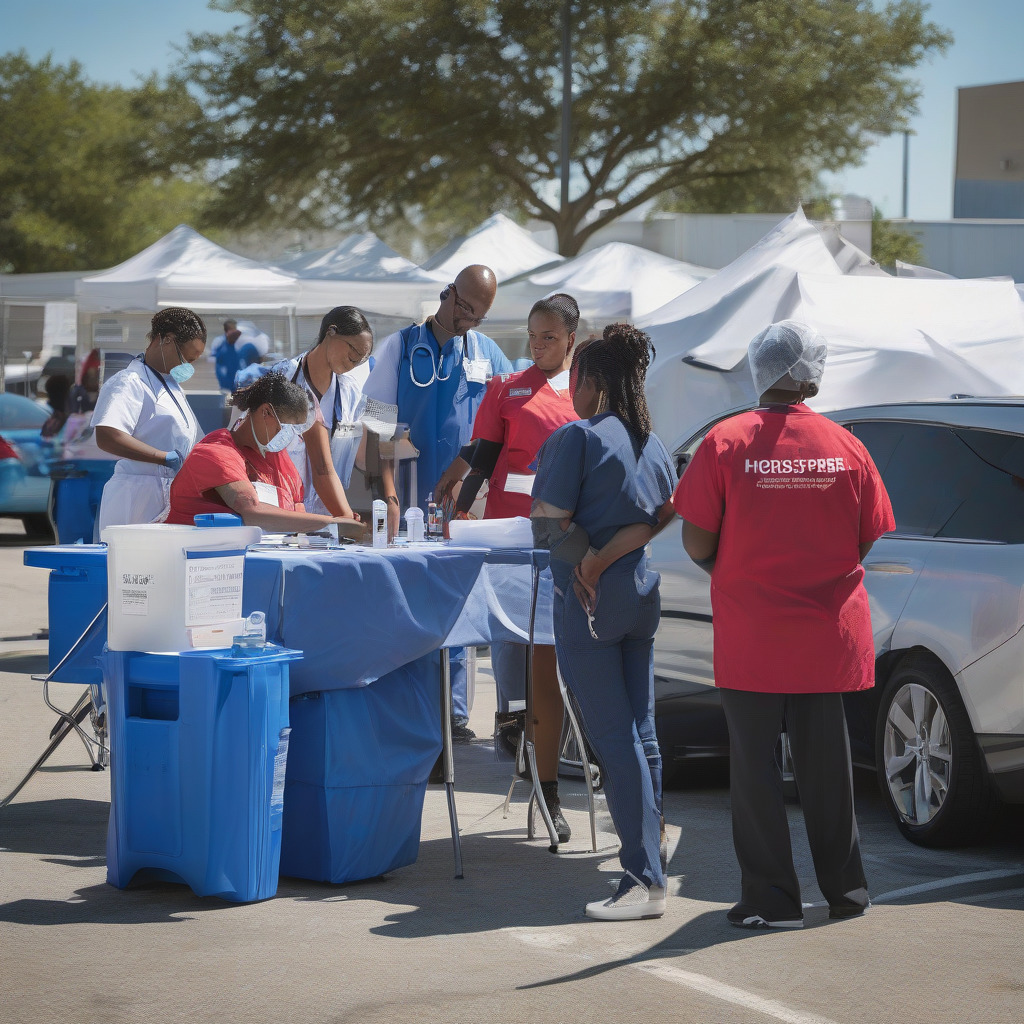
A single-location health fair matters in Houston’s low-income communities in ways that are easy to miss if you’ve never had to rely on one. One Saturday morning in a parking lot can mean a blood draw, a blood pressure check, a FIT kit, and a referral — no transit across town, no separate appointment queues, no navigating multiple phone trees. These events are frequently not well-publicized in advance and sometimes materialize with a week’s notice.
Harris County Public Health’s event calendar at hcphtx.org is the most comprehensive centralized listing for county-organized or county-affiliated events. Check it weekly through October.
LBJ Hospital’s Northeast Houston outreach covers Kashmere Gardens, Trinity/Houston Gardens, and surrounding neighborhoods. Call Harris Health central at (713) 566-6400 to be directed to the LBJ outreach team.
Quentin Mease Community Hospital focuses outreach on Third Ward and Sunnyside. Call (713) 566-6400 to reach the Quentin Mease outreach contact.
Faith congregations — Wheeler Avenue Baptist Church and St. Luke’s United Methodist Church among them — have histories of hosting health events for surrounding neighborhoods. Call their offices in the first week of October to ask what’s scheduled this month.
The grocery store parking lot circuit in Gulfton (Southwest Houston), the East End (Navigation Blvd. and Canal St.), and Northside (near Airline Dr. and Fulton St.) runs informal health fairs tied to HHS outreach, community health workers, and local nonprofits. No official website catches all of them. Track through neighborhood Facebook groups — search “Gulfton community” or “East End Houston salud” — and through Spanish-language radio stations, which reliably announce health events for Spanish-speaking communities before they appear anywhere in print.
Quick-Reference Table
| Program / Institution | Cancer Types Covered | Income Threshold | Who Is Eligible | Walk-In or Appt | Contact |
|---|---|---|---|---|---|
| Harris Health Gold Card | Colorectal, Prostate, Cervical (via primary care + referral) | ≤200% FPL | Harris County residents, uninsured/underinsured | Appt required after enrollment | (713) 566-6400 — verify current |
| Healthy Texas Women (HTW) | Cervical (Pap, HPV) | ≤200% FPL | Women 18–44, uninsured/underinsured | Varies by clinic | 1-800-250-4904 |
| Texas BCCS (TBCCS) | Cervical (Pap, HPV, colposcopy) | ≤200% FPL | Women 18–64, uninsured/underinsured | Varies by clinic | Verify current DSHS/Harris County enrollment contact |
| Houston Health Dept. Clinics | Colorectal (FIT), Cervical | Income-based; confirm at intake | Harris County residents | Walk-in most likely — verify | (832) 393-5080 |
| UT Physicians | Colorectal, Cervical, Prostate | Income-based (HTW/TBCCS enrolled) | Income-eligible patients | Appt required | (713) 486-5000 |
| Houston Methodist Charity Care | Multiple — varies by event | ≤200% FPL full; ≤400% FPL partial — verify 2026 | Harris County and metro residents | Varies by event | houstonmethodist.org/community or call campus directly |
| MD Anderson Cancer Prevention Ctr | Multiple; risk-focused | Charity care pathway — verify | Uninsured income-eligible; some referral required | Appt required | (877) 632-6789 |
| AAD SPOTme Program | Skin | Free; no income threshold | Open to public at volunteer events | Walk-in at events — verify | aad.org/spot |
| ZERO Prostate Cancer | Prostate (PSA) | Free at events; no threshold | Men — requires shared-decision discussion with provider | Event walk-in — verify | zero360.org |
All income thresholds and contact information require verification before use. FPL dollar amounts change annually.
Spanish-Language Resources and Bilingual Access Points
For a substantial portion of Harris County residents who need these screenings most, English-only access is as real a barrier as cost. Not an abstraction — the difference between a completed phone intake and a hung-up receiver.
Casa de Amigos clinic (2420 Airline Dr., Houston 77009), operated by the Houston Health Department, serves a predominantly Spanish-speaking patient population in Northside. Walk-in availability for reproductive health services including cervical screening has historically been offered here. Call (832) 393-5080 to confirm current hours and services.
The Healthy Texas Women hotline (1-800-250-4904) operates with Spanish-language intake. Spanish-speaking callers can complete enrollment and get clinic referrals without a translator. Harris Health enrollment support is available in Spanish at both Ben Taub and LBJ offices. The Harris Health community health centers in Aldine and Settegast serve predominantly Spanish-speaking neighborhoods and conduct the majority of intake in Spanish. If phone intake feels uncertain, visiting an enrollment office in person is a reasonable alternative — call ahead to confirm a Spanish-speaking worker will be available that day.
The health fair circuit in Gulfton, the East End, and Northside runs substantially in Spanish. Community health workers — promotoras — who staff these events are typically bilingual and serve as guides into the programs listed throughout this guide. They are often the most practically useful person in the room.
Univision Houston and Telemundo Houston run public health segments in October tied to awareness months. Health fair announcements and clinic program spotlights appear there before they appear anywhere else, and are worth monitoring if you’re trying to help a Spanish-speaking family member or neighbor navigate this system.
Before You Go
Call before you show up. Every program in this guide is real and every contact is as current as our reporting allows. But specific event dates, walk-in availability, and income threshold dollar amounts change faster than any published guide can track. The difference between a useful Saturday morning and a wasted trip is a five-minute phone call on Friday afternoon.
If you’re in Harris County, uninsured, and don’t know where to start: the Harris Health Gold Card enrollment line at (713) 566-6400 is the single most useful call you can make. Everything else in this guide connects to or runs parallel with that card. Most uninsured residents who qualify have never been told they do. That’s the problem this guide is trying to fix.
CityDesk Houston will update this guide as October event listings are confirmed. If you have a verified screening event to add, contact the newsroom.