How to Run Outside in Houston Summer Without Getting Heat Stroke
With heat indexes topping 105°F before 9 a.m. in July, generic running advice doesn't apply here. Here's what Houston sports medicine doctors and local coaches actually recommend.

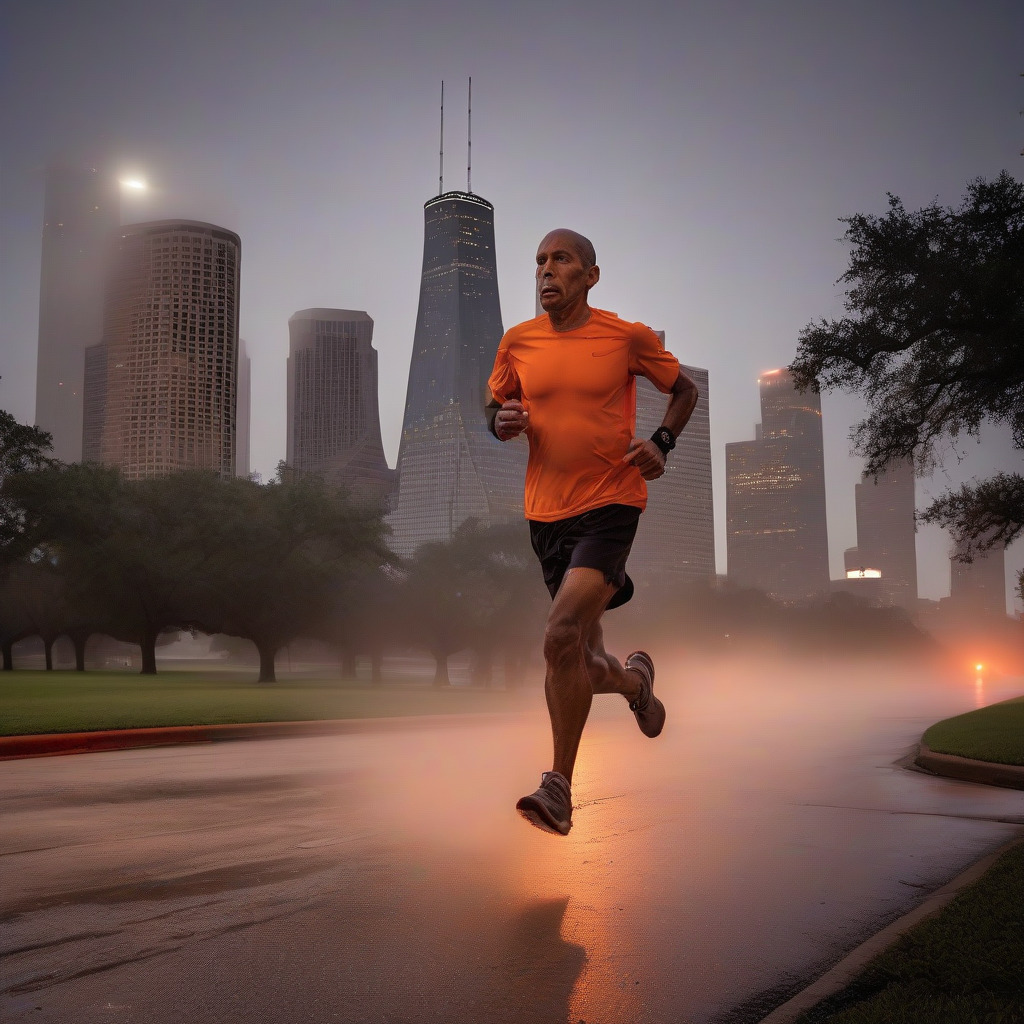
With heat indexes topping 105°F before 9 a.m. in July, generic running advice doesn’t apply here. Here’s what Houston sports medicine doctors and local coaches actually recommend.
The national running media publishes plenty of summer heat advice. Most of it will get you hurt in Houston.
“Run before 8 a.m.” sounds responsible. In Houston in July, 8 a.m. already feels like running inside a warm, wet towel — the heat index may already be past 100°F and climbing. “Stay hydrated” is technically true but dangerously incomplete when dew points hover near 78°F and your body’s cooling system is losing a fight against the air itself.
Houston’s summer isn’t a hot summer that requires extra caution. It’s a physiologically distinct environment that demands different training rules. What follows is a framework built around the specific conditions runners here actually face from June through September, drawn from the sports medicine and coaching professionals who treat and train them.
Check the Clock Before You Lace Up
The safe window for outdoor running in Houston during peak summer — roughly June 15 through mid-September — is 5:00 to 6:30 a.m. That’s not a comfortable suggestion. It’s a ceiling.
Houston’s dew points in June and July commonly reach 75°F to 78°F, among the highest of any major U.S. city. By 8:30 a.m., heat index readings above 100°F are routine. National Weather Service data for Houston shows the coolest outdoor temperatures occur between 5:00 and 6:30 a.m. By 8:00, the index is already climbing fast.
That progression surprises transplants. In Denver, Dallas, or Chicago — hot summers, but drier — a 7:30 a.m. run is genuinely safe most days. In Houston, that same run puts you in a heat index category the National Weather Service classifies as “danger: heat cramps and heat exhaustion likely.” That’s not a yellow flag. That’s a stop sign.
Evenings are more complicated and, honestly, not much better. Air temperature stays well above 90°F into the night, and humidity never really drops. There’s no meaningful overnight cool-down in a Houston summer. The city cycles from brutal to merely bad. Runners who prefer evenings should treat any evening effort as carrying a higher physiological load than the early-morning window, with no buffer if the run runs long.
Set your alarm for 4:45 a.m. Be out the door by 5:00. Plan to be finished — not wrapping up, but finished — by 6:30. If that’s not possible on a given day, the final section of this article covers where to take it indoors.
Why Houston Heat Is a Different Animal
Your body cools itself through sweat evaporation. The hotter your skin gets, the more you sweat, and as that moisture evaporates, it carries heat away from your body. This system is remarkably efficient in dry conditions. The problem in Houston is that evaporation requires a gradient between the moisture on your skin and the moisture in the air around you. When the dew point reaches 75°F to 78°F — which it does here routinely from June through August — that gradient nearly disappears. Your sweat doesn’t evaporate. It drips. Your core temperature keeps climbing.
This is why a 90°F day in Houston feels categorically different from a 100°F day in Phoenix. Phoenix runners sweat heavily, but low humidity pulls that moisture off the skin almost immediately. A Houston runner at 90°F with a 78°F dew point is essentially running through warm steam. The air has nearly as much moisture as the skin, cooling nearly stops, and core temperature rises faster than the thermometer alone would predict.
Runners who have finished marathons in Dallas or Atlanta in similar temperatures often discover in their first Houston summer that their fitness hasn’t transferred the way they expected. That’s not a personal failing. That’s physiology.
Step One: Acclimatize Before You Push
If you’re new to Houston, returning after time away, or coming back from a summer of reduced training, read this section first.
Heat acclimatization is a real physiological process, not a matter of toughening up. Over 10 to 14 days of progressive daily heat exposure — meaning consistent outdoor effort, not just walking to your car — the body makes measurable changes. Plasma volume expands. Sweating begins earlier and in greater volume. Heart rate at a given effort drops. Core temperature rise is blunted. These are changes at the cellular and cardiovascular level, and they take time. There’s no shortcut, which I realize is not what anyone moving to Houston in June wants to hear.
The mistake most runners make is treating aerobic fitness as a proxy for heat fitness. They’re not the same thing. A runner who comfortably handles a 10-mile training run in Chicago in June may be at serious risk doing six miles at equivalent effort in Houston two weeks later. The aerobic engine is there. The thermoregulatory system hasn’t caught up. Humid-heat acclimatization takes longer than dry-heat adaptation because the evaporative impairment adds a layer the body needs extra time to compensate for — primarily by increasing sweat rate and expanding plasma volume.
For runners coming into Houston summer for the first time, the progression looks like this:
Days one through three: 20 to 30 minutes easy, within the safe window, no pace targets. Monitor how you feel in the hour after you finish. Depleted for more than an hour? Cut the next run shorter. Days four through seven: extend to 35 to 45 minutes at conversational pace. Start practicing pre-run hydration (more on this below). Check urine color before you go out. Days eight through eleven: if the previous week felt manageable, reintroduce light structure — easy pickups, light fartlek — but skip workout-intensity efforts entirely. Time on feet, not quality, is what you’re building. Days twelve through fourteen: most runners can start reintroducing normal training structure, with pace expectations adjusted for conditions.
For returning Houston runners who took the winter off or spent spring traveling: one week of hot weather doesn’t reclimatize you. Expect at least 7 to 10 days easing back in, even if you ran in this heat last September.
Step Two: Hydrate Ahead of the Run, Not During It
Hydration for Houston summer running begins the night before, not at the trailhead water fountain.
The American College of Sports Medicine recommends starting any exercise session in a fully hydrated state. For workouts in heat indexes above 100°F, that requires active pre-loading. The ACSM benchmark most commonly cited in heat-specific protocols is around 17 to 20 ounces of water or a low-sodium electrolyte fluid in the two hours before running, with another 8 ounces in the 15 minutes immediately before you head out. Urine color is your field test. If it’s not pale yellow before you start, you’re behind before you’ve laced up.
During the run, 6 to 8 ounces every 15 to 20 minutes is the standard guidance for heat index conditions above 100°F. But Houston runners need to understand a risk that gets underreported. Hyponatremia — dangerously low blood sodium from overdrinking plain water — is a documented problem in the endurance community, and the Houston Marathon medical staff has addressed it directly in their athlete preparation materials. When you sweat heavily for extended periods, you lose significant sodium alongside fluid. Replacing those losses with plain water dilutes the sodium remaining in your bloodstream. The symptoms — nausea, headache, swelling, confusion — mimic heat exhaustion, which makes it easy to misidentify and dangerously easy to worsen by drinking more water.
For any effort lasting 60 minutes or longer in Houston summer conditions, sodium replacement is not optional. Sports drinks with electrolytes, sodium-containing gels, salt tabs — the specific product matters less than the principle. Water alone isn’t enough for runs over an hour here. Carry fluids rather than relying on water fountains. Buffalo Bayou and Terry Hershey both have water stops, but the spacing is inconsistent, and a 20-minute gap between hydration opportunities in July heat is genuinely unsafe.
Step Three: Know Your Warning Signs Before You Need Them
Most heat-related running emergencies are preceded by a recognizable window of symptoms. The problem is that runners — especially experienced runners who have pushed through discomfort before — rationalize their way past those signals. The decision tree below is designed to remove the ambiguity.
Mildly warmer than usual, slightly fatigued, a little thirsty, but pace has slowed and thinking is clear: continue with caution. This is baseline Houston summer running. Slow down, drink fluids, finish at reduced effort.
Heavy sweating that suddenly decreases, nausea, significant headache, muscle cramps, dizziness when you stop moving, or skin that feels hot and dry: stop immediately and find shade. These are heat exhaustion signals. Get out of the sun, sit or lie down, apply cool water to the neck and inner wrists, drink a sodium-containing fluid slowly. Don’t continue the run. Don’t drive yourself home until you’ve been stable and symptom-free for at least 20 minutes.
Confusion, slurred speech, inability to answer simple questions, loss of coordination, or unconsciousness: call 911. These are signs of heat stroke — a life-threatening neurological emergency caused by core temperature exceeding 104°F. Heat stroke is not heat exhaustion that got worse. It’s a different medical emergency, and it kills people who delay calling for help because they’re trying to self-treat. Get the person into shade, apply ice or cold water aggressively to the neck, armpits, and groin while waiting for EMS, and don’t leave them alone. If you’re on Memorial Park’s inner loop or the Buffalo Bayou corridor, you’re within reasonable proximity to major Houston medical centers. But EMS response — not personal transport — is the right call. Every time.
Step Four: Choose Your Route by Shade, Not by Habit
Not all Houston running routes are equal in summer. The differences are worth planning around.
Terry Hershey Park, along the Buffalo Bayou corridor in western Houston near Eldridge and Dairy Ashford, has the most consistently shaded canopy of any major running trail in the city. The established hardwood cover along the main trail provides real protection during the early morning window. The surface is packed dirt and asphalt — both preferable to concrete for surface temperature. If you only run one route this summer, this is it.
Memorial Park’s inner loop is a reasonable option with a real caveat. The 3-mile crushed granite loop is well-traveled and has tree coverage in stretches, but open sections shed canopy quickly and absorb heat fast. In the 5:00 to 6:00 a.m. window it’s workable. After 6:30, those exposed sections are a genuine problem. Buffalo Bayou Park is popular among runners who live or work in the urban core, and the varied terrain is a legitimate draw. Two things are worth knowing before you commit to a long effort there: large sections are exposed and bordered by concrete that retains overnight heat and radiates it back in the early morning hours, and the bayou itself elevates local humidity above background levels. Not dramatically, but enough to matter when dew points are already near 78°F. Worth knowing. Brays Bayou Greenway offers long, flat mileage and decent connectivity, but much of the trail runs in open sun. Early morning only, and the same bayou-humidity caveat applies.
Step Five: Know When to Move It Indoors and Where to Go
Moving a run indoors during a Houston summer isn’t a concession. It’s the decision that keeps your training block intact.
Houston Fit — the local marathon training program that prepares more than 2,000 runners annually for the Houston Marathon — builds indoor flexibility directly into its summer programming. Group runs shift to treadmill meetups during the worst heat stretches, and coaches are explicit that protecting aerobic base matters more than maintaining the specific stimulus of outdoor training in August. If the people training runners for one of the country’s largest marathons are fine with treadmills, you should be too. Several other Houston running clubs have made the same call, shifting summer group runs to treadmill meetups at local running stores.
Life Time Fitness has multiple Houston-area locations — Memorial and Sugar Land among them — with treadmill banks, indoor pools, and in some locations indoor tracks. Full infrastructure for a summer training pivot. Tellepsen Family Downtown YMCA serves the downtown and Midtown runner community at a more accessible price point. For runners whose normal routes follow Buffalo Bayou, it’s a natural swap without adding significant travel time to a 5 a.m. morning. Houston Methodist’s sports performance facilities cater more specifically to athletes in structured programming. For youth athletes, many Houston-area high school indoor tracks are accessible through school athletic programs during summer conditioning.
A Note for Parents, Youth Coaches, and Anyone Training Minors
The UIL mandates a phased introduction to summer practice for Texas high school athletics for a reason. Young athletes have lower heat tolerance thresholds and are significantly less reliable at recognizing their own early warning symptoms. That last part is worth sitting with if you’re coaching teenagers who will insist they feel fine right up until they don’t.
Apply the warning signs above with greater conservatism for youth athletes than you would for trained adults. Any youth athlete showing confusion, headache with nausea, or reduced performance during a morning practice should be pulled immediately — regardless of what the thermometer reads. The margin is smaller, the signs appear faster, and the consequences of waiting are identical to those for adults. UIL’s heat acclimatization rules exist because the clinical data supports them. You can find the current guidelines in our health & wellness coverage alongside related reporting on Houston’s summer physical environment.
Quick-Reference Card: Houston Summer Running Rules
Safe time window: 5:00 to 6:30 a.m. Aim to be finished, not starting, by 6:30. Any effort outside this window carries meaningfully elevated risk.
Pre-run hydration: 17 to 20 oz of water or electrolyte fluid in the two hours before running. Another 8 oz in the 15 minutes before departure. Urine should be pale yellow before you go out.
During-run hydration: 6 to 8 oz every 15 to 20 minutes. For any effort over 60 minutes, include a sodium source — sports drink, gel with sodium, or salt tabs. Plain water alone isn’t sufficient for long runs here.
Acclimatization: 10 to 14 days of progressive daily heat exposure for full adaptation. New residents and returning runners should expect a longer adjustment for humid-heat specifically. Aerobic fitness and heat fitness are separate variables. Treat them that way.
Warning signs:
Mild fatigue, mild warmth, clear thinking — slow down and continue. Nausea, significant headache, sudden sweat reduction, or dizziness when you stop — get to shade immediately, cool down, drink electrolytes. Confusion, slurred speech, loss of coordination, or unconsciousness — call 911. Cool aggressively while waiting for EMS.
Best-shaded routes: Terry Hershey Park has the best canopy in the city. Memorial Park’s inner loop works early, but watch the exposed sections after 6:30 a.m. Buffalo Bayou serves downtown runners well, but urban heat island and bayou humidity are real factors. Brays Bayou Greenway has limited canopy — early morning only.
When to go indoors: If the safe window doesn’t fit your schedule, or you’re returning from injury, take the run inside. Houston Fit coaches do it. The clubs do it. Life Time, Tellepsen YMCA, and local running store treadmill meetups are all legitimate training environments. A consistent summer base beats a heroic effort that puts you on the sideline for two weeks.