How to Get a Fair Hail Damage Repair in Houston and Spot Storm Chasers
What every Harris County car owner needs to know before signing anything or filing a claim

What every Harris County car owner needs to know before signing anything or filing a claim
Spring Storms, Dented Cars, and a Parking Lot Full of Out-of-State Trucks
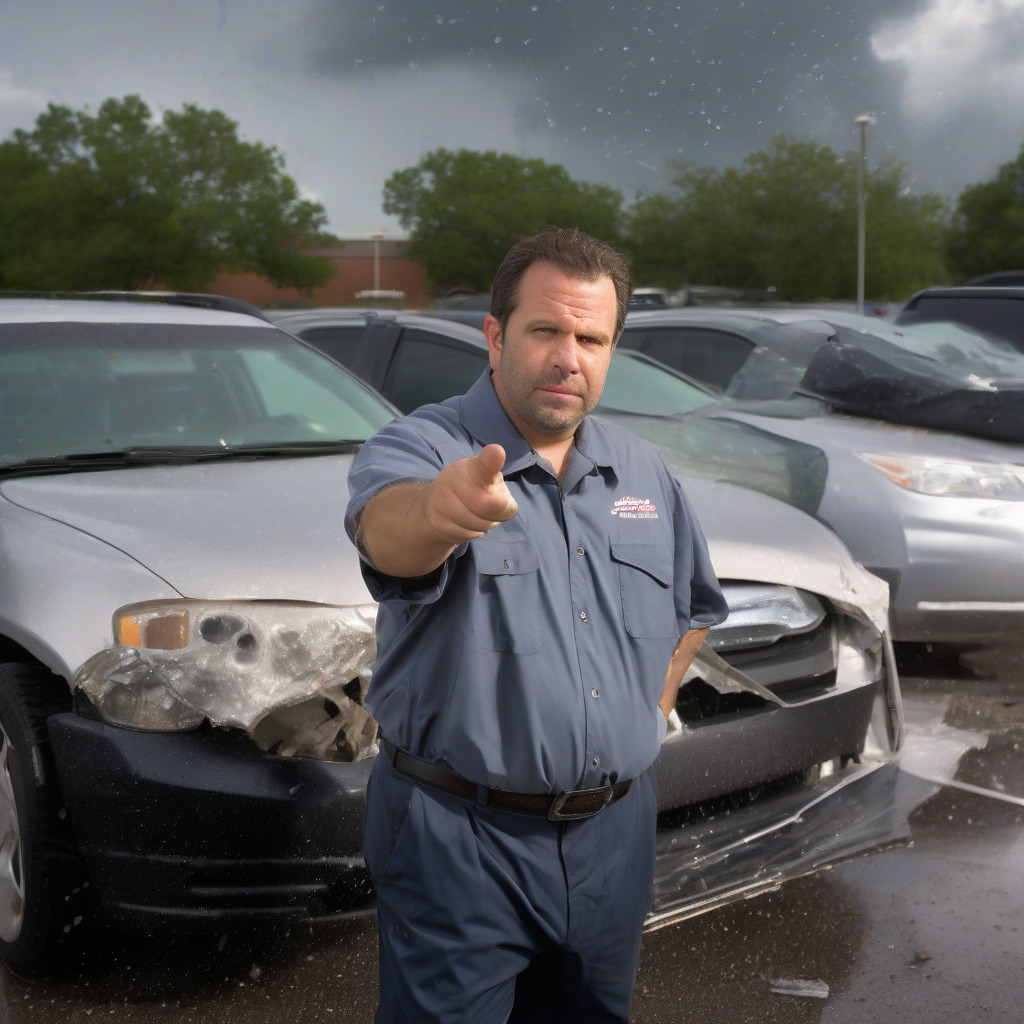
Harris County took a beating this spring. Hail-producing systems swept through during the March–May peak season, dropping large stones across the suburban corridors that consistently absorb the worst of these events: Katy, Cy-Fair, Sugar Land, Pearland, and the Spring/Klein area straddling northern Harris and southern Montgomery counties. Damage ranged from light scatter across hoods to impacts large enough to breach paint and push older vehicles into total-loss territory.
None of that surprises anyone who has lived here more than one spring. Houston sits squarely inside the hail corridor that runs from North Texas to the Gulf Coast. The March–May window is when Gulf moisture and cold fronts collide in exactly the combination that produces car-denting hail. What does surprise residents every single year — without fail — is what happens next: parking lots fill with out-of-state trucks, the doorbell rings at dinnertime, and someone with a clipboard is suddenly very interested in your car.
This guide is for Harris County drivers who right now have a dented car, a claim to file, and a decision to make. It covers what paintless dent repair actually is and when it isn’t enough, what a real estimate looks like line by line, how your insurance claim is supposed to work under Texas law, how to tell a local shop from a seasonal operation, and exactly where to complain if something goes wrong. Read it before you sign anything.
PDR or Body Shop — How to Read Your Own Damage Before Anyone Else Does
Paintless dent repair uses metal rods and picks to access the back side of a damaged panel and gradually push the metal back to its original shape without touching the factory paint. Done correctly on the right damage, PDR leaves no visible mark, doesn’t appear on a Carfax report, and doesn’t affect resale value. For moderate hail damage on a vehicle with intact paint, it’s typically faster and cheaper than a conventional body shop repair.
The operative phrase is “the right type of damage.” PDR has firm physical limits, and any technician who tells you otherwise is either poorly trained or overselling you.
PDR works when dents are round or near-round (hail dents typically are), the paint is uncracked and unchipped, the metal hasn’t been stretched beyond its elastic limit, the dents aren’t sitting on a body line or crease, and the panel can be accessed from behind. Most hail damage on hoods, roofs, trunk lids, and fenders of steel-bodied vehicles qualifies.
When hail hits hard enough, it doesn’t just push the metal — it thins and stretches it. PDR can’t restore thinned metal; the result will be a visible low spot or, eventually, a crack. Once the paint is broken by chipping or cracking, there’s no paintless option. The panel needs sanding, priming, and repainting. Body lines — the character lines that run across doors and quarter panels on most modern vehicles — are structurally stiffened by design. Dents on a body line almost always require conventional work.
Aluminum is worth a separate mention, and this matters in Houston because of the concentration of Ford F-150s, Ram 1500s, and various luxury SUVs on local roads. Many of these vehicles have aluminum hoods, doors, or complete body structures. Aluminum lacks the elastic memory of steel, and mishandled aluminum can crack. If your vehicle has aluminum panels, confirm your shop’s aluminum capability before anything else. Not every PDR tech working a Houston surge has that experience — and a surprising number won’t say so upfront.
Golf ball-size hail (1.75 inches or larger) typically requires full roof and panel replacement evaluation, not PDR alone. Impacts at that size are more likely to crack paint and stretch metal beyond recovery.
On pricing: local shops report that minor hail with quarter-size or smaller impacts on a single panel runs roughly $75–$150. Moderate hail spanning multiple panels with golf ball-size impacts typically runs $800–$2,500 total. Severe hail affecting the roof with high density of large impacts starts around $3,000 and can approach an insurer’s total-loss threshold on older vehicles. Get itemized written estimates from at least two shops before agreeing to any work. Two estimates takes an afternoon. A bad repair decision takes years to undo.
One thing PDR won’t do: trigger a Carfax entry. There’s no title brand, no salvage flag, and no insurance loss notation unless you file a claim with your insurer. Filing the claim creates the record — not the repair method.
What a Fair Estimate Actually Looks Like
Hail season in Houston produces thousands of estimates, and a significant fraction of them are incomplete, deliberately lowballed to win the job, or written vaguely enough to give the shop cover when a supplement dispute arises. Before you agree to anything, check every estimate against the following.
Any shop performing paint work in Texas must be licensed by the Texas Department of Licensing and Regulation, and that license number belongs on the estimate header. Shops that do PDR exclusively and never touch paint operate under different rules, but any shop offering refinishing without a TDLR number is operating illegally. Look it up at tdlr.texas.gov before you drop off your car. This takes two minutes and almost no one does it.
The estimate must include a real street address — not a P.O. box — that you can verify exists on Google Maps. A real estimate itemizes every affected panel and notes the number and approximate size of dents on each. “Hood — hail damage” is not an itemization. “Hood — 47 dents, 0.5 to 1.25 inches, PDR-eligible, 11 requiring conventional repair due to paint damage” is. These are different repair operations with different costs.
Ask for the labor rate explicitly. If it’s not on the estimate, you have no basis for comparing quotes. If parts need replacement, the estimate must say whether OEM or aftermarket parts will be used. Texas insurers may specify aftermarket on older vehicles, but you have the right to know what’s going in your car and to pay the difference for OEM if you want it.
Every legitimate estimate should include a supplement clause, because every legitimate estimator knows the first look doesn’t catch everything. It’s the provision that allows the shop to add to the repair order if hidden damage turns up once work is underway. If a shop tells you their estimate is final and supplements will never be needed, leave. Get warranty terms in writing — what’s covered, for how long, under what conditions. Legitimate shops offer a minimum of one year on workmanship; some offer lifetime warranties on paint.
Finally: if someone requires you to sign an Assignment of Benefits as a condition of service, that’s a problem. An AOB transfers your insurance claim rights to the shop, cutting you out of your own claim. Texas hasn’t banned the practice in auto claims, but no shop that doesn’t plan to exploit it actually needs one. If someone’s pushing you to sign before work begins, they’re telling you something about how they intend to handle your claim.
How Your Texas Insurance Claim Works
Texas has specific and consumer-favorable insurance claims statutes, and most Houston policyholders have no idea those protections exist. That’s not an accident — insurers aren’t obligated to walk you through your own rights.
The Texas Insurance Code, Chapter 542, sets firm deadlines. Your insurer must acknowledge your claim and begin an investigation within 15 days. Once you submit all requested documentation, the insurer has 15 business days to accept or reject. Once they accept, payment must follow within 5 business days. Miss any of those deadlines and the insurer owes you 18 percent annual interest on the claim amount plus reasonable attorney fees. Document every contact with dates and times. If they’re slow, that slowness has a dollar value — use it.
Your policy almost certainly contains an appraisal clause, which is Texas’s faster alternative to litigation when you and your insurer disagree on damage value. Each side hires an independent appraiser; the two appraisers select a neutral umpire; the umpire’s decision is binding. You pay your appraiser, but the process resolves disputes in weeks rather than years and is worth invoking when an insurer’s estimate is materially lower than what a qualified shop says the repair requires. Most policyholders never invoke it. Most policyholders also leave money on the table.
Before you file, call your agent and ask specifically about your policy’s chargeable event language. Hail falls under comprehensive, not collision, but how your carrier treats weather-related comprehensive claims at renewal varies by carrier and policy.
If you own the vehicle outright, you’re generally free to keep an actual cash value payment and not repair the car. If you have a loan or lease, the lienholder will typically require proceeds be applied to the repair. And if you choose not to repair, any future claim involving those panels gets complicated by the prior unrepaired damage.
Most auto policies pay actual cash value for hail damage — the fair market value of the vehicle in its pre-loss condition, minus your deductible. Texas’s average comprehensive deductible runs $500–$1,000. For owners of older vehicles, the ACV can be close to or below the deductible, meaning you might be paying out of pocket for a car the insurer says is worth less than the repair. Get two independent valuations before accepting their ACV figure. Local dealer data and industry valuation tools frequently support a higher number than the first offer.
Texas doesn’t set a statutory total-loss threshold percentage. It uses the Total Loss Formula: a vehicle is a total loss when repair cost plus salvage value exceeds ACV. In practice this typically triggers at a significant percentage of ACV, and that percentage varies by insurer — confirm the specific threshold with your carrier. If your car is totaled, you’re entitled to ACV minus your deductible, and you have the right to dispute the ACV through the appraisal clause.
How to Spot a Storm Chaser Before You Sign Anything
Storm chasers follow large hail events across the country. Houston’s storm frequency, population density, and sheer number of registered vehicles in Harris County make this one of the most heavily targeted markets in the United States. If you’ve lived here through a bad spring, you already know what it looks like — the doorbell rings two days after a storm and you open it to find someone who just drove in from Oklahoma holding a brochure with your zip code on it.
The tells are worth learning before the next estimate shows up at your door. Out-of-state plates on service vehicles or the estimator’s personal truck. A physical address that doesn’t show a real building on Google Maps satellite — look for a working shop, not a mail center or a shared office suite. A pitch that arrives within 48 to 72 hours of the storm, door-to-door. Pressure to sign before your insurer’s adjuster has seen the vehicle. An offer to “handle your claim entirely” — which is an offer to insert themselves between you and your insurer. And most critically: any offer to waive your deductible.
Texas law prohibits repair shops from waiving a policyholder’s deductible as an inducement to sign a repair contract. The practice is a false representation to the insurer about the true cost of repairs. When someone offers to waive your deductible, they’re not doing you a favor. They’re falsifying your claim, and you can be implicated in that fraud.
Storm chasing isn’t inherently illegal. A hail repair business that opens after a storm, does quality work, and leaves at the end of the season isn’t breaking any laws. What becomes illegal — or actionable under the Texas Deceptive Trade Practices Act — is deductible waiving, AOB manipulation, deceptive solicitation, and unlicensed paint work. If a storm chaser performs paint work without a TDLR license, that’s a violation. Complaints go to the Texas Attorney General’s Consumer Protection Division.
Harris County and the City of Houston have provisions governing commercial door-to-door solicitation. If a solicitor can’t produce a permit or is operating at an unusual hour, that’s worth reporting to the city. Check current permit requirements at houstontx.gov before filing. This is also a topic we track in our automotive coverage, particularly during the spring and fall storm seasons when complaint volume spikes.
How to Verify Any Shop in Under Ten Minutes
Before you hand over your keys, run through this sequence. It takes less time than waiting on hold with your insurer.
Go to tdlr.texas.gov and search the shop name or license number. A licensed auto body shop that performs paint work will appear with its license status, expiration date, and address of record. If the shop doesn’t appear, or the license is expired, walk away.
Then pull up Google Maps satellite view of the address on the estimate. Does a physical auto body facility appear? Does street view show a working shop? Has the Google listing existed for more than a year? Filter the reviews by date. A shop with 200 reviews, all posted in the last six weeks, is a shop that didn’t exist here six weeks ago — and you should think hard about what happens to your warranty claim when they leave.
Check the Houston Better Business Bureau at bbb.org/local/houston. A pattern of unresolved complaints around supplement disputes or warranty failures tells you something a smooth sales pitch won’t.
What a Decade in This Market Actually Buys You
The shops that have worked Harris County through multiple hail cycles know how local insurers behave in a surge. They know which adjusters are reasonable. They know how to write supplements that get approved rather than denied. That knowledge takes years to accumulate, and a shop that arrived three weeks ago doesn’t have it — no matter what they tell you.
Established local operations cluster in the corridors that absorb the hardest hits: Katy and the I-10 West corridor, Sugar Land and the Fort Bend County line, Pearland along Highway 288, and the Woodlands and Spring/Klein areas to the north. When CityDesk verifies and publishes the named-shop addendum to this piece, the inclusion criteria will be: ten or more years of documented operation in Harris or immediately adjacent counties, active TDLR licensure where applicable, verifiable ownership consistency, and an on-record owner or manager willing to speak to their experience managing Houston’s specific hail and insurer environment. Geographic distribution matters — a Pearland resident shouldn’t have to drive to Katy without knowing whether comparable tenure exists closer to home.
Buying a Used Car in Houston After a Major Hail Storm
If you’re shopping for a used vehicle in the months following a major hail event, a vehicle history report will show insurer-paid claims — but it won’t show damage that was unreported or paid out and never repaired. Both situations are common after a Houston storm surge, and motivated sellers have every reason not to mention either one.
Look with your own eyes under indirect lighting. A cloudy day or a shaded area with a flashlight held at an oblique angle will reveal hail damage. The characteristic dimpling pattern across the hood, roof, and trunk is hard to miss once you’re looking for it. Check also for orange-peel texture or paint inconsistency suggesting a repaint, or overspray on rubber trim — signs that damage was repaired, which may be fine, or signs it was rushed, which is not.
A properly completed PDR job on a steel-bodied vehicle is genuinely invisible and doesn’t affect structural integrity. There’s no reason to reject a used vehicle solely because it received professional PDR after a hail event, provided the paint is intact. Ask the seller for the repair invoice. A legitimate shop provided a written one. Be skeptical of unusually low prices on recent-model-year vehicles at private-party or independent-dealer lots in the weeks following a storm — cars priced to move fast after hail season may carry unrepaired damage or rushed cosmetic work. On any significant purchase, pay for a pre-purchase inspection from an independent shop. Not the selling dealer. An independent one. Houston homebuyers face a similar dynamic with pre-purchase inspections that commonly skip critical items — the principle of verifying independently, not through the seller, applies in both markets.
Where to File a Complaint in Texas
When something goes wrong with a repair, an estimate, or a claim, you have four channels. Use them. These agencies track complaint patterns, and volume drives enforcement.
Texas Department of Licensing and Regulation handles complaints against unlicensed repair facilities or licensed shops that violated professional standards. File at tdlr.texas.gov. A TDLR investigation creates an official record that can support civil action if needed.
Texas Department of Insurance processes complaints against your insurer — delayed payments, unreasonable denials, failure to meet Chapter 542 timelines. File at tdi.texas.gov. TDI complaints go into the insurer’s regulatory file and carry real weight when a carrier is accumulating a pattern. This is also where you report adjusters whose conduct crosses into bad-faith territory.
Texas Attorney General’s Consumer Protection Division handles DTPA violations: storm chaser fraud, deceptive solicitation, deductible waiving, and related consumer harm. File at texasattorneygeneral.gov. The AG’s office doesn’t represent individual consumers, but complaint volume informs enforcement priorities and can trigger action against operations that have hit multiple people.
Houston Better Business Bureau is useful for general business disputes and to add your experience to the public record. File at bbb.org/local/houston. BBB complaints prompt a formal response from the business and, if unresolved, appear in their public profile.
If you’re invoking the appraisal clause in a dispute with your insurer, filing a parallel TDI complaint on the same issue creates a paper trail and signals that you understand your rights. It’s not a prerequisite for appraisal, but it costs nothing and it matters.
CityDesk Houston will publish verified shop data, owner interviews, and ZIP-code-specific storm impact maps as reporting is completed. Readers with experiences — good or bad — with storm-season repairs can submit tips to the editorial desk.