How to Spot a Flood-Damaged Car Before You Buy in Houston
Before you hand over a check, run this sequence. Harvey-era and Beryl-era salvage inventory is still moving through Houston's private-sale market. The next storm will add another wave. Here's how t…

Before you hand over a check, run this sequence. Harvey-era and Beryl-era salvage inventory is still moving through Houston’s private-sale market. The next storm will add another wave. Here’s how to read a Texas title history, spot the physical signs yourself, and find a local mechanic before you sign anything.
Peak Atlantic hurricane season runs through October. The six-to-eighteen-month window after any named storm — when totaled vehicles move from Harris County insurance auctions into private listings — lands squarely inside used-car shopping season. This guide is written for Houston buyers shopping right now, not after they’ve already handed over a check.
Why Houston Has a Specific and Persistent Flood-Car Problem
Most cities deal with flood-damaged vehicles after a single catastrophic event. Houston deals with them continuously. It’s an important distinction, and most buyers from other parts of the country don’t fully grasp it until they’ve already made a mistake.
Harvey in 2017 produced a massive wave of salvage-titled vehicles across Harris County and surrounding areas. Before Harvey, Tax Day 2016 flooded vehicles across the region. Before that, the Memorial Day storms of 2015. In July 2024, Beryl made landfall as a Category 1 hurricane near Matagorda Bay and sent another cohort of totaled vehicles into the insurance pipeline across Harris, Galveston, and Brazoria counties.
Each event produced its own batch of salvage-titled cars. The pipeline from insurer to auction to rebuilder to private sale takes the better part of a year, so the used-car market in Houston at any given moment contains inventory from multiple storm cycles simultaneously. You’re not shopping in the aftermath of one disaster. You’re shopping in the accumulated aftermath of several.
Beryl-era vehicles — primarily 2020 through 2023 model-year cars and trucks totaled last summer — are actively entering private-sale channels during the late-2024 through mid-2025 window. If you’re shopping right now, these vehicles are in the market right now.
The neighborhoods most likely to produce flood-car listings are not evenly distributed across the metro. Meyerland (ZIP 77096) has flooded in at least three named events since 2015 and is arguably the single densest concentration of repeat flood-vehicle history in the state. Kingwood flooded heavily during Harvey. Pearland and Friendswood took significant Beryl flooding. League City and Clear Lake sit in low-lying terrain draining toward Galveston Bay. Galveston Island floods in any named storm that makes landfall within range.
When you see a private listing for a 2021 or 2022 model-year vehicle from a seller in any of these areas, priced below Kelley Blue Book, treat it as a heightened-scrutiny situation regardless of what the listing says. That combination alone isn’t proof of anything. It’s a reason to slow down.
What Texas Law Actually Says About Flood-Damaged Car Titles
Texas operates a three-tier title branding system administered by TxDMV. The distinctions matter before you run any search.
Salvage title is issued when an insurer declares a vehicle a total loss — typically when repair costs exceed a statutory percentage of the vehicle’s actual cash value. A salvage-titled vehicle can be repaired and returned to Texas roads, but it must pass a DPS inspection and be retitled first. Once applied, the salvage brand persists in the system.
Non-repairable title is a permanent designation. Issued for vehicles too severely damaged to safely return to the road, it means the car can be sold for parts or scrap — but it can never receive a clean Texas title, no matter how thoroughly it’s repaired. A seller claiming a non-repairable-titled car has been “fully restored” and can be legally registered is wrong, and almost certainly knows it.
Rebuilt/prior salvage brand is the notation that appears permanently on a Texas title after a salvage vehicle has been repaired, passed DPS inspection, and retitled for normal use. This brand does not disappear. Every subsequent Texas title for that vehicle will carry the rebuilt/prior salvage notation for as long as the vehicle exists. Legal to drive and insure — but carrying materially lower resale value.
Here’s the real vulnerability. That permanence only holds if the title stays in Texas. A rebuilder can transport a salvage-branded vehicle to a state with less rigorous title inspection requirements — Vermont, Arkansas, West Virginia, and New Hampshire have appeared repeatedly in title-washing cases — and obtain a clean title there. That out-of-state clean title can then come back to Texas, where TxDMV will often accept it at face value and issue a new Texas title with no flood brand. The vehicle re-enters the market looking, on paper, like any other used car.
This isn’t a theoretical loophole. It happens. Keep it in mind every time you see a vehicle with an out-of-state title history.
How to Run a Texas Title History Check Before You Inspect Anything
Do this sequence before you drive to see any vehicle. It costs almost nothing and can save you a wasted trip — or worse.
The National Insurance Crime Bureau offers a free VIN check at nicb.org that pulls from the National Motor Vehicle Title Information System (NMVTIS), the federal database aggregating title brand information from all fifty states. Takes about thirty seconds. Its documented limitation is a reporting lag of up to sixty days — a vehicle totaled in July 2024 may not show a flood brand in NMVTIS until September or October. For Beryl-era inventory entering the market now, that lag has likely closed. But don’t treat a clean result as final. It’s a starting point.
Carfax and AutoCheck both pull NMVTIS data and supplement it with direct insurer reporting, which closes some of the lag. A Carfax report shows odometer readings, service records where reported, and previous state registrations. That last item is useful: out-of-state title history is exactly what a title wash produces. A clean Carfax is useful data, not a guarantee.
The most authoritative document a private buyer in Texas can obtain is TxDMV Form VTR-275, the Motor Vehicle Record. It costs $5.75 and shows the complete Texas title brand history for a vehicle — every brand ever applied to that VIN within the Texas system. Look specifically for any salvage, non-repairable, or rebuilt/prior salvage notation. If the vehicle has never been titled in Texas, the VTR-275 will show no Texas history. That absence is itself worth noting.
Run all three checks before you look at the car. No exceptions.
The Gap That Enables Clean Titles on Damaged Cars
Here’s how this actually works in practice.
A Harris County vehicle floods in a named storm. The owner files a claim. The insurer totals the vehicle and obtains a Texas salvage title. The salvage vehicle sells at an insurance auction — Copart or ADESA — to a licensed dealer or rebuilder. The rebuilder cosmetically repairs the vehicle: new carpet, dried-out upholstery, a detail job, possibly some electrical work.
A Texas retitle would require a DPS inspection and would permanently brand the title as rebuilt/prior salvage, cutting resale value substantially. So that’s not what happens.
The rebuilder transports the vehicle to a more permissive state and titles it there as a clean vehicle. That state issues a clean title. The car comes back to Texas, where TxDMV accepts the out-of-state title at face value and issues a new Texas title with no flood brand.
Uninsured flood losses create another gap entirely. A vehicle totaled in a flood whose owner didn’t carry comprehensive coverage may never generate a salvage record anywhere, because no insurer ever touched it. A private seller in Meyerland who totaled an uninsured car in Harvey and had it repaired at a cousin’s body shop may have a vehicle with no salvage brand in any database — carrying a clean title that is technically accurate, because no official record of the damage was ever created.
The VTR-275 catches Texas-branded vehicles. Carfax catches insurer-reported losses. Neither catches a properly executed out-of-state title wash on an uninsured vehicle, or uninsured losses that never reached any database. This is why physical inspection is not optional, no matter how clean the paperwork looks.
The DIY Physical Inspection
Do this yourself before you pay for a mechanic. You’re looking for evidence the car was submerged, and water leaves marks that are genuinely difficult to fully erase — even with a professional detail.
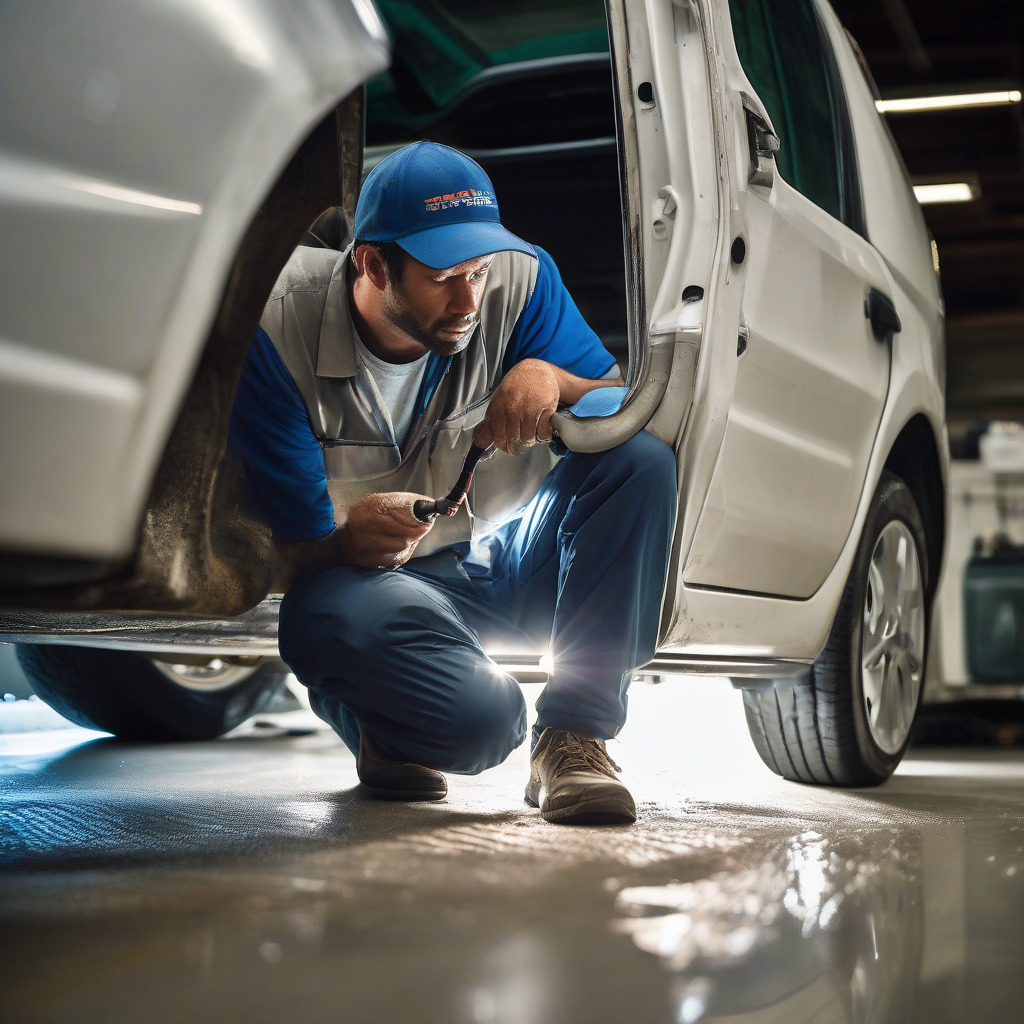
Outside the vehicle. Crouch down and look at the door jambs on all four doors — the painted inner surfaces where the door seals contact the body. Flood water leaves a consistent horizontal line at whatever depth the vehicle sat. Check the trunk lid inner surface and the engine compartment walls at the same height.
Houston’s clay-heavy soil — that distinctive reddish-tan color — leaves a specific tinted sediment in wheel wells and, importantly, in the spare tire well under the cargo floor. Lift the cargo floor and look. Rotor and caliper rust is normal on any used car; rust that looks heavier or more advanced than the vehicle’s age and mileage suggests can indicate prolonged water exposure.
Inside the vehicle. New carpet or new upholstery in an otherwise older vehicle is a red flag. Pull back the carpet at the edges near the door sills and look at the bare metal beneath. Rust and water staining are telling. Look at the instrument cluster from an angle — moisture trapped behind the gauge glass leaves fog or residue that’s difficult to fully remove.
Shine a flashlight into the AC vents and seatbelt receivers; silt and sand pack into both. Pull a seatbelt all the way out and let it retract. A sticky or sluggish retractor has water-damaged internals. Reach under the front seats and look at the seat rail sliders for rust. If the car has aftermarket speakers, pop a grille and look at the cone — corroded paper cones are a clear water sign.
Mold and mildew establish themselves fast in a flood-damaged vehicle sitting through a Houston summer. A freshly detailed car with an aggressive air freshener — especially pine or floral scents — is a warning sign by itself. Detailing masks odors temporarily; it doesn’t eliminate the source. If you smell anything musty underneath the air freshener, leave. Trust that instinct.
Under the hood. Look at the firewall — the vertical panel separating the engine compartment from the cabin — for mud lines or sediment residue. Pull the engine oil dipstick and look at the oil. Milky, foamy, or coffee-colored oil means water has entered the crankcase. Do the same for the transmission fluid if it’s accessible.
Look at the fuse box contacts and battery terminals for corrosion beyond normal oxidation. Look at the engine block itself for a waterline — a horizontal discoloration at whatever depth the engine sat in flood water.
Under the car. Mud packed into frame rails is one of the most reliable flood indicators because it’s difficult to reach during a cosmetic detail. Catalytic converters are damaged when a hot exhaust system is suddenly quenched by flood water, producing cracking in the honeycomb substrate. Worth noting if you hear a rattle under hard acceleration.
What a Houston Mechanic Should Check That You Cannot
A flood-specific pre-purchase inspection goes well beyond a standard PPI, and it costs more. In Houston, a standard pre-purchase inspection at most independent shops runs $100 to $175. A flood-specific extended inspection will run higher — call ahead and confirm pricing, because shops vary. When you call, ask specifically whether the inspection includes an OBD-II scan with freeze-frame data review and a borescope check of the door cavities. If the shop doesn’t know what you mean, find a different shop.
A borescope inspection of door cavities and rocker panels lets a mechanic insert a camera through drainage holes in the door panels and look for sediment deposited inside — an area a detailer can’t reach and rarely tries. Rocker panels, the structural channels running beneath the doors, trap sediment and hold moisture, accelerating rust from the inside out.
An OBD-II scan with freeze-frame data review is different from a standard code scan. A standard scan tells you whether any fault codes are currently active. Flood damage typically throws multiple ECU fault codes simultaneously — from sensors that were submerged — which are then cleared by the rebuilder before sale. Freeze-frame data and pending codes show evidence of previously cleared faults consistent with flood exposure. Most general-purpose shops skip this, which is why you have to ask for it by name.
A mechanic opens both the interior and engine-compartment fuse boxes to look for water staining, corrosion on fuse contacts, and evidence that fuses have been replaced — a sign of prior electrical failures from water intrusion.
The evaporator box sits inside the dashboard and is one of the most common locations for trapped mud in a flood vehicle. Inspecting it properly requires partial dashboard disassembly. Mud in the evaporator box produces persistent mold and is expensive to remediate. Not an obscure edge case — a genuine recurring problem in Houston flood repairs.
The most safety-critical item on this list: airbag control modules. Water damage to the module can cause airbags to deploy unexpectedly or fail to deploy in a crash. Most buyers don’t think to ask about it. Ask about it.
On the mechanic question: Christian Brothers Automotive has locally owned franchise locations in Katy, Sugar Land, and the Memorial area, and produces detailed written inspection reports that are useful as documentation. For flood-specific experience, though, the independent shops along Beechnut Street and South Braeswood Boulevard in the Meyerland corridor (ZIP 77096) have inspected more flood vehicles than virtually any comparable cluster of shops in the city — simply because of where they are. That neighborhood has flooded in at least three named events since 2015. The mechanics there have seen every variation of flood repair and cosmetic concealment that exists in Houston. That’s real experience. It’s worth calling ahead and asking whether they handle flood-specific inspections.
Which Houston-Area Auctions Are Selling Flood Inventory Right Now
Understanding where flood vehicles enter the market helps you trace the pipeline — and lets you run due diligence even if you never plan to bid.
Copart Houston North at 14450 TX-249 and ADESA Houston at 4526 N. Sam Houston Pkwy E. near IAH are the two primary Harris County insurance total-loss auction sites. Both handle large volumes of insurer-consigned vehicles, including flood inventory from named storms. Copart’s listings are publicly searchable at copart.com without an account. Filter by location (Houston), loss type (flood/water), and you can see current inventory. Searching for Harris County vehicles with July 2024 loss dates will surface Beryl-era inventory actively moving through the system right now.
You’re not bidding here. You’re running due diligence. If the VIN on a private-sale vehicle you’re considering shows up in Copart’s auction records as a flood loss, you have your answer.
IAA (Insurance Auto Auctions) is the third major handler of insurance total-loss inventory nationally and has Harris County operations. Same approach — check iaai.com using the flood-loss filter.
The pipeline timeline matters. Flood vehicles typically enter private-sale channels six to eighteen months after the storm event. For Beryl (July 2024), peak private-sale exposure runs through mid-2025. You’re in that window now.
Red Flags in Houston Private-Sale Listings
The platforms most likely to carry flood inventory in the Houston metro are Facebook Marketplace, Craigslist, and OfferUp. Treat any 2020-through-2023 model-year vehicle priced below KBB private-party value, listed by a private seller in Pearland, Friendswood, Galveston, League City, Clear Lake, or Meyerland ZIP codes, as a prompt for everything in this guide. Recent model year, below-market price, flood-prone geography — that combination isn’t proof of anything. It’s the profile that warrants the full sequence of checks before you proceed.
Specific listing language to treat as a flag: “recently detailed” (detailing is either normal maintenance or concealment — it’s never neutral), “minor water intrusion” (there’s no such thing in a totaled vehicle), and “runs great” paired with no service records, no explained history, and a seller who wants to close quickly. Flood-car sellers are frequently not the rebuilders. They may be downstream buyers who didn’t know what they were getting — or they may know exactly what they’re selling. You often can’t tell which until it’s too late.
Galveston Island listings require separate consideration. Galveston floods in saltwater. Every other flood-prone area in this guide — Meyerland, Kingwood, Pearland, League City — floods in freshwater or brackish water. Saltwater corrosion advances substantially faster, and the damage is categorically more severe. If you’re looking at a vehicle with any history connecting it to Galveston Island in a storm year, the honest advice is to move on. There are easier cars to buy.
One final legal point: Texas’s lemon law covers new vehicles only. It does not apply to used cars sold by private sellers. If you buy a flood car from a private seller in Houston, your legal recourse depends on your ability to prove, under the Texas Deceptive Trade Practices Act, that the seller fraudulently concealed a known material defect — which requires evidence of the seller’s knowledge, not just evidence that the car was damaged. It’s a harder case to make than most buyers expect, slow to resolve, and expensive to pursue. The inspection costs a few hundred dollars. The lawsuit costs multiples of that, and you might still lose.
What to Do If You Think You Already Bought a Flood Car
If you’ve already purchased a vehicle and you’re now seeing signs you missed, move quickly. Corrosion advances fast, and documentation becomes harder to assemble as time passes.
Document everything now. Photograph every sign of flood damage you can find — waterlines, rust on seat rails, mud in frame rails, moisture behind the instrument cluster. Write down the date of purchase, the seller’s contact information, the price, and everything the seller represented about the vehicle’s history. Screenshot the listing before it disappears.
Get the VTR-275 if you haven’t already. If the vehicle has a branded title history in Texas and the seller represented it as clean, you have a documented misrepresentation.
Get a flood-specific inspection from a mechanic. You need a written report. The inspection report is your evidence.
Consult a consumer protection attorney. The Texas Deceptive Trade Practices Act may provide recourse if a seller fraudulently concealed known flood damage. The Texas State Bar Lawyer Referral Service can help you find attorneys who handle consumer fraud matters.
The used-car market in Houston doesn’t pause between storms. Harvey inventory, Beryl inventory, the next storm’s inventory — it cycles through private-sale channels on an ongoing basis, and we cover the full range of situations Houston drivers face in our automotive coverage. The next named storm affecting Greater Houston will add another layer within months of landfall.
Running the title checks costs about six dollars and half an hour. A flood-specific pre-purchase inspection costs an afternoon. Buying the wrong car costs thousands, and in the case of a compromised airbag module, it costs more than money. Do the sequence. Find a mechanic who has actually seen flood vehicles. Don’t let a seller’s urgency compress your timeline.