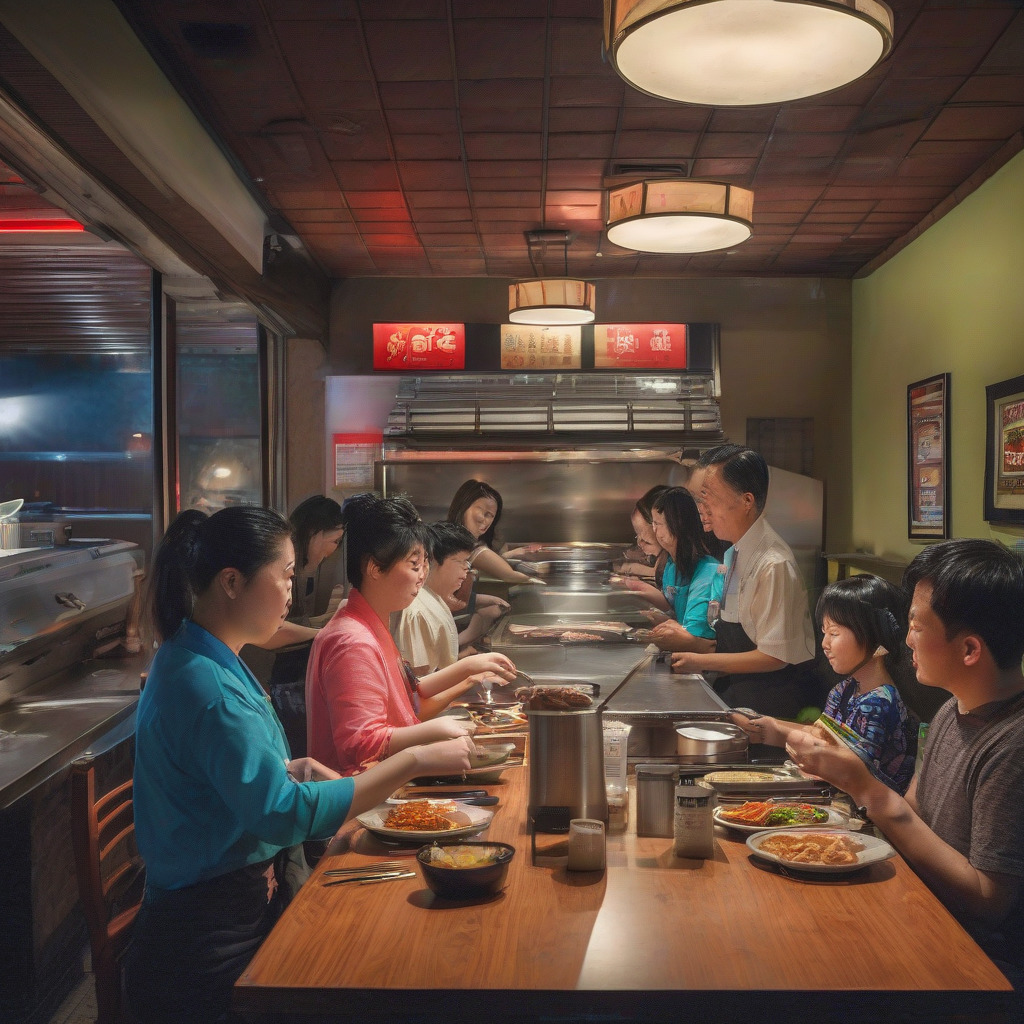
What Houston Restaurant Service Charges Actually Mean for Servers and Diners
Texas law lets restaurants keep every dollar of a mandatory service charge. With Houston Restaurant Week approaching, CityDesk Houston reports what named local operators are actually doing with tha…


Texas law lets restaurants keep every dollar of a mandatory service charge. With Houston Restaurant Week approaching, CityDesk Houston reports what named local operators are actually doing with that revenue — and what you’re entitled to ask before you order.
The check arrives at your table in Montrose. You had a good meal, your server was attentive, and you’re already calculating a tip in your head when you see it: a line item reading “Service Charge — 20%.” You assume it works like a tip. It goes to your server, maybe gets pooled with the bussers and food runners. You sign the receipt, add nothing extra, and feel like you’ve done right by the person who brought your food.
You may have done no such thing.
Under Texas Labor Code §203.003, a mandatory service charge belongs to the employer. Any compulsory fee collected as a condition of service is employer income. The statute does not require the employer to distribute any portion of it to the workers who served the meal. The restaurant can keep every dollar and apply it to overhead, rent, or operating margin. Your server may receive none of it.
This is the explicit structure of Texas law, and it governs every Houston restaurant that collects a mandatory service charge — whether they print it in fine type at the bottom of the menu or announce it on a sandwich board at the host stand. Almost no one in a Houston dining room knows this is the default legal position. Not most diners. Not all servers.
Houston Restaurant Week begins in August — a subject we return to regularly in our food & hospitality coverage. Dozens of participating restaurants will charge service fees on top of already fixed-price menus. This is the moment to understand exactly what that line item means, where the money goes, and what you can actually do about it.
Service Charge, Automatic Gratuity, Tip: Not the Same Thing
The confusion starts with language. “Service charge,” “automatic gratuity,” and “tip” appear on menus, receipts, and reservation confirmation emails as though they were interchangeable. They are not, and the difference isn’t semantic — it’s legal and financial.
A tip is voluntary. The diner chooses the amount. Under federal and Texas law, a tip belongs to the employee. Employers cannot retain tips or apply them to wages except in narrow, legally defined tip pool arrangements.
A service charge is mandatory. The restaurant collects it as a condition of the transaction. Under Texas Labor Code §203.003, that revenue belongs to the employer. If the restaurant passes some or all of it to staff, that’s a business choice, not a legal obligation. When amounts are distributed to employees, they’re treated as wages for payroll tax purposes — not tips.
Automatic gratuity is where things get genuinely murky. Many Houston restaurants impose it for large parties — typically six or more — and call it a “gratuity,” which sounds like a tip. IRS Revenue Ruling 2012-18 is clear: if the customer has no meaningful choice about whether the charge applies and cannot freely set the amount, the IRS classifies it as a service charge regardless of what word the restaurant printed on the menu. If it’s distributed to workers, it runs through payroll as wages.
Texas has no separate statutory definition for “automatic gratuity,” which is why Houston menu language varies wildly and sometimes feels designed to blur the distinction. A restaurant can call something a “hospitality contribution,” a “kitchen appreciation fee,” a “service gratuity,” or simply “service.” The legal analysis turns on whether payment is optional, not on which word appears on the check. When you see a mandatory charge — whatever it’s called — assume it’s a service charge under Texas law unless the restaurant tells you otherwise in writing and specifies how the money is distributed.
What Named Houston Restaurants Are Actually Doing
Most coverage of service charges stops at the legal explainer. Here’s what specific Houston operators are actually doing with the revenue — or, in several cases, what they’ve declined to say.
Underbelly Hospitality, which operates Underbelly, Georgia James, and One Fifth among other concepts, uses a service charge model that distributes revenue across front-of-house and back-of-house staff. The stated intent is to reduce the income gap between kitchen workers, who earn no tip income, and servers, whose earnings swing sharply by shift. CityDesk Houston could not independently verify the current distribution formula before publication; confirm current practice directly with the restaurant.
Whether an individual server comes out ahead compared to a traditional tip night is genuinely uncertain and shifts with the shift. Some high-earning servers in service-charge models do come out behind. Back-of-house workers generally do better. This is the real trade-off at the center of the model — it’s a labor structure change, not primarily a consumer-facing one, and it redistributes money already in the room rather than generating new revenue.
Brennan’s of Houston, the white-tablecloth property on Travis Street, applies a service charge and distributes revenue to staff across departments. The restaurant operates in the upper end of the Houston market and represents the category of upscale independent that has moved toward service charge models partly to manage labor costs and reduce income volatility. CityDesk Houston could not independently verify specific distribution figures before publication.
Ninfa’s on Navigation, the original East End location, applies automatic gratuities for large parties. The restaurant’s ownership did not respond to CityDesk Houston’s inquiry about whether that revenue is distributed to servers as wages or retained by the house, and did not confirm whether any policy changes have been made recently. The absence of a response is itself a finding. Diners at Ninfa’s who see a mandatory charge on a large-party check are entitled to ask directly how that money is handled. As of publication, the restaurant hasn’t made that policy publicly available.
Escalante’s operates multiple Houston locations including River Oaks and Memorial. The group applies automatic gratuities on large parties. CityDesk Houston’s inquiry about distribution policy yielded no response. Escalante’s has been a fixture in Houston dining for decades, which makes the silence on this particular question more conspicuous, not less. The word “gratuity” on their menu does not legally ensure the money reaches your server.
Landry’s, Inc., headquartered in Houston, is the most significant volume player in this story by a considerable margin. The company operates Rainforest Cafe, Bubba Gump Shrimp, locations at Kemah Boardwalk, and Mastro’s Ocean Club, among dozens of others. Landry’s applies automatic gratuities for large parties across its brands and has published no unified policy on service charge distribution. Corporate did not respond to a request for comment. For diners visiting any Landry’s location, the lack of a public policy statement means the question has to be asked at the table — every time, at every location.
March and Turner’s, both operated by Goodnight Hospitality, apply service charges designed to pay kitchen and service staff more equitably. This tracks with a broader shift among fine-dining operators nationally, where the income gap between front-of-house and back-of-house workers in high-volume restaurants has become genuinely difficult to justify. CityDesk Houston could not independently verify current distribution details before publication.
The pattern across these operators reflects real change in how restaurants handle labor compensation — several formalized or revised service charge policies between 2020 and 2023 as a pandemic-era labor cost tool, with further modifications since. The operators most transparent about distribution are the upscale independents. High-volume chain operators are mostly not disclosing. That asymmetry is worth sitting with.
What This Means for the Server’s Paycheck
When a restaurant passes service charge revenue to employees, it cannot treat that money as tips. Distributed service charge revenue is wages. The restaurant must run it through payroll, withhold income tax, and pay and match FICA — the 7.65% employer share of Social Security and Medicare taxes.
That’s a real cost. A restaurant that collects $10,000 in service charges on a busy Saturday and distributes $7,000 to staff now owes payroll taxes on $7,000. It would owe nothing if it retained the revenue as operating income. This is a direct financial incentive for some operators to keep service charge revenue rather than distribute it — and it’s one of the less-discussed structural reasons some restaurant groups have moved to this model. Not to improve worker compensation. To reduce tax exposure. That’s worth saying plainly.
For the server, the W-2 treatment creates its own confusion. A worker earning $600 through voluntary tips reports that as tip income. A worker receiving $600 as distributed service charge sees it as ordinary wages on their year-end W-2 — same line as their hourly base pay. The withholding timing differs. The tax reporting differs. Workers who aren’t clearly informed of this at hire often don’t understand why their W-2 looks different from their last restaurant job. It’s a confusing situation even for workers paying close attention.
CityDesk Houston contacted UNITE HERE Local 23, which represents some Houston hotel and food-service employees, and ROC United’s Texas contacts, asking whether either organization has documented worker complaints about service charge disclosure at point of hire in Houston. Neither provided a response by publication deadline. That doesn’t mean workers are satisfied. It more likely reflects that service charge distribution falls into a gray zone workers often don’t know they can challenge — or realize they should.
Houston Restaurant Week and the Real Cost of That $35 Dinner
Houston Restaurant Week runs in August, organized through Insight Dining and the Greater Houston Restaurant Association. The promotion brings thousands of first-time or occasional diners to participating restaurants on the appeal of fixed-price menus: roughly $20 for lunch, $35 for dinner, $55 for a premium dinner. The appeal is obvious — you know the price going in.
Except often you don’t. HRW’s promotional materials display the fixed-price tier without any uniform disclosure requirement for service charges. A participating restaurant that charges a 20% service charge is not required by the HRW participation agreement to disclose that charge in HRW promotional listings, based on review of publicly available HRW materials. CityDesk Houston asked Insight Dining to confirm whether participation agreements require service charge disclosure in promotional materials. Insight Dining did not respond by deadline.
The math on a $35 HRW dinner with a 20% service charge: the service charge adds $7. Sales tax brings the total to the mid-to-upper $40s before any additional tip. If you leave $5 cash for your server because you’re uncertain whether the service charge reaches them, your $35 dinner is approaching $50. That’s the price diners should have before they arrive. Not after they see the check.
This complaint surfaces in Houston dining forums, Google reviews, and local food media every August, reliably. Diners discover a service charge at settlement on an HRW check they understood to be fixed-price. It keeps recurring because there’s no disclosure requirement in HRW promotional materials and restaurants applying service charges aren’t required to feature that information prominently at the point of booking. After several years of the same complaint, the absence of a fix starts to look less like an oversight.
What Texas Law Actually Requires — and Doesn’t
Texas does not require restaurants to explain how service charge revenue is split among owners, management, and staff. The law requires only that a mandatory charge appear on the menu or the bill. Where the money goes is entirely up to the operator to disclose voluntarily.
There’s no Houston city ordinance filling this gap. Texas law limits local labor ordinances, which is why the city couldn’t pass a service charge transparency rule even if city council wanted to. That’s the ceiling on what local action can accomplish.
The one available legal hook for a diner who believes a false claim was made — menu language stating a charge goes to staff when it demonstrably does not, for instance — is the Texas Deceptive Trade Practices Act. Consult a Texas consumer protection attorney to assess a specific situation. Readers who believe they have a concrete misrepresentation claim should contact the Texas Attorney General’s consumer protection division.
The entire current framework rests on voluntary disclosure by individual operators, with no enforcement mechanism behind it. The operators with the least incentive to disclose are high-volume chains serving price-sensitive diners. They are, predictably, the ones not disclosing. That’s not a coincidence.
What to Ask Before You Order
Before you sit down, you should know whether a service charge will appear on your check and where that money actually goes. Some Houston restaurants using service charges are distributing revenue to workers in ways that genuinely improve compensation equity. Some are not. You cannot tell the difference from the menu. No law requires them to tell you.
Before you arrive: check the restaurant’s website for a menu PDF, not just an online ordering page. Mandatory service charges, when disclosed in advance, tend to be in fine print at the bottom of the printed menu. Search the restaurant name plus “service charge” on Google — some Houston operators have addressed this in press interviews or posted FAQ language. On Resy and OpenTable, check the “About” section and any pinned notes; some operators have added service charge language there in the last two years. If you’re booking for a large party, read the confirmation email carefully. The automatic gratuity policy is often there.
At the restaurant: ask your server or the host directly — “Does the service charge go to the staff, or does the restaurant keep it?” A server who says “I honestly don’t know” is telling you something real about how the operation is run. A server who says it’s distributed to the whole team is giving you information you can factor into your tipping decision. A server who’s been instructed not to answer is also telling you something — probably the most important thing.
On the check: you are not obligated to tip on top of a service charge. You’re also not doing anything wrong if you ask whether the charge reaches your server and then leave cash directly for them when the answer is no. Cash given directly to a server at the table is, in most circumstances, a tip in the legal sense — voluntary and employee-owned.
If a charge appears on your bill that was not on the menu: ask the manager to remove it. A charge that wasn’t disclosed before the transaction is on firmer legal ground as a consumer complaint. If they decline, pay under protest, document it in writing, and file a complaint with the Texas Attorney General’s consumer protection division.
The Bottom Line
Texas Labor Code §203.003 is unambiguous. A mandatory service charge belongs to the employer. Transparency is entirely voluntary, and there’s no enforcement mechanism requiring disclosure of how the revenue is distributed.
In this reporting, the operators who provided the clearest public framing are the upscale independents: Underbelly Hospitality, Goodnight Hospitality’s March and Turner’s, and Brennan’s of Houston. They’ve stated a distribution policy exists. The operators who did not respond or did not confirm a policy include Ninfa’s on Navigation, Escalante’s, and Landry’s. That asymmetry tracks with a straightforward reality: mission-driven independent restaurants have stronger reputational incentives to be honest about this. Large-volume chains have weaker ones.
Ask the question at the table. Spend money at restaurants that answer it. If you work at a Houston restaurant where service charge distribution was never explained at hire — or where the policy changed without notice, or where you’re seeing distributed service charges on your W-2 without having been informed that this was the pay model when you took the job — CityDesk Houston wants to hear from you. Use the tip line in the footer of this page.
Houston Restaurant Week participating restaurants are listed at the HRW website. For any restaurant on that list you’re planning to visit, twenty seconds on their website before you book will tell you more than the promotional listing will. That’s a low bar, and right now it’s the only one available.
CityDesk Houston is a locally independent publication. If you have documentation of service charge policies, worker communications, or pay stubs related to service charge distribution at a Houston restaurant, contact our newsroom through the tip line below. Restaurant policies described in this article reflect available public information and responses to reporter inquiries as of publication. Policies may change; contact individual restaurants to confirm current practice.