Houston Restaurant Weeks 2026 Is Coming. Here's What Operators and Diners Need to Know Now.
Registration opens months before August. The best reservations disappear within a day of the participant list dropping. The business math is more complicated than the promotional copy suggests.

Registration opens months before August. The best reservations disappear within a day of the participant list dropping. The business math is more complicated than the promotional copy suggests.
The calendars aren’t posted yet. The participant list won’t drop for weeks. But if you’ve eaten in Houston long enough, you already know that Houston Restaurant Weeks isn’t really an August event — it’s a June conversation, the kind held in walk-in coolers and over reservation dashboards, where operators decide whether the city’s biggest dining promotion makes sense for their kitchen, their margins, and their staff heading into summer.
This piece is written for both audiences: the diner who wants a great table at a restaurant they’d otherwise never try, and the operator staring at a registration deadline doing the math. We’ll cover what we know, flag what’s still unconfirmed, and explain the mechanics that most coverage skips.
What the 2026 Dates Look Like — and Where to Get Official Confirmation
Houston Restaurant Weeks has run on a first-Friday-of-August start for years, typically anchoring at the back end near Labor Day weekend. That pattern puts the 2026 window at August 7 through September 7 — a 32-day run matching recent years. To be direct: the organizer has not publicly confirmed 2026 dates, price tiers, or registration timelines. The dates above reflect established pattern, not a press release.
Before you put anything on your calendar or your POS system, verify at HoustonRestaurantWeeks.com and through Cleverley Stone’s social channels. Stone — the Houston media personality who founded HRW in 2003 and has run it since — posts registration openings and date confirmations simultaneously. Watch either channel and you’ll catch both at once.
The reason to pay attention in June rather than July: registration for participants typically opens months before August, and the best reservations at the most in-demand restaurants fill within hours of the participant list going live. Getting ahead of this, whether you’re booking dinner or planning your kitchen’s prep calendar, pays off.
How Houston Restaurant Weeks Actually Works
HRW is not a city-sponsored food festival. No permits, no ticketed events, no outdoor stages. It’s a privately organized promotional program run by Stone’s company, in which restaurants elect to participate, submit prix-fixe menus at standardized price tiers, and get listed in a central directory that drives diners to their rooms during what would otherwise be one of Houston’s slowest dining months.
Typically more than 250 restaurants participate in a given year — hotel fine-dining rooms, neighborhood Vietnamese spots, suburban steakhouses. Each sets its prix-fixe menus at designated tiers and handles its own reservations through OpenTable, Resy, direct phone, or walk-in, depending on the house.
One point of persistent confusion: alcohol is always a separate charge. This is a TABC requirement — alcoholic beverages can’t be bundled into a fixed-price promotional package under state law. When you see a $45 dinner menu, your wine or cocktail is on top of that number. Every year someone is surprised by this at the table. Don’t be that person.
The Charity Math
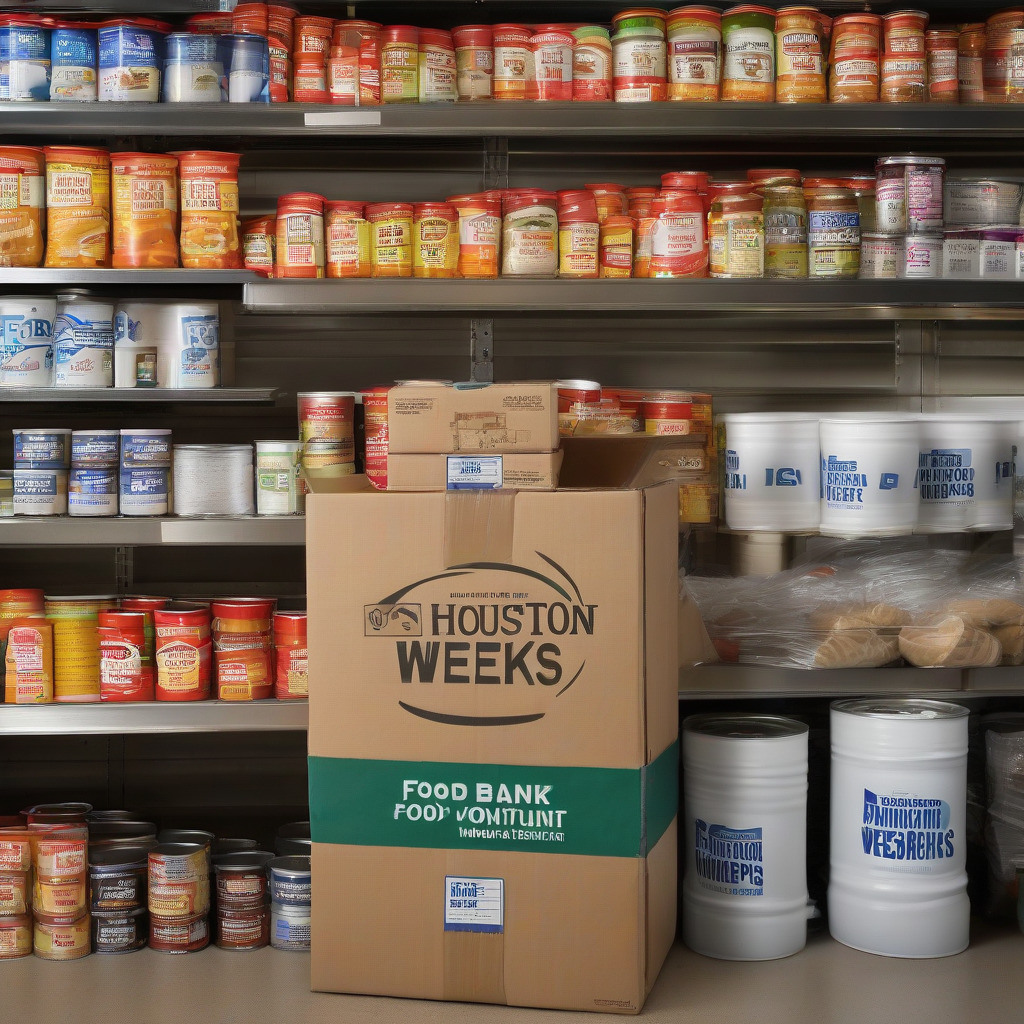
Every cover sold during HRW generates a donation to the Houston Food Bank: $1 per lunch or brunch cover, $2 per dinner cover. Per-cover amounts are modest, but across 250-plus restaurants running for 32 days at volume, they add up. Since 2003, HRW has raised more than $10 million for the Food Bank — making it one of the more productive single-month fundraising efforts any Houston nonprofit has generated. (CityDesk is seeking an updated cumulative total from the Houston Food Bank and will update this when confirmed.)
The Food Bank operates out of 535 Portwall Street in the East End and covers 18 counties across Southeast Texas through more than 1,500 partner agencies: food pantries, community kitchens, shelters. A pantry in Pasadena, a shelter in Galveston County. When HRW markets the charity component, it’s woven into the price, not a separate ask at checkout. The restaurant remits the per-cover amount from the prix-fixe price. Your job is to show up and eat.
The Price Tiers and Whether They’re Actually a Good Deal
Historically, HRW has offered lunch at roughly $20–$25 for a multi-course meal, brunch around $25, and dinner at three tiers — $35, $45, and $55 — corresponding loosely to where the restaurant sits in the market. The 2026 figures need organizer confirmation. Pricing has crept upward modestly over the program’s history, tracking Houston’s broader menu inflation, and it’s reasonable to expect the tiers to hold near these numbers.
Whether any specific HRW offer represents value depends almost entirely on which tier and which restaurant you’re looking at. Houston’s top independent dining rooms at the $55 dinner tier regularly run $80 to $120 per person before wine on a normal Friday. At $55 for a structured multi-course menu, the math strongly favors the diner. At the $35 tier, you’re often looking at restaurants where a normal dinner runs $40 to $60 anyway, so HRW is less a discount than a menu-simplification exercise. The value is access to a curated experience, not necessarily price reduction.
The lunch tier is the most straightforward. A $20–$25 three-course lunch at a restaurant charging $15–$18 for an entrée normally is a genuine deal — if the kitchen actually executes it. Some do. Some deploy their B-team on lunch service and it shows in the plate.
The honest advice: look at the menu when it posts on the HRW site. A kitchen that takes the promotion seriously posts a menu that reads like a real representation of their cooking. A kitchen going through the motions posts three proteins, two sides, and a chocolate lava cake. The menu tells you everything. You can spot a checked-out kitchen from the PDF.
The Operator’s Calculation — Why Restaurants Join, and Why Some Don’t
August is brutal for Houston restaurants. Summer heat, vacation travel, school transitions — it’s one of the slowest months on the dining calendar, full stop. HRW manufactures demand during a period when operators would otherwise be staring at half-empty rooms. The promotional infrastructure — a working directory, media coverage, social amplification — costs a restaurant nothing out of its own marketing budget. That matters.
But participation has real complications.
A kitchen locked into a fixed price point has to engineer a three-course menu it can execute at volume without destroying the margin. That’s doable — it’s menu engineering, which any experienced chef can handle — but it requires actual planning. Restaurants that treat the HRW menu as an afterthought often find they’ve sold themselves into a month of break-even on those covers. Then there’s the participation fee, which HRW charges operators for the directory listing. The exact 2026 figure isn’t confirmed and we won’t speculate on a number we can’t verify. What operators report consistently: the fee is real, not trivial, but the marketing reach — HRW’s established media relationships and diner audience — justifies it for kitchens that planned their menus with enough margin discipline.
The question veteran operators watch most closely is whether HRW diners return at full price. Experienced participants say a strong HRW experience builds repeat customers. An overwhelmed kitchen and thin service on a prix-fixe night can train a new diner to stay home permanently. That’s the actual risk — not the math on a single cover, but the long-term impression on someone who’s never been to your restaurant before.
Some operators raise a separate concern: heavy prix-fixe volume might condition a subset of diners to expect discounted pricing, making it harder to convert them to full-margin visits later. The counterargument — and veteran participants tend to make it — is that the HRW diner base and the regular full-price base are largely different populations. HRW is customer acquisition, not discounting your existing audience. I find that argument mostly convincing, though I’d want to see a specific restaurant’s repeat-visit data before calling it settled.
First-Timers vs. Veterans: A Different Calculation
Restaurants that opened in 2021, 2022, or 2023 are approaching HRW 2026 with a different set of questions than an established Midtown fine-dining room that has run the promotion fifteen times.
The upside for newer operators is real: HRW is probably the fastest way to put a new restaurant in front of a large number of diners who are actively looking for somewhere to go. A well-designed menu executed at volume can accelerate brand-building by months.
The risk is also real, and here I’d push back on anyone who tells first-timers to just dive in. A volume spike a small kitchen isn’t staffed to absorb doesn’t just produce a bad night. It produces a bad Yelp review that sits in your search results permanently. Heights and EaDo operators, where dining rooms tend to be smaller and culinary-worker attrition since 2020 has been substantial, face this most acutely.
The advice experienced operators give new participants is consistent: participate at a level your kitchen can actually execute, not the level you aspire to. A strong $35 menu delivered cleanly builds more long-term business than a $55 menu delivered badly. Cap your reservation exposure. Every reservation platform HRW participants use allows operators to limit covers during the promotion period — use that feature, and don’t let the excitement of a full calendar override what your actual staffing can handle.
A Neighborhood Guide to Where HRW Actually Plays Out
Houston’s dining geography shapes how HRW unfolds on the ground, and knowing which neighborhoods to target is more useful than scrolling an alphabetical participant list. In our food & hospitality coverage, we return to this geography repeatedly because Houston’s restaurant landscape is genuinely decentralized in ways that matter to both operators and diners.
Montrose is the independent restaurant heartland of Houston’s HRW participation. Chef-driven, mid-sized dining rooms — the kind that built their audiences on quality rather than marketing spend — make it the strongest cluster for diners who want to discover something genuinely new. Expect variety across price tiers. The most sought-after rooms fill fast.
River Oaks and Upper Kirby concentrate the $55-tier fine dining. These are the restaurants where HRW’s value proposition is clearest: places where a normal dinner for two runs $200-plus before wine, and where a $55 prix-fixe is a real window into what the kitchen does. Reservations here vanish first. If a specific room in this corridor is on your list, book the day the participant list drops. Not the next day. That day.
Midtown offers larger dining rooms, often hotel-adjacent, with more walk-in flexibility and easy access to Wortham Center for diners pairing dinner with a performance. The neighborhood’s mix of national chains, local operators, and hotel F&B makes HRW menu quality more variable than elsewhere. Worth a little research before committing.
The Heights presents the post-pandemic new-operator cohort discussed above: smaller spaces, tighter staffing, potentially higher reward if you find a kitchen executing well under volume pressure. Worth researching before booking, not just browsing on a whim.
Sugar Land and The Woodlands participate meaningfully every year and consistently get less attention than they deserve in HRW coverage. They serve a real purpose — capturing diners who won’t drive inside Loop 610 on a Tuesday night but want the same structured dining experience. Suburban participants tend to run larger-format rooms with easier late-booking availability and often represent solid value at the dinner tiers.
When to Book — and What Won’t Wait
Small River Oaks dining rooms — 40 to 60 seats, a couple of prime-time windows per night — historically fill within a day or two of the participant list going live. If you want a specific table at a specific restaurant in that tier, you need to be watching the HRW site the day the list is announced. This is not a strategy for someone who decides Thursday where they’re eating Saturday.
Popular Montrose independents with strong social followings fill nearly as fast for Friday and Saturday nights. Weeknight availability is more forgiving — Tuesday and Wednesday reservations at these restaurants can often be made a week or two out. Hotel dining rooms, larger Midtown restaurants, and suburban participants have more capacity. You can book a week out at most of these, and some take walk-ins during slower lunch service.
One practical note on August in Houston, because it genuinely affects your evening: the heat index routinely exceeds 100 degrees through 7 p.m. Patio dining in August is an exercise in either very early timing or accepting you will be warm — not “a little stuffy,” genuinely warm. If you’re targeting restaurants with outdoor seating along West Gray or the patio-dependent spots in EaDo, think about your reservation time. Six o’clock or after 8:30 is tolerable. Seven p.m. on an uncovered patio is a commitment most people regret about ten minutes in.
What Operators Need to Know Before Registration Closes
Registration opens well before August — in recent years, several months before the program starts. The participation fee is paid at registration. Operators submit their prix-fixe menus for review, and the organizer maintains quality standards: menus have to be genuine representations of the restaurant’s cooking, not a stripped-down budget version designed to hit the price point on paper.
One requirement that catches some first-time participants off guard: vegetarian options have historically been required at each prix-fixe tier. CityDesk is confirming whether that requirement remains in effect for 2026. Verify directly with the organizer before finalizing menus.
In exchange for participation, restaurants get a directory listing, inclusion in the organizer’s media and social campaigns, and access to HRW’s promotional assets. Stone’s organization drives traditional media coverage — television, radio, print — that individual restaurants would struggle to generate on their own. The marketing support is real. It’s also directory-level marketing. The restaurant is still responsible for its own reservations, its own content during the promotion, and its own execution on the floor. HRW gets you in the room. What happens next is entirely on you.
For operators weighing a broader set of business decisions alongside HRW participation, the staffing and cost considerations covered in what Houston businesses actually pay for a PEO are relevant context — particularly for newer operators trying to manage culinary-worker costs heading into a high-volume month.
For registration timelines, fee structures, and menu submission requirements, contact the organizer directly at HoustonRestaurantWeeks.com. Don’t rely on third-party summaries — including this one — for specifics. The authoritative source is the organizer.
What’s Still Unconfirmed
A piece published in June about an August event has gaps. Here’s what CityDesk has not confirmed as of this writing:
Official 2026 dates. The August 7–September 7 window reflects pattern, not organizer confirmation.
2026 price tiers. Historical tiers are reported here; the organizer may adjust.
Registration deadline and fee structure. Require direct confirmation from HRW.
Cumulative fundraising total. The $10 million-plus figure is based on available historical reporting; the current total should be confirmed with the Houston Food Bank or HRW directly.
Participant list. No restaurants have been confirmed as 2026 participants.
CityDesk will update this piece when the organizer announces official dates and when the participant list is published. We’ll also return with operator interviews as the program approaches — how specific Houston kitchens are thinking about the 2026 edition is a story worth telling separately. For the most current information: HoustonRestaurantWeeks.com.
Have a tip on a restaurant’s HRW participation decision, or are you an operator with a perspective on the business math? Reach the CityDesk Houston newsroom at the contact listed in our masthead.