Where to Get a Free Flu Shot in Houston This Fall If You Have No Insurance
Every September, the same thing happens. Someone without insurance searches for a free flu shot in Houston, clicks the first result, and lands on a CVS or Walgreens booking page that wants an insur…

Every September, the same thing happens. Someone without insurance searches for a free flu shot in Houston, clicks the first result, and lands on a CVS or Walgreens booking page that wants an insurance card. They try the next link. Same problem. Eventually they give up, skip the shot, and roll the dice on a flu season that routinely sends thousands of Houstonians to emergency rooms they also cannot afford.
This guide maps the actual no-cost network: Harris County Public Health Department clinics and mobile units, Federally Qualified Health Centers, and community events. It answers the questions the pharmacy pages never touch — whether you need ID, whether immigration status matters, what to do if a site turns you away.
September Is the Window, and Retail Pharmacies Won’t Help Most Uninsured Houstonians
Houston’s flu season peaks between December and February. A shot taken in September or early October gives your immune system time to build protection before the real pressure begins. Miss that window and you’re catching up to a moving target.
Here’s the frustrating part: search results for “free flu shot Houston” are dominated by CVS, Walgreens, and vaccine-finder aggregators that route to those same chains. At the counter, an uninsured adult at either chain pays cash — approximately $40 to $70 based on 2025 pricing, though readers should confirm current rates directly with Houston-area locations. You can spend twenty minutes clicking around pharmacy websites before you figure that out. I find that infuriating.
The Vaccines for Children program funds free vaccines at pharmacies and clinics nationwide, but it covers only patients through age 18. Uninsured adults don’t qualify.
What those search results largely hide is a separate infrastructure built specifically for uninsured Houstonians. Harris County Public Health runs immunization clinics and mobile units funded by federal Section 317 immunization grant dollars. Three Federally Qualified Health Centers with dozens of Houston locations provide flu shots at zero cost to patients at the lowest income tier. Community health workers reach people in Gulfton, Fifth Ward, and Sunnyside who never make it to a clinic at all. For more on where this city’s public health safety net extends, this topic sits squarely within our health & wellness coverage.
Harris County Public Health Department: County Clinics and Mobile Units
The Harris County Public Health Department immunization program is the broadest free-shot infrastructure in the region. It draws funding through Section 317 of the Public Health Service Act, which routes federal immunization dollars to state and county health departments to vaccinate uninsured and underinsured populations. The shot is free because that’s what the money is for — not a promotional offer or a limited-time program, but the intended use of federal dollars. The pharmacy experience trains you to expect a catch. There isn’t one here.
HCHD operates fixed immunization clinics across the county’s North, South, and East service areas. For fall 2026, the department’s clinics are expected to open flu shot availability in late September, consistent with their annual pattern. Weekday business hours with some Saturday availability is typical. Confirm current hours at hchd.net or by calling (713) 274-2200, since specific fall 2026 dates weren’t publicly posted at publication time.
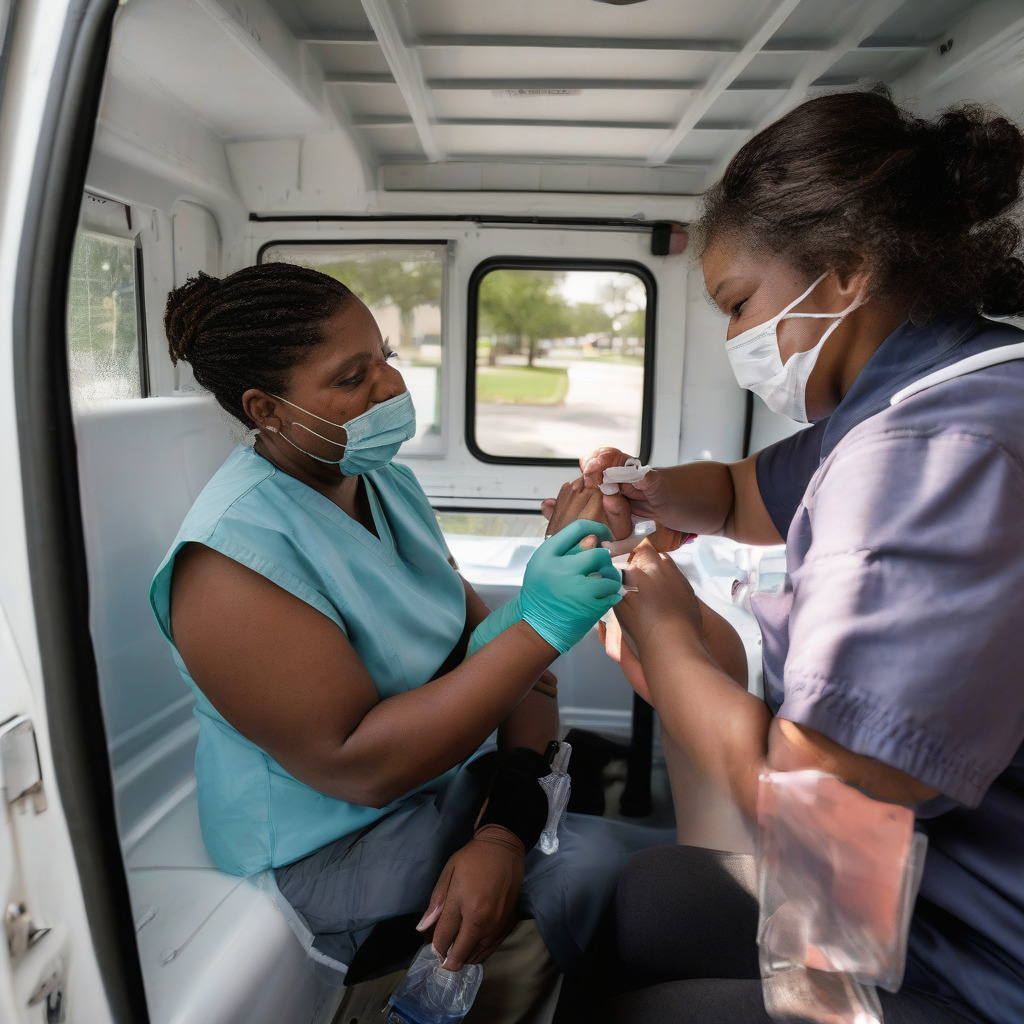
The mobile unit program reaches neighborhoods that can’t easily get to a fixed clinic. The department operates climate-controlled vans — not open-air tents or folding tables — which matters in a city where fall heat can be a real logistical obstacle to outdoor vaccination events. If you’ve ever sat through a health fair in Houston in late September, you know why this is worth noting. Mobile units historically prioritize ZIP codes with high uninsured rates: Fifth Ward, Sunnyside, East Houston, the Northside/Irvington area, and the Hobby corridor have all been regular stops.
One practical reality specific to Houston: HCHD’s September and October mobile schedule can be disrupted by hurricane season. If a storm makes landfall or forces county emergency operations into activation, some mobile unit dates will be postponed or rerouted. Real-time updates are at hchd.net. The department’s social media accounts post same-day changes as well.
FQHCs in Houston: Vecino, Avenue 360, and Legacy Community Health
Federally Qualified Health Centers operate under a different structure than retail pharmacies, and the difference matters before you show up — because once you understand it, a lot of the anxiety about whether you’ll actually be turned away at the door starts to dissolve.
FQHCs receive federal grant funding under Section 330 of the Public Health Service Act and are required by that funding to serve patients regardless of ability to pay, using a sliding-scale fee schedule based on income and family size. At the lowest income tier, the visit and the vaccine cost nothing. Not a reduced rate. Zero.
This works because of the 340B drug pricing program, which lets FQHCs purchase vaccines at federally mandated discounted prices — up to 50 percent below market rates. FQHCs pass that savings to uninsured patients. A retail pharmacy can’t offer a free flu shot to a walk-in adult because the purchasing economics are entirely different and there’s no community-benefit obligation written into their operating charter. That’s not a loophole. It’s the design.
Houston has three major FQHCs.
Vecino Health Centers operates in the Northside and Denver Harbor communities — two of Houston’s historically underserved Latino neighborhoods. Both sites have bilingual staff integrated into clinical operations, not just available on request. For flu shots, Vecino has historically accepted walk-in patients during normal clinic hours in fall. Calling ahead on high-demand days is worth doing. Reach Vecino at (713) 426-0027.
Avenue 360 Health and Wellness operates in Montrose, Midtown, and Near Northside, among other sites, serving a diverse patient population that includes significant immigrant and LGBTQ+ communities. Flu shot availability follows their standard immunization schedule beginning in September. Appointments are available but haven’t always been required for vaccine-only visits. Call (713) 661-9955 to confirm walk-in availability at the site nearest you.
Legacy Community Health is the largest FQHC in Harris County, with approximately 50 clinic locations across the Houston metro. That number buys you a lot in a sprawling city — Legacy has clinic presence in Sharpstown, the East End, Fifth Ward, Baytown, Pasadena, Sugar Land, and a dozen other communities. Their flu shot program is among the most organized in the region. Call (832) 548-5000 to find the site closest to your ZIP code.
All three will ask for income information at intake to determine your sliding-scale tier. It’s typically a brief self-reported form. You’re not required to bring documentation to prove what you report.
What You Need to Bring, and What You Don’t
This is the question that stops people from going. So let’s be direct.
At HCHD immunization clinics and mobile units: no Social Security number, no proof of insurance, no proof of residency, no government-issued ID. You’ll likely be asked for a name and date of birth for the vaccine record. That’s standard immunization registry practice in Texas, not a gatekeeping mechanism.
At Vecino, Avenue 360, and Legacy: same low bar. No immigration documentation required — FQHCs are federally prohibited from making immigration status a condition of care. No insurance card. You’ll be asked to self-report income to determine your sliding-scale rate, and you’ll need a name and date of birth for your patient record.
What’s helpful but not required: a current address helps the clinic pull prior records and aids follow-up. A phone number means they can reach you if there’s a scheduling issue. If you’ve had prior care at the same FQHC, your patient ID speeds intake.
That’s it. Name, date of birth. Show up.
If You Are Undocumented: What Houston’s Public Health Clinics Have Said
This section stands alone because the anxiety about it stands alone. For many Houstonians, the question isn’t whether a flu shot is available — it’s whether showing up at a clinic puts them at legal risk.
FQHCs are governed by the Health Resources and Services Administration, which explicitly prohibits conditioning care on immigration status or using patient information for immigration enforcement purposes. This isn’t a local policy preference — it’s a condition of the federal grant that funds every FQHC in the country. Vecino, Avenue 360, and Legacy all receive HRSA Section 330 funding. All three are bound by this prohibition. No exceptions.
Harris County Public Health and the Houston Health Department have historically operated their community immunization programs with a welcoming posture toward all residents regardless of immigration status. The city’s community health worker network, run through the Houston Health Department, exists specifically to reach residents reluctant to engage directly with government services. Community health workers are community members — they speak the language of the neighborhood they serve and can walk someone through the clinic experience before they ever set foot inside. That often makes the difference for someone who’s been burned by a bad institutional experience before. To connect with a community health worker, contact the Houston Health Department at (832) 393-5080.
Federal immigration enforcement priorities can shift, and I’m not going to pretend otherwise. What I can say is that HCHD immunization clinic sites and all three named FQHCs are healthcare settings, not immigration enforcement venues, and federal law constrains how patient information can be used.
If formal 2026 written statements from any of these organizations update their access policies, those statements will be noted in updates to this article.
Neighborhood by Neighborhood: Where Coverage Is Thinnest and Where to Go
Gulfton (77081, 77096). High uninsured rate, majority Latino population. The nearest FQHC options are Legacy’s Sharpstown clinic and Vecino’s Northside locations. HCHD mobile units have served this corridor in prior seasons. Check hchd.net for confirmed fall 2026 stops.
Fifth Ward (77020). Legacy’s Fifth Ward clinic is the most direct option. HCHD mobile units have consistently included this ZIP in their fall routes.
Sunnyside (77051). South Houston. HCHD mobile units have prioritized this neighborhood. Call ahead to confirm a mobile unit date before making the trip — a wasted trip across Houston on a hot afternoon is its own deterrent.
East End / Second Ward (77003, 77011). Legacy has clinic presence in the East End corridor. HCHD’s East service area covers it as well.
Northside / Irvington (77076). Vecino’s primary service area. Their Denver Harbor clinic on Navigation Boulevard is directly accessible for this community, bilingual, and walk-in friendly in fall. This is one corner of the city where the infrastructure actually matches the need.
Spring Branch (77055, 77080). Significant uninsured population, limited FQHC density relative to its size. Legacy has reachable locations, and the HCHD Northwest clinic serves parts of this area. Worth calling ahead before committing to a drive.
Acres Homes (77088). North Houston, high uninsured rate, majority Black and Latino community. HCHD North service area clinics cover this ZIP. Legacy’s North Houston locations are the closest FQHC option.
Denver Harbor (77020). Vecino’s Denver Harbor Family Clinic on Navigation Boulevard is built specifically for this community — predominantly Latino, working-class, uninsured. Walk-ins for flu shots have historically been accepted during fall immunization season.
Hispanic Heritage Month Clinics and Spanish-Language Resources
Hispanic Heritage Month runs September 15 through October 15 — exactly the window when flu shot availability peaks. That alignment isn’t accidental. The organizations that serve Houston’s Latino communities have figured out how to use it.
HCHD has historically partnered with community organizations in Gulfton, Northline, and the East End to hold Spanish-language flu clinics during this window. Vecino and Legacy both run additional community-facing events during this period, often in partnership with parish organizations and community centers.
Telemundo Houston and Univision Houston have aired flu vaccination public service announcements in prior seasons tied to this window. La Raza has run Spanish-language public health segments as well. Check those stations’ community calendars beginning in early September for confirmed 2026 media partnerships.
All three FQHCs have Spanish-speaking clinical and intake staff at their core service-area clinics. HCHD mobile unit teams have historically included bilingual community health workers. Any caller who reaches an English-speaking staff member at these organizations can ask for a Spanish interpreter — all are equipped to provide one.
What Retail Pharmacies Will and Won’t Do
CVS and Walgreens aren’t the villain here. They’re built for a different customer.
Both chains offer flu shots in September, and if you have insurance, most plans cover the shot at zero cost at either chain. The problem is that the uninsured adult has no equivalent path. At Houston-area CVS and Walgreens locations, uninsured adults pay cash — check current pricing directly with the location before you go, since rates change. Neither chain has a blanket free-shot program for uninsured adults, and no federal program covers uninsured adults at retail pharmacy counters the way Vaccines for Children covers kids.
CVS and Walgreens don’t purchase vaccines under the 340B pricing available to FQHCs, and they don’t carry the community-benefit obligation written into FQHC status. The economics simply don’t allow a zero-cost shot to walk-in uninsured adults as standard practice. That’s worth understanding so you stop wasting time on their websites.
One complication worth knowing: some Houston CVS and Walgreens stores have participated in community vaccination events in partnership with local health departments, at which no-cost shots are available. These are event-specific, announced through HCHD or the partnering organization rather than through pharmacy websites. Watch HCHD event calendars for any such partnerships this fall.
To check whether any pharmacy is a 340B covered entity, HRSA maintains a public database at hrsa.gov/opa.
Walk-Ins, Scheduling, and What to Do If You Get Turned Away
HCHD fixed immunization clinics accept walk-ins during posted clinic hours. Mobile units do too — but arrive early. Sessions have set departure times and supplies are finite per stop.
Legacy has historically made walk-in flu shots available at most locations. Call (832) 548-5000 to confirm same-day vaccine availability before traveling, especially if the site is across town.
Vecino has generally accepted walk-ins for vaccine-only visits during flu season. Call (713) 426-0027 to confirm on high-demand days.
Avenue 360 prefers appointments but has typically accommodated walk-ins for vaccine-only visits. Call (713) 661-9955 first.
All policies above reflect historical operating patterns. Confirm fall 2026 policies directly with each organization before traveling.
At high-volume community clinic sites, flu vaccine supplies historically thin in late November. If you’re reading this in October or November, don’t assume the window is closed — but call ahead rather than making a trip that results in a turned-away visit.
A legitimate FQHC cannot turn you away for inability to pay. That’s a condition of their federal funding. If an FQHC site does — citing inability to pay or refusing to apply sliding-scale fees — contact HRSA’s Bureau of Primary Health Care to report it. For HCHD clinics, call (713) 274-2200. Don’t just absorb that experience and walk away. Document it.
September and October overlap with the most active part of hurricane season. If Harris County enters emergency operations mode, HCHD immunization events — mobile units especially — may be postponed or rerouted. Check hchd.net for day-of status. For residents managing chronic conditions during storm disruptions, preparing medications and medical supplies for hurricane season covers what to stockpile and how to plan. Legacy’s distributed network of roughly 50 locations is the most resilient fallback in a disruption scenario; it’s unlikely all locations would be closed at once.
The short answer for anyone who arrived here with one question: walk into a Legacy Community Health clinic, a Vecino site, an Avenue 360 location, or an HCHD immunization clinic. Bring your name and date of birth. Tell them you’re uninsured. You will get the shot.
Verification checklist: HCHD confirmed 2026 mobile unit routes and fall clinic schedule, (713) 274-2200; Vecino walk-in flu policy fall 2026, (713) 426-0027; Avenue 360 walk-in and appointment policy, (713) 661-9955; Legacy flu shot availability and walk-in status, (832) 548-5000; any formal 2026 immigration access statements from named FQHCs or HCHD; current uninsured cash price at CVS and Walgreens Houston locations; confirmed Hispanic Heritage Month clinic events from HCHD or FQHC communications teams.