What Houston Homeowners Are Actually Paying for Slab Foundation Repair in 2026
August is peak season for foundation calls in Harris County. Here is what the three main repair methods cost, what drives the differences between bids, and the specific contract language that shoul…

August is peak season for foundation calls in Harris County. Here is what the three main repair methods cost, what drives the differences between bids, and the specific contract language that should stop you cold before you sign.
If you’ve noticed a door that won’t latch, a diagonal crack running from the corner of a window toward the ceiling, or a floor that feels subtly off-level, you’re not imagining things. Every August, foundation contractors across Harris County report their highest call volumes of the year. The phones were ringing hard again this summer — and if you’re reading this, you’ve probably already made one of those calls, or you’re close to it.
This piece gives you what no contractor website will: independent price benchmarks broken down by method and pier count, a clear explanation of what drives cost differences between bids, and the specific contract language that should stop you cold before you sign.
Why August Is the Worst Month for Houston Foundations
The mechanism is worth understanding before you spend a dollar. Houston sits atop a thick belt of expansive Vertisol clay — the Houston Black, Lake Charles, and Beaumont series — that behaves unlike almost any other urban soil in the country. During wet periods, this clay absorbs moisture and swells. During drought and summer heat, it shrinks, sometimes dramatically, pulling away from the edges of concrete slabs and removing the uniform support those slabs were poured to rest on.
What you see inside the house is the result of differential movement. One part of the slab drops slightly relative to another, and the structure on top reflects that distortion. Doors stick. Drywall cracks appear diagonally from door and window corners, following the stair-step pattern of mortar joints in brick or a straight diagonal slash across drywall. Floors slope in ways that weren’t noticeable six months ago.
Spring rains complicate the picture — and this is the part that trips up a lot of homeowners. A wet April and May can re-swell the clay, temporarily closing cracks and making doors operate smoothly again. Homeowners conclude the problem resolved itself. It hasn’t. The slab moved twice, and the second movement rarely returns it to exactly the original position. Houston’s 2022–2023 drought accelerated a multi-year soil moisture deficit across Harris County that one wet spring cannot fully reverse.
Neighborhoods that flooded repeatedly during and after Hurricane Harvey face a compounding problem. The wet-then-dry cycles in Meyerland, Westbury, and parts of Bellaire have been more severe than in areas that stayed dry. Repeated saturation followed by accelerated drying has put those slabs through more clay movement cycles than comparable homes elsewhere in the county.
Which Houston Neighborhoods Sit on the Worst Soil
Soil mapping and contractor call-volume data tell the same story.
Meyerland (77096) sits on deep Houston Black clay — a Vertisol profile that extends well below the surface. The housing stock is almost entirely 1950s and 1960s slab-on-grade construction, built before builders fully understood what the local soil would do over decades. Add the flooding history and you have soil moisture cycling as severe as anywhere in Harris County. Contractor call frequencies in Meyerland during August rival those of any area in the Houston metro.
Westbury (77035) shares the same soil profile and the same mid-century construction vintage. Foundation companies planning their peak-season dispatch schedules cite the two neighborhoods in the same breath. They’re effectively the same problem, street to street.
Oak Forest (77018) adds a variable the others don’t carry at the same scale: a dense canopy of mature oaks. Tree roots extend far beyond the drip line and extract soil moisture aggressively, accelerating the localized shrinkage around slab edges that triggers differential settlement. The 1950s ranch homes in Oak Forest were built without the tree canopy those lots now carry. A homeowner in Oak Forest may see more severe foundation movement in a single drought cycle than a comparable property in Meyerland — most people don’t realize this until they’re comparing bids with a neighbor two zip codes over and wondering why the numbers are so different.
Spring Branch (77055 and 77080) shows up on contractor lists for the same soil and housing-age reasons, with the added complication that some properties span the transition between Houston Black and adjacent clay series. Soil behavior becomes less predictable lot to lot. A contractor quoting two adjacent homes on opposite sides of a soil boundary may recommend entirely different repair approaches — which is one reason “my neighbor paid X” comparisons break down in Spring Branch more than almost anywhere else in the city.
The western suburbs — Katy, Sugar Land, and much of Pearland — sit on different soil profiles that, while containing clay, don’t exhibit the same shrink-swell behavior. Foundation problems exist there. The frequency and severity differ markedly from inner Harris County. And for readers in the Heights, Montrose, or Woodland Heights: most homes in those corridors rest on pier-and-beam construction, not slab-on-grade. The repair methods and costs are an entirely different conversation.
If you want to check the specific soil classification under your address, use the USDA Web Soil Survey at websoilsurvey.sc.egov.usda.gov. It allows parcel-level lookups. Enter your address, draw a small area of interest around your lot, and look for the dominant map unit. If you see Houston Black or Lake Charles clay in the results, you’re in the high-shrink zone. It takes about five minutes and costs nothing.
The Three Repair Methods Houston Contractors Actually Use
They are not interchangeable. Understanding what you’re buying before you start comparing bids matters.
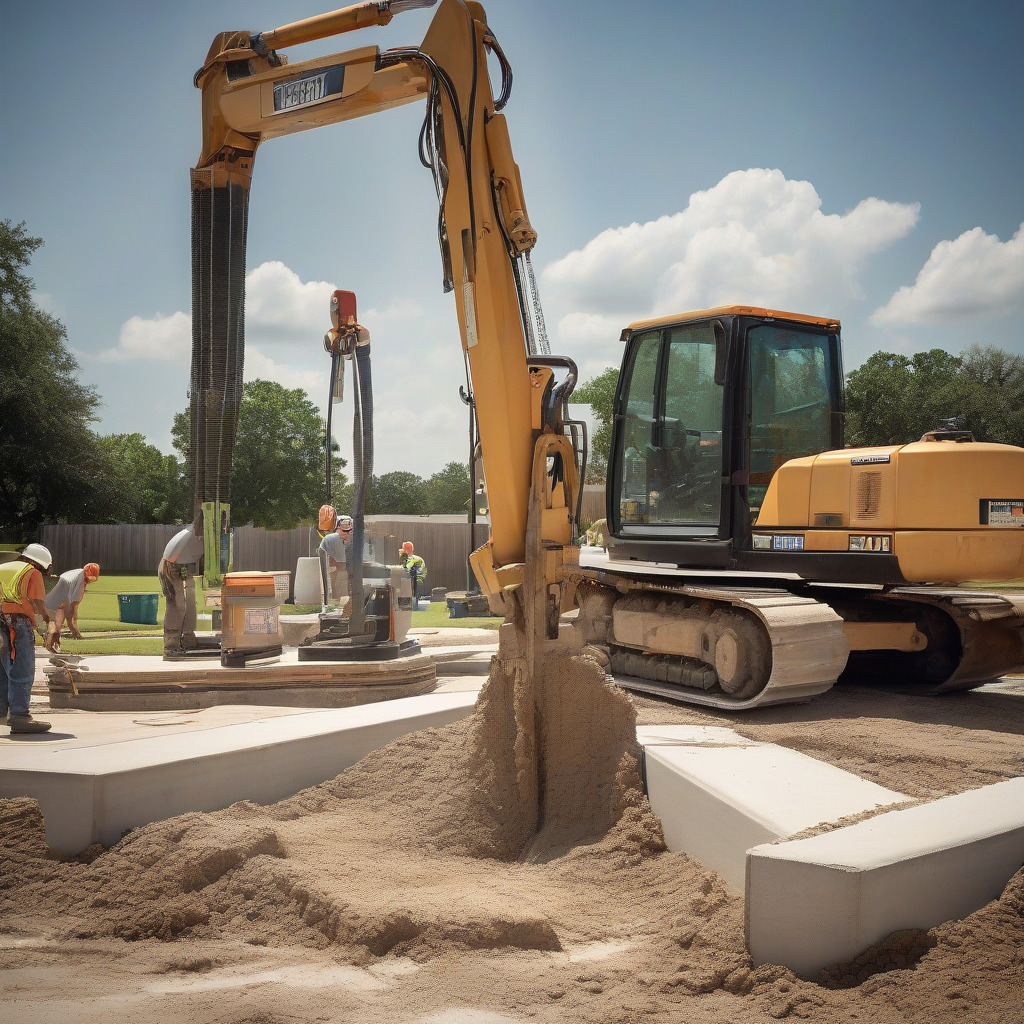
Pressed concrete pilings are what most Houston homeowners encounter in a first bid. Hydraulic equipment presses precast concrete cylinders into the ground in stacked columns beneath the slab edge until they reach refusal — resistance from a harder layer below the problem zone. The process is relatively fast and doesn’t require large excavation pits. Material cost per pier is lower than steel. They dominate residential repair work in Houston by volume.
Steel piers go deeper and attach more definitively to load-bearing soil. Installation takes longer, requires heavier equipment, and costs roughly two to three times as much per pier. Contractors and structural engineers typically recommend them for more severe settlement, heavier masonry construction, or situations where adequate refusal can’t be achieved with pressed pilings in a particular soil profile. A recommendation to use steel piers should come with a clear written explanation of why the specific soil or structural conditions warrant it — not a vague assertion that they’re “better” or “what we use on nicer homes.” That kind of pitch is worth probing.
Slab grouting and polyurethane foam lifting involve pumping material beneath the slab to fill voids or lift settled concrete. Foam lifting works for concrete flatwork — driveways, sidewalks, pool decks, garage floors — and for filling voids where the issue is genuinely a void rather than structural settlement. It is not a substitute for pier work on a foundation where the clay beneath has shrunk away. If a company’s first and only recommendation for a visibly settled home is foam injection, ask hard questions before you commit. That recommendation occasionally makes sense. More often, it’s a lower-cost pitch designed to close the sale.
One issue separates competent contractors from dangerous ones. Many Houston homes built after 1985 have post-tensioned slab construction — the concrete contains high-tension steel cables under load. Drilling through a post-tension cable is a genuine structural failure, not a minor error. Any contractor who doesn’t ask about your home’s construction date, doesn’t mention post-tension slabs, or doesn’t recommend a ground-penetrating radar scan before drilling on a post-1985 home is not running a safe operation. This disqualifies them. Full stop.
What Houston Foundation Repair Costs in 2026
The figures below reflect current Houston market pricing. Because contractor pricing shifts with material costs, scheduling demand, and individual firm practices, get at least three written bids before signing anything. Use these ranges to assess whether a quote is plausible — not as a substitute for live bids.
Pressed Concrete Pilings — The Most Common Houston Repair
Pressed concrete pilings are priced per pier, and pier count is the primary driver of your total.
| Scope | Per-Pier Range | Estimated Total |
|---|---|---|
| 10-pier job (moderate perimeter repair) | $450–$700 | $4,500–$7,500 |
| 20-pier job (full perimeter plus some interior) | $450–$700 | $8,500–$14,000 |
These totals cover basic perimeter pier work and don’t include common add-ons. Interior piers — where the contractor tunnels beneath the slab from outside — carry an additional surcharge of $300–$500 per pier in labor. A post-repair plumbing pressure test runs $200–$400 and should appear on any bid involving piers near plumbing lines. If your home was built after 1985, a GPR scan to locate post-tension cables before drilling costs an additional $300–$600 where not included in the base bid.
Houston-area firms with significant market presence in pressed piling work include RAM Jack Texas, Olshan Foundation Solutions, Foundation Support Specialists, and HD Foundations, alongside several active independent operators. Get bids from at least one major regional operator and one or two independent firms. The spread between them can be significant — and the reasons for that spread are worth understanding before you default to the lowest number.
Steel Piers
| Scope | Per-Pier Range | Estimated Total |
|---|---|---|
| Per pier | $800–$1,500 | — |
| 20-pier equivalent scope | — | $16,000–$30,000 |
Steel pier bids often include GPR scanning and plumbing retesting in the base price. When comparing a steel pier bid to a pressed piling bid, confirm what’s bundled in each. A steel pier quote that looks outrageously higher may include items the pressed piling quote charges separately. Do the like-for-like comparison before deciding the difference is just markup.
Slab Grouting / Polyurethane Foam Lift
For concrete flatwork or genuine void fill, mudjacking costs $500–$1,500 for a typical repair area. Polyurethane foam injection runs $1,000–$3,000, cures faster, and is lighter. Neither method works as a standalone fix for structural slab settlement caused by clay shrinkage. Right tools for flatwork. Wrong tools for a foundation with significant differential movement. Worth repeating because the upsell pitch for foam on a settled foundation is common enough that you’ll probably hear it.
What Actually Drives the Final Number on Your Bid
When two bids for the same house come back thousands of dollars apart, here’s where the differences typically live.
Pier count is the primary driver. A contractor quoting 12 piers versus 18 piers on the same home isn’t just giving you a lower price — they’re proposing a different amount of work. A pier count that seems low for your home’s perimeter footage isn’t a deal; it may be an incomplete repair that leaves you calling them back in three years. Ask any contractor to walk you through their pier placement logic on a sketch of your foundation. If they can’t or won’t, move to the next bid.
Interior versus perimeter piers carry a meaningful surcharge. Accessing the interior of a slab requires tunneling from outside, adding $300 to $500 per pier. A bid that doesn’t mention interior piers for a home with central sag may be omitting necessary work — and that omission will show up in your floors after the job is done, not before.
Post-tension GPR scan. Budget $300 to $600 if it’s billed separately. Some larger contractors include it in the base bid. If your home was built after 1985 and no one mentioned this during the site visit, ask directly. The response will tell you something.
Plumbing pressure test. A post-repair test confirming the work didn’t disturb existing pipes runs $200 to $400. Ask whether it’s included or available as an add-on. If a contractor says it’s unnecessary, ask for a specific explanation. Listen carefully.
Access complications — landscaping removal, concrete flatwork over pier locations, AC condenser pads requiring temporary relocation — vary widely and are bid at contractor discretion. These items should be itemized, not bundled into a vague line. A contractor who groups them under “miscellaneous” without detail is asking you to sign blind. Push back on that.
An independent structural engineer evaluation is worth getting before signing any contract above $5,000. You get a third-party pier count recommendation, a placement map, and a professional opinion that is not financially tied to whether you hire any particular contractor. Contractors who push back hard against this are the ones for whom outside scrutiny is most inconvenient. That reaction alone is useful information. Licensed structural engineers with residential foundation experience in Houston can be found through the Texas Structural Engineers Association (TSEA). As part of our home & property coverage, we’ve noted repeatedly that an independent engineer’s review on large-ticket repair work is among the highest-value steps a Houston homeowner can take before signing.
What Your Foundation Repair Warranty Should Actually Say
The warranty section matters as much as the price. Read it before you sign, not after.
The current market standard from established Houston contractors is a lifetime transferable warranty on pressed piling and steel pier work. Any warranty shorter than 10 years on both parts and labor needs a written explanation before you commit.
Transferability means the warranty conveys to a subsequent owner. This has real dollar value at resale — a non-transferable warranty is worth considerably less the day you list the house. A reasonable transfer fee is around $100 to $150. Fees well above that are a negotiating point. Some contracts require notification of transfer within 30 days of sale and void coverage if you miss the window. Miss a 30-day window during a busy closing and you’ve just voided the warranty that was supposed to protect the buyer. Read that provision carefully.
Return-trip coverage for continued settlement must explicitly state that the contractor will return and install additional piers at no charge if the repaired area continues to move beyond a defined tolerance. Vague language about “monitoring” or “adjustment” without specifying what triggers a return trip — and what that trip includes — is not adequate coverage.
Several warranty clauses warrant rejection outright. Any warranty voided by “any structural modification to the home” is broad enough that adding a room, replacing a roof, or installing a new HVAC system could theoretically terminate coverage. Demand language tied specifically to modifications that directly affect the repaired area. A labor-only warranty after the first year — where materials are covered for life but labor is excluded after 12 months — means return trips cost you money. This is common in lower-tier contracts and easy to miss if you’re skimming.
Watch for warranties held by a subsidiary LLC rather than the operating company. Some foundation repair firms structure warranties through subsidiaries that can be dissolved before you ever need to file a claim. Ask who exactly is the warranting entity and whether it’s the same entity that will be operating in 15 years. If the contract routes warranty disputes to a specific arbitration service that’s expensive for a homeowner to access, an attorney familiar with Texas construction law can review that language for a modest flat fee. On a $12,000 job, that’s money worth spending.
Does Homeowners Insurance Cover Foundation Repair in Texas
Almost certainly not. Standard Texas homeowners policies — both the HO-3 and HO-A forms that most Harris County homeowners carry — explicitly exclude damage caused by soil movement, settling, shrinkage, or expansion. The Texas Department of Insurance has confirmed this is standard policy language. The exclusion was written specifically to cover what happens to Houston slabs every August. If a contractor suggests your foundation claim is likely to be covered, they’re either misinformed or telling you what you want to hear.
Two narrow exceptions exist. A sudden accidental plumbing leak — an acute failure, not gradual deterioration — can trigger coverage if the resulting water loss causes localized foundation damage. An adjuster will scrutinize whether the pipe failure was sudden or the result of ongoing deterioration, and gradual leaks are excluded. If you have any reason to believe a plumbing failure is contributing to your foundation problem, document it thoroughly with a pressure test before and after repair.
For Meyerland homeowners and others in mapped flood zones carrying National Flood Insurance Program coverage, flood-related foundation damage may be covered under that separate policy — specifically for homes that sustained damage in direct connection with a documented flood event. This is not a general workaround for clay shrinkage.
Budget for full out-of-pocket costs. A 20-pier pressed piling job in inner Houston falls in the $8,500 to $14,000 range before add-ons, with no insurance offset in the typical case. If you’re also weighing whether current market conditions affect how much you can absorb in repair costs before deciding to sell, what the Houston housing market actually looks like at mid-year 2026 is useful context for that calculation.
Permits, Paperwork, and Why Skipping Them Costs You at Resale
Foundation pier installation generally requires a City of Houston building permit. The permit fee is nominal — typically $75 to $200 depending on project scope. The associated inspection is where the actual value sits: a city inspector reviewing pier placement and depth provides an independent check on work quality that you don’t otherwise get.
Many contractors skip the permit. Ask directly, before hiring, whether your specific job will be pulled with a permit. Ask to see the permit document before work begins. If a contractor says permits aren’t required for their type of work, confirm that independently with Houston’s Development Services Department. Don’t take a contractor’s word on the contractor’s regulatory obligations.
Texas real estate law requires disclosure of known material defects, and unpermitted structural work qualifies. Buyers’ inspectors flag it consistently. A buyer who discovers unpermitted foundation work post-inspection can demand a price reduction, demand retroactive permitting, or walk. The short-term convenience of a contractor who skips permits becomes your liability at resale. It will come up. It always comes up.
For homes in unincorporated Harris County outside city limits, requirements differ — check with Harris County’s Permits office for the specifics.
To verify whether a contractor has historically pulled permits on past Houston jobs, search the City of Houston’s permit database through the Development Services portal by contractor name or license number. A contractor with a long Houston history and no permit records on residential foundation work has been routinely skipping the step. That’s probably not the only shortcut they take.
For post-tension slabs or larger jobs, the city may require a licensed structural engineer’s stamped plan as part of the permit application. Another reason the GPR scan and the engineer evaluation aren’t optional on a post-1985 home — they may be required before the permit is even issued.
How to Read a Houston Foundation Bid Before You Sign
Work through this against the actual bid document — not the estimator’s verbal assurances during the site visit.
Pier count rationale. Ask the contractor to show you, on paper, where piers are being placed and why. If the count seems low for your home’s perimeter footage, ask for a written explanation of the spacing logic. A vague answer is a reason to move to the next bid.
Post-tension slab acknowledgment. If your home was built after 1985 and the bid doesn’t mention post-tension status, doesn’t include or recommend a GPR scan, or the estimator didn’t ask about your home’s construction date during the site visit — stop. That omission disqualifies the contractor. No exceptions.
Plumbing retest. If it’s not on the bid, ask whether it’s included. If the contractor says it’s unnecessary, ask for a specific explanation. Listen carefully to that answer.
Payment terms. A deposit to schedule the job is reasonable. Any demand for a large share of the total before work begins is a red flag. Payment of the balance upon completion — and your satisfaction — is standard practice for established contractors. If they push back on this, ask why.
Warranty entity and transferability. Confirm the warranting entity is the operating company, not a subsidiary. Confirm the transfer fee and the transfer process in writing.
Permit commitment. Ask directly: will you pull a City of Houston permit for this job? Get it in the contract as a written term. A verbal assurance is worth nothing if the inspector never shows up.
Independent structural engineer evaluation. For any substantial contract — most jobs beyond a handful of piers — the cost of an independent engineer’s assessment is justified. The engineer provides a pier count recommendation, a placement map, and a professional opinion that is not financially tied to the outcome. Find licensed structural engineers with residential foundation experience through the Texas Structural Engineers Association (TSEA). If a contractor actively discourages you from getting an independent opinion, pay close attention to that reaction. A home inspection that covers what many inspectors skip is worth scheduling before you finalize any repair plan — a thorough inspector will often flag foundation issues alongside the plumbing, roofing, and structural items that compound the problem.
The foundation repair industry in Houston has capable operators and exploitative ones, and the bid in front of you doesn’t announce which category it came from. The price matters. So does the pier count, the warranty language, the permit commitment, and whether anyone mentioned the words “post-tension” during the site visit. Use every section of this article before you sign anything — especially the warranty section, which most homeowners read last and too quickly.