Heat Index 108°F and the Patio Is Still Open. Here's What That Actually Costs.
Houston operators are running misting rigs, shifting service windows, and spending tens of thousands on shade structures to hold onto outdoor revenue through the worst summers in the country. Here'…

Houston operators are running misting rigs, shifting service windows, and spending tens of thousands on shade structures to hold onto outdoor revenue through the worst summers in the country. Here’s the honest breakdown.
On a Wednesday evening in late July, the heat index at a Westheimer patio read well above 100°F at 6 p.m. The patio was closed. By 7:45 p.m., it had eleven tables seated. The manager hadn’t changed the thermostat. The sun had simply moved.
That’s not unusual in Houston right now. Across Montrose, the Heights, Midtown, and Washington Avenue, a quiet operational reckoning is underway at restaurants and bars that built or expanded outdoor seating during the pandemic and now have to figure out how to make those seats earn revenue in July instead of just October. The solutions run from high-pressure misting infrastructure that costs upward of $8,000 to install to reprinting the reservation sheet with a 7:30 p.m. floor for patio covers. All of it is more complicated and more expensive than the Instagram-ready pergola photos suggest.
This is the operational reality of running a Houston patio in summer: what it costs, what works, what doesn’t.
The Math That Forces the Investment
Houston restaurant operators didn’t build patios during 2020 and 2021 because they wanted to. They built them because indoor capacity restrictions made outdoor seating the only path to revenue. Operators who added 20, 30, or 40 outdoor covers during that period now carry those seats on their operating models permanently — paying for infrastructure, furniture, outdoor lighting, quarterly pest treatments, and in many cases a commercial lease amendment that added square footage to the footprint. A patio that represents 25 percent of total covers can’t simply be roped off from Memorial Day to mid-September without hemorrhaging revenue, without making the fixed costs of that infrastructure look absurd on the P&L.
“We can’t just close it,” said one Montrose bar operator who asked not to be identified. “I’ve got money in a shade structure and a pergola out there. If I close that for four months, I’m paying for something that earns nothing. The math doesn’t allow it.”
That math is the engine driving every investment in this story. The operator who installed $12,000 in shade infrastructure isn’t making a cooling decision. They’re making a financial one. There’s no sentimentality in it — just fixed costs that don’t care what month it is.
When a Houston Patio Actually Becomes Unusable
The National Weather Service Houston office tracks heat index as the operative measure of human heat stress — the combination of air temperature and relative humidity that determines how hot it actually feels outdoors. Houston’s average July high is 94°F. In the urban core, average July afternoon heat index readings run between 105°F and 108°F, with individual days spiking well above that.
The practical threshold most operators have landed on, through trial and error and the brutal feedback of watching tables empty, is somewhere around 100°F heat index. Below that, with adequate shade and air movement, many diners will tolerate outdoor seating voluntarily. Above it, occupancy collapses regardless of cooling technology. You don’t need a study to know this if you’ve ever tried to linger over a margarita at 5 p.m. in August.
That threshold means a dead zone from about 11 a.m. to 7:30 p.m. on peak summer days. It’s not uniform across the city. Operators in Midtown, on Washington Avenue, and on rooftops in denser commercial corridors consistently report higher ambient temperatures than their counterparts in the Heights or older Montrose. This is the urban heat island effect at work — driven by the concentration of asphalt, concrete, and low-albedo commercial roofing in denser areas. A patio on a Washington Avenue strip surrounded by surface parking absorbs and re-radiates heat from acres of black asphalt. A patio tucked behind a 1940s bungalow on 19th Street in the Heights does not. Same city, same afternoon, genuinely different experience.
The Humidity Problem That Makes Houston Different
Any operator who’s shopped cooling solutions for a Houston patio has encountered misting system marketing that promises dramatic cooling effects. Those numbers are real — in Phoenix, Scottsdale, Las Vegas. In cities where afternoon relative humidity in July sits at 15 or 20 percent, evaporative cooling is extraordinarily effective. Houston is not those cities. This is where the vendor brochure and reality part ways.
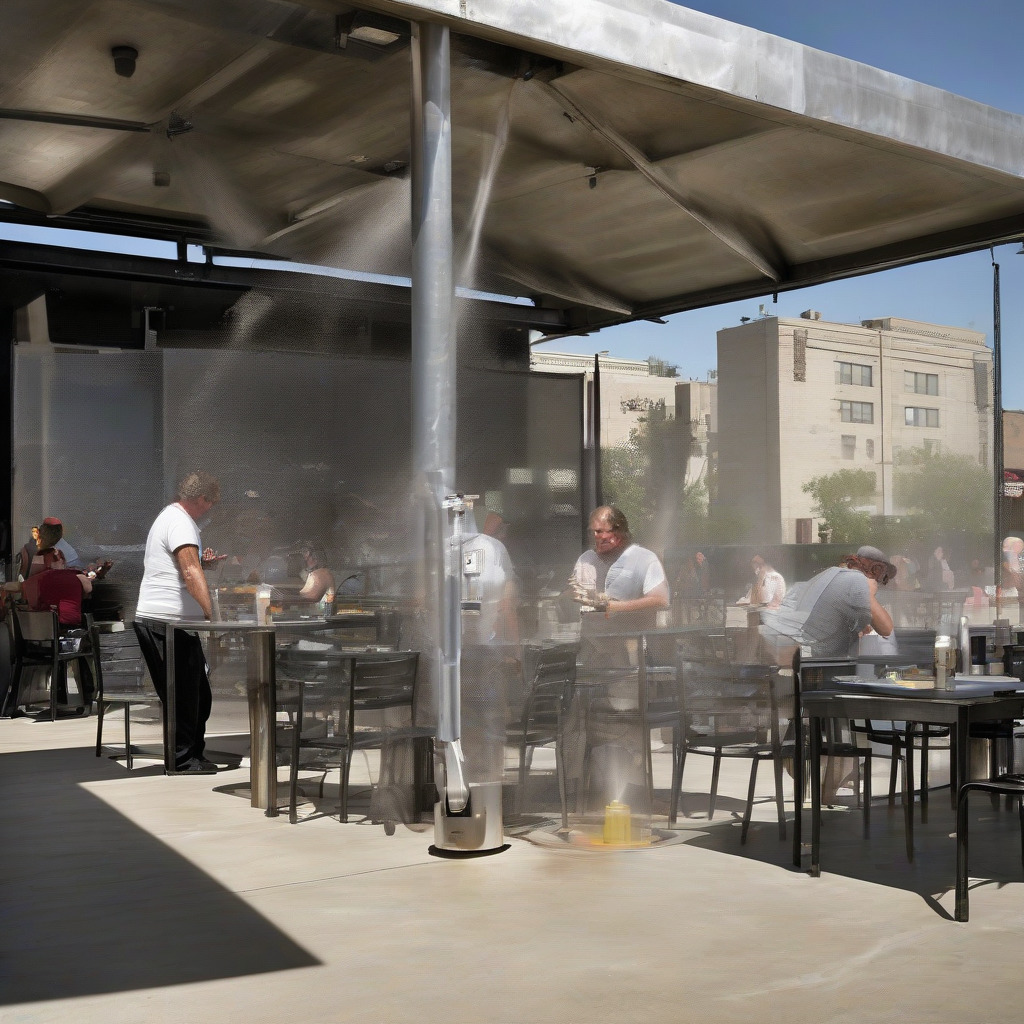
The physics is straightforward: misting systems force water through high-pressure nozzles to create a fog of micro-droplets, which evaporate rapidly and absorb heat from the surrounding air. The cooling effect is directly limited by how much moisture the air can still accept. In low-humidity climates, high-pressure systems can produce 8 to 15 degrees of cooling. When relative humidity is already at 70 to 90 percent — Houston’s baseline throughout summer — the air’s capacity to absorb additional moisture is severely reduced. The droplets evaporate slowly. The cooling effect diminishes. In the worst cases, the mist just settles on your food and your shirt.
“The honest number in Houston, on a typical humid afternoon, is probably 4 to 8 degrees of cooling from a high-pressure system,” said one mechanical engineer familiar with outdoor thermal comfort systems, who asked to be identified only by his professional designation. “When a vendor tells you 15 or 20 degrees, ask them where they’re testing. That’s a desert number.”
Four to eight degrees is not nothing. On a 108°F heat index day, dropping to 100°F is still miserable. On a 98°F heat index evening in late September or during an October warm spell, that same drop is the difference between a comfortable dinner and a skipped reservation. Whether misting is worth the investment depends entirely on context — which is a more honest answer than most vendors will give you.
One more thing diners want to know: a poorly calibrated or low-pressure misting system in Houston humidity can leave you damp. High-pressure systems operating at 800 to 1,200 PSI atomize water into droplets small enough that they flash-evaporate before contacting skin or surfaces under most conditions. But the margin is thin at peak humidity. Operators who dial back nozzle output to avoid the wetness problem are also getting less cooling. It’s a genuine trade-off, not a solved problem — and anyone who tells you otherwise is selling something.
What Operators Are Installing, and What They’ve Given Up On
The technology choices for Houston patios break into distinct categories with very different track records.
High-pressure misting systems remain the most common active cooling investment, primarily because the price point is accessible and installation is relatively non-invasive. At 800 to 1,200 PSI, they deliver the best evaporative result available in this climate, modest as that result is by marketing standards. Multiple operators describe them as “better than nothing.” Not a ringing endorsement, but accurate. They’re the first rung on the investment ladder for operators who can’t justify a full shade structure.
High-volume low-speed (HVLS) fans — the large-diameter, slowly rotating ceiling or pergola fans designed for commercial spaces — have become more common among operators who’ve decided that air movement matters more than evaporative cooling in Houston’s humidity. Moving air accelerates sweat evaporation from skin, which is the body’s primary cooling mechanism. HVLS fans create meaningful perceived cooling through that mechanism even when ambient conditions can’t be reduced much. One Heights restaurant owner installed a single 16-foot diameter fan over their main patio and reported an immediate change in booking patterns for late afternoon service — not because the temperature dropped, but because the air movement made the space feel less stagnant. Several operators on the Washington Avenue corridor now run HVLS fans combined with high-pressure misting as their primary active cooling stack.
Commercial shade structures — engineered fabric canopies, tensile shade sails, steel-framed pergola covers with high-density shade cloth — address radiant heat rather than air temperature. That’s a fundamentally different problem. A significant portion of perceived outdoor heat in Houston comes from direct solar radiation and radiant re-emission from surrounding hardscape. Substantial shade coverage reduces that load before any mechanical cooling is applied. One Montrose bar operator who installed a 16-by-20-foot tensile shade sail over half their patio noticed that diners migrated naturally to the shaded half during service. The unshaded portion went from full to nearly empty once the sun angle hit it directly. People vote with their feet. In July they vote for shade.
Retractable awnings provide flexibility but rarely solve the core problem. They’re useful for rain protection and for capturing the late-afternoon cool-down window when the goal is blocking the setting western sun rather than active cooling. One Heights café uses retractable units to cover their patio from 5 to 8 p.m., picking up the golden hour before full darkness.
Full HVAC enclosures — essentially building a conditioned room with transparent or screened walls — work. They also cost $30,000 to $100,000 or more and require full building permits, which changes the calculus entirely. One upscale restaurant in the Medical Center enclosed their patio in 2023 and reported the first fully air-conditioned summer service in the facility’s history. They acknowledged the expense made sense only at their specific volume and price point. For most independent operators, it’s out of reach. For context on what commercial cooling systems run in Houston right now, the numbers in HVAC replacement cost data for Houston in summer 2026 offer useful benchmarks on equipment and labor costs.
What operators have abandoned is its own education. Low-pressure misting fans — the residential-grade oscillating units with a water reservoir at the base — don’t work well in peak summer conditions. The droplet size is too large, the pressure too low, and the result in high humidity is simply a wet, slightly miserable seating area. Several operators described buying them, trying them for one summer, and removing them. One Washington Avenue bar owner spent $4,000 on a commercial evaporative cooler unit after reading about their effectiveness in dry climates. They used it for two weeks in July and moved it to their warehouse. “Learned that lesson,” they said. It’s an expensive lesson, and apparently a fairly common one. Houston is not a swamp cooler market, despite the nickname.
What It Actually Costs
These are the numbers competing coverage almost never publishes, sourced from Houston-area contractor conversations and operator-described projects.
High-pressure misting systems run $2,000 to $8,000 installed for a typical patio perimeter, depending on linear footage and pump capacity. Monthly operating costs — water and energy combined — run $150 to $400 for a mid-sized patio running afternoon and evening service. The maintenance reality vendors tend to understate: Houston’s water supply is moderately hard, with calcium and magnesium mineral content that fouls high-pressure nozzles over time. One operator in Midtown reported replacing nozzles quarterly at roughly $80 per cycle — nearly $400 annually on top of utility costs, and well above what the vendor quoted for maintenance.
HVLS pergola fans cost $500 to $2,000 per unit installed, depending on diameter and motor spec. Most operators with larger patios run multiple units. A 1,500-square-foot patio typically needs two 14-foot units or three 12-foot units to avoid dead zones.
Commercial shade structures fall in a wide range: $5,000 to $25,000 depending on type, span, and whether freestanding or attached. A 16-by-20-foot tensile shade sail runs roughly $8,000 to $12,000 installed. A steel-framed pergola with permanent shade cloth over a similar footprint runs $12,000 to $18,000.
Retractable awnings run $3,000 to $12,000 depending on span and mechanism. A 12-foot motorized unit with quality materials costs around $6,000 to $8,000 installed.
Full HVAC enclosures start at $30,000 on the low end for a basic screened-and-cooled structure. One Medical Center operator put total project cost at $87,000, which included structural engineering review, permitting, an electrical upgrade to support the HVAC system, and a custom transparent polycarbonate wall system. That’s a real number. Plan accordingly.
How Some Operators Are Restructuring the Service Day
A quieter adaptation — less capital-intensive than cooling infrastructure — has emerged among a subset of Houston operators. They’ve restructured the service day so outdoor covers are anchored at the beginning and end of the comfortable window rather than distributed throughout operating hours. It’s unglamorous. It works.
The model: a brunch-forward operation opens its patio at 7 or 8 a.m. and runs hard outdoor service through 10:30 a.m., before conditions deteriorate. Then it treats the patio as effectively closed from roughly 11 a.m. through 7 or 7:30 p.m., with servers steering guests toward indoor seating. Then it reopens for evening service when the heat index drops below 100°F, typically sometime between 7:30 and 8 p.m. in peak summer months.
Several Heights and Montrose operators describe this as their de facto operating calendar from June through September, even when they haven’t formally published separate patio hours. One popular breakfast spot in the Heights uses this framework without calling it a summer schedule. They simply tell the host stand not to seat patios during the 11 a.m. to 7 p.m. window unless the guest specifically requests it. By August, regulars understand.
Whether the shift window recovers real revenue or just manages the optics of a patio that isn’t earning depends on the concept. For brunch-heavy operations with strong early morning traffic — particularly the café-style operators in the Heights and along 11th Street — the morning window is genuinely productive. One Heights café owner reported that 7 a.m. to 10:30 a.m. patio service accounts for roughly 35 percent of their total covers in July, compared to about 20 percent in spring and fall. For dinner-focused concepts, the post-7:30 window is the meaningful one, and it requires diners to arrive at what many Houstonians consider a late dinner hour.
“We pushed our patio dinner hour to 8 p.m. in July and August,” said one operator near Montrose. “We lose some people who won’t eat that late. But the people who come at 8 actually stay. It’s become more leisurely, cooler, genuinely pleasant. I think it might be a better product, honestly.” The shift has changed the demographic composition of their summer patio crowd — fewer families with children, more adult couples willing to dine later. Economically, the later service window has held revenue at comparable levels to their spring dinner schedule. Better outcome than most people would predict.
The Tree Canopy Advantage, and Why It’s Not Available to Everyone
The most effective and least expensive cooling solution available to a Houston patio operator is one they almost certainly didn’t install: a mature tree canopy overhead.
This is not a minor advantage. A full overhead canopy of established live oaks or pecans — the kind that exists in the older residential neighborhoods of Montrose, the Heights, and parts of West University — intercepts direct solar radiation, reduces re-radiated heat, lowers the local ambient temperature through transpiration, and creates an environment that is measurably different from an adjacent unshaded surface on the same afternoon. That difference outperforms almost any mechanical cooling investment at comparable cost. Houston gets roughly 204 sunny days per year. The shade you start with determines the fight you’re in.
The gap shows up in operating costs. A Heights café shaded by 50-year-old oak trees reported July misting system costs of roughly $100 monthly because the pre-existing canopy already reduced peak ambient temperature by 5 to 8 degrees before any active cooling engaged. An otherwise identical café on a surface lot in EaDo, with the same misting system, runs $350 monthly because the starting thermal load is so much higher. That difference compounds over a five-year operating horizon. You cannot buy a 50-year-old live oak. You either inherit it or you don’t.
Operators who happen to have mature tree cover — who inherited a lot with 40-year-old trees or whose building backs up to a wooded easement — are playing a structurally different game from competitors who built patios on former parking lots or rooftops in newer commercial corridors. The patio behind a craftsman bungalow in the Heights is not in the same category as the rooftop bar on a Midtown high-rise, and no amount of misting infrastructure fully closes that gap. This geographic inequality in cooling capacity is one of the most underappreciated factors in Houston’s outdoor dining scene, and the industry doesn’t talk about it honestly enough.
The hardest problem belongs to rooftop operators and patios in industrial-conversion neighborhoods like EaDo, where building stock is newer, tree cover is sparse, and the surrounding environment is a heat sink. These operators face the highest mechanical spend and the most modest return on it. One EaDo restaurant owner looked at combined shade and active cooling costs reaching $35,000 to $40,000 and decided to close the rooftop completely from June through August rather than commit the capital. They now call June through August their indoor season and have adjusted labor and menu accordingly. That’s not a failure. That’s an honest read of the math.
The Permit Maze: What Houston Actually Requires
This is the section most operators wish someone had told them before they started. The permitting requirements for outdoor cooling infrastructure are more consequential than they appear, and the gap between what operators expect and what the city actually requires has derailed more than a few projects.
Houston has no traditional zoning, which shapes how patio permits work differently than in most U.S. cities. The Houston Permitting Center distinguishes between attached and freestanding structures, and that distinction matters. A shade sail or fabric awning attached to an existing building wall generally requires a permit for the attachment point and a review for wind load — Houston sits in hurricane country, and structures must be engineered to withstand 93 mph sustained winds and gusts up to 115 mph per city building code. This is not a paperwork formality. It is an engineering requirement that will add time and money to any substantial project.
Permanent enclosures are treated far more seriously. They effectively constitute an addition to the building, require full building permit review, and trigger fire code review for egress, occupancy classification, and sprinkler requirements depending on size and occupancy load. One operator who enclosed their patio with a transparent wall system discovered mid-project that the addition changed their occupancy classification from “patio” to “indoor dining space,” triggering a requirement for an additional ADA-compliant restroom and a full fire suppression evaluation. The project scope expanded from $25,000 to $55,000 after permitting conversations began. For a small operator, that kind of surprise is ruinous.
The TABC layer adds another dimension. When a licensed outdoor consumption area is physically modified by the addition of a permanent or semi-permanent structure, TABC may require notification and potentially a license amendment. An operator who adds a permanent pergola that changes the physical description of the licensed premises has potentially changed the terms of their outdoor license. Verify directly with TABC before beginning any structural modification to a licensed outdoor area. One Montrose bar owner discovered mid-construction that their proposed pergola — which the city had approved — required TABC notification as a material change to their licensed space. The delay cost roughly two weeks and required a lawyer to untangle the notification requirement.
One Heights-area restaurant owner described the permitting timeline for a freestanding shade pergola as running approximately four months from application to approval, including structural engineering review. “Nobody warns you about that,” she said. “You think you’re buying a pergola, and then you’re in a four-month conversation with the city about wind load calculations.” She began the process in January planning a spring installation. The permit didn’t issue until May. Construction finished in early June — just as peak summer heat arrived. She missed spring patio season entirely.
The practical advice from operators who’ve been through it: hire a licensed contractor familiar with Houston commercial permitting from the start, not after you’ve ordered the structure. Retrofitting permit compliance after construction is both harder and more expensive than building it into the project from day one.
The Honest Verdict
No single technology has solved the Houston summer patio problem. What works is layered: substantial shade coverage, high-pressure misting calibrated to avoid the wetness problem, HVLS fans for air movement, and a service schedule that doesn’t try to fight the worst afternoon hours. Operators who’ve made the full investment have meaningfully recovered summer patio revenue. Operators who’ve bought one piece of it at a time have largely been disappointed.
The investments that have underperformed are the inexpensive ones — low-pressure portable misters, single residential fans, shade sails without mechanical cooling. They show up on a restaurant’s website as evidence of a comfortable outdoor space and tend to disappoint diners who arrive expecting a pleasant July dinner at 6 p.m. The gap between what looks reasonable in marketing photos and what actually feels reasonable at a 108-degree heat index is where most operators initially stumble and where most diners get burned.
The investments that have moved the needle are expensive and, in some cases, require permitting that adds months and real money. One Heights restaurant owner who invested $18,000 in a steel-frame pergola with shade cloth, plus a 16-foot HVLS fan, plus a high-pressure misting retrofit, reported recovering approximately 65 percent of the summer patio covers she’d lost before any infrastructure existed. That recovery justified the investment and the four-month permitting process. But it worked because she approached it as a system, not a series of individual purchases. That’s the pattern that holds up.
For diners: if you want to eat outside in Houston in July, book for 8 p.m. or later. Look for patios with visible overhead shade structures and large-diameter commercial fans — not portable misting fans and residential furniture. Neighborhoods with established tree cover, including the Heights and older Montrose, offer the most reliably comfortable outdoor environments. Rooftop patios and patios on Washington Avenue and in Midtown without significant shade infrastructure are, on a July afternoon, genuinely uncomfortable regardless of what the photos look like. The people eating at those patios at 6 p.m. are not having a good time, even if they’re smiling for Instagram.
The operators who are honest about this will tell their guests the same thing. The ones who aren’t will have empty tables at 5:30 and wonder why.