What Houston Drivers Actually Need to Know About Car Insurance and Flood Damage
Car insurance exists everywhere. Flood risk in Houston operates at a different scale. The standard coverage advice written for everywhere else leaves Houston drivers holding policies they don't ful…

What Houston Drivers Actually Need to Know About Car Insurance and Flood Damage
Car insurance exists everywhere. Flood risk in Houston operates at a different scale. The standard coverage advice written for everywhere else leaves Houston drivers holding policies they don’t fully understand until the water is already inside the cab.
This piece is written specifically for Harris County drivers. It covers what comprehensive auto coverage actually pays for when a car floods, the exclusions that generate the most post-flood claim disputes in this market, how Texas’s total-loss rules work and why payouts often fall short, when gap insurance matters and why the dealer’s version costs more than it should, what the statutory claims timeline looks like versus what actually happened after Harvey and the May 2024 floods, and what to do in the first 48 hours after your car goes underwater. If you have a car loan, live in a repeat-flood neighborhood, or simply haven’t read your policy since you signed it, read this before the next storm.
Houston’s Flood Math Is Different
Harris County averages 49 inches of rain per year — about 11 inches above the national average. The water drains through roughly 2,700 miles of bayous and channels. That infrastructure moves water, but not fast enough when the storms are big enough.
The recent pattern is hard to argue with. The Memorial Day floods of 2015 hit in May, outside hurricane season. Tax Day 2016 did the same. Harvey in 2017 brought the catastrophic scale everyone had been dreading. Then the May 2024 flooding damaged thousands of vehicles across Harris County — another off-season event. Three of the four worst flood events in recent memory hit outside the traditional June–November window. That’s not a coincidence. It’s the reason year-round preparedness here is genuinely different from what drivers in most U.S. cities need to think about.
The bayous rise fast. The underpasses fill in minutes. Meyerland has flooded repeatedly across these events — it’s among the most persistently flooded residential neighborhoods in the country, which is a grim distinction but a real one. Kingwood, Greenspoint, Fifth Ward, Westbury, and Spring Branch have all generated significant vehicle loss claims multiple times in recent years. If you live in any of these areas and have a loan on your car, this is a when conversation, not an if.
The One Policy That Covers Flood Damage — and It’s Not Collision
Most Houston drivers assume collision coverage pays for water damage. The intuition makes sense. Water hit the car. Collision, right?
Wrong. The Texas Department of Insurance is direct: comprehensive coverage covers flood damage. Collision applies to impact events — your car hitting another car or object, or vice versa. Rising water, storm surge, and water intrusion during a storm are environmental events. They go under comprehensive.
TDI defines comprehensive as protection against losses outside the driver’s control: theft, fire, falling objects, hail, animal strikes, flooding. If your car was sitting in your driveway when Buffalo Bayou rose and put two feet of water through it, comprehensive is what pays. If a storm drain backed up in a parking garage while your car was sitting in it, same answer.
There’s no NFIP equivalent for vehicles, which surprises a lot of people. The National Flood Insurance Program covers residential structures and their contents — not automobiles. No standalone private flood policy exists for cars either. Comprehensive is it. And if you carry only liability — which is all Texas law requires — and your car floods, you have no coverage for the vehicle itself.
This is the first thing to confirm: do you actually carry comprehensive? Liability-only policies are common, particularly on older paid-off vehicles where dropping comprehensive is a rational call. In Harris County, that calculation carries more risk than it does almost anywhere else in the country. If you’re not sure what’s on your declarations page, call your agent and ask directly. It’s a 30-second question.
What Comprehensive Does Not Cover
Knowing what comprehensive pays for is only half the picture. The exclusions are where post-flood disputes actually happen — and in Houston, they happen with documented regularity. For additional context on how auto insurance claims and consumer protections interact in Texas, see our automotive coverage at CityDesk Houston.
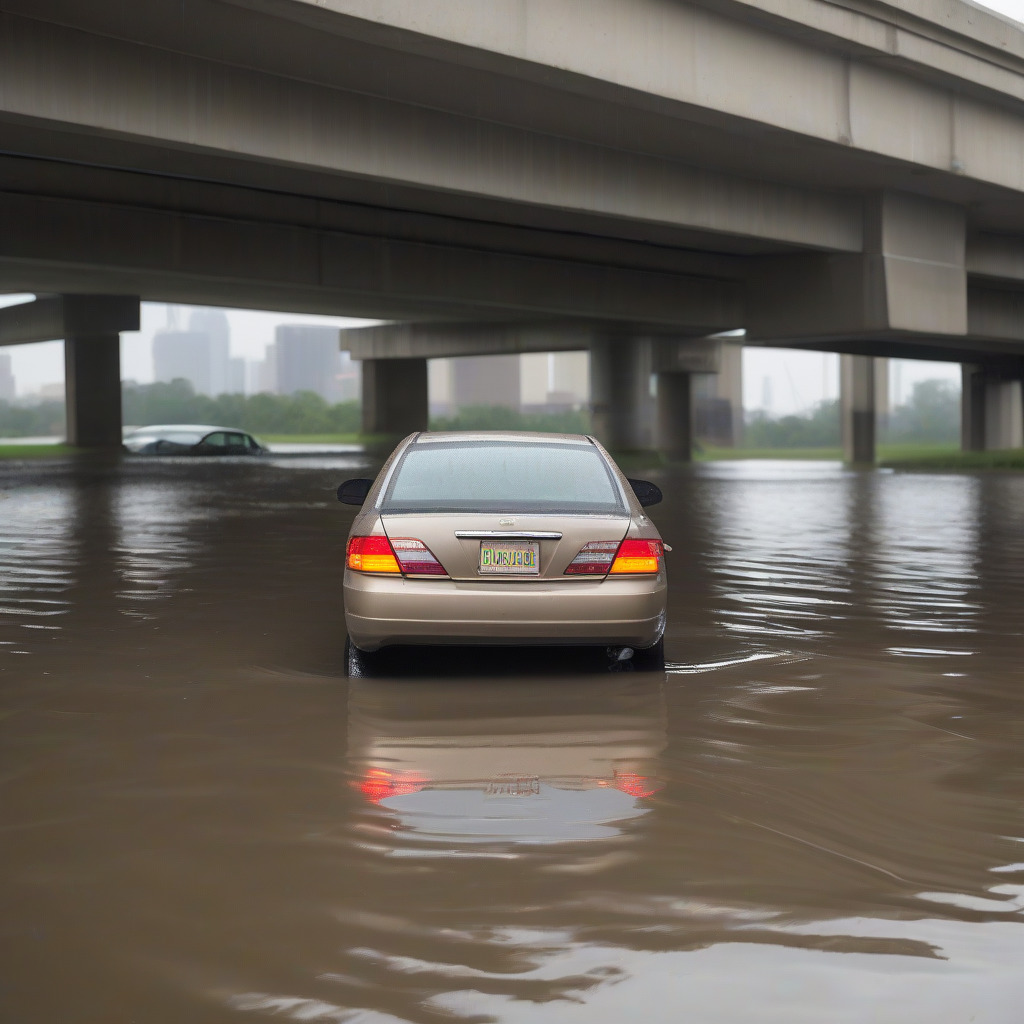
Driving into a flooded roadway. When an adjuster can establish that a driver knowingly operated a vehicle into a flooded underpass or street, the claim can be reclassified or denied on grounds of negligent operation. Comprehensive covers environmental events. When the damage shifts from “rising water overwhelmed my stationary car” to “the driver drove into water they could see,” insurers argue the direct cause was driver conduct, not weather. This came up repeatedly after Harvey at underpasses and low-water crossings where flooding was visible before drivers entered. The rule isn’t complicated: if you can see water on a roadway, don’t drive into it.
Mold and interior deterioration from delayed reporting. Texas policies include a duty-to-mitigate provision. After a loss, you’re expected to take reasonable steps to prevent further damage. This created a specific problem after Harvey. Vehicles that sat for days before being reported — because roads were impassable, phone lines overwhelmed, owners were dealing with flooded homes — developed mold and interior damage beyond the initial flood event. Insurers invoked failure-to-mitigate language to limit payouts on that secondary damage. The delay was completely understandable. The contractual exposure was real anyway.
Document and report as early as possible, even when physical access isn’t possible yet. A timestamped call to your insurer’s claims line and a photo uploaded through their app puts you on record before an adjuster can get to the car. Don’t wait for perfect conditions.
Hydrolock from driver-caused water ingestion. Hydrolock happens when water enters the engine through the air intake — usually by driving through deep water — and causes catastrophic internal damage when the engine tries to compress it. Comprehensive covers hydrolock when it results from rising water around a stationary vehicle. But if an adjuster determines the driver voluntarily operated the car through standing water, the same negligent-operation argument applies. Starting a flooded engine also causes hydrolock, which is why the first rule in the post-flood section below is the most important one in this article.
Texas’s Total-Loss Rules and Why the Payout Often Falls Short
If repair costs exceed 75 percent of your vehicle’s actual cash value, Texas law requires a total-loss declaration. The insurer pays you ACV — not replacement cost, not what you paid, not what you still owe on the loan.
Actual cash value is calculated using market data: comparable vehicles in your area, adjusted for condition, mileage, and pre-loss pricing. The problem that surfaced clearly after Harvey was timing. Adjusters calculated ACV using pre-storm comparable sales — the only data available at that point — while the post-storm used-car market in Houston had already shifted sharply upward because so many vehicles were destroyed simultaneously. Owners received offers based on what their truck was worth before the storm. By the time they went shopping, the same truck cost several thousand more. That valuation gap drove a substantial share of Harvey-era complaints through TDI, and it wasn’t a small number of claims.
The same dynamics will recur in any large-scale flood event. Do this now, before storm season: pull your vehicle’s current value from NADA (nada.com) or Kelley Blue Book (kbb.com) and write it down. If you get a total-loss offer that seems low, that number gives you something concrete to work from. Texas law permits policyholders to dispute ACV calculations, and insurers must provide their valuation methodology in writing upon request. Your vehicle’s trim level, option packages, and TxDMV title history are all legitimate grounds for pushing back.
Gap Insurance — Who Needs It and Why the Dealer’s Version Costs Too Much
Gap insurance covers the difference between your insurer’s total-loss settlement and what you still owe on the loan. Cars depreciate faster than most loan balances shrink — especially in the early years.
The Houston drivers most exposed to a gap problem: anyone who financed with less than 20 percent down, anyone in a 72- or 84-month loan (now standard in new-vehicle financing), and anyone who bought a truck or SUV at the price peaks of 2021 or 2022, when dealers were adding markups above sticker on top of a historically inflated used-car market. A vehicle can drop several thousand dollars in value during its first year while the loan balance barely moves. In a Houston flood, that gap becomes a real out-of-pocket liability that shows up on your credit at the worst possible moment.
Where you buy gap coverage matters — and this is something the dealership’s finance office has no incentive to explain clearly. F&I desks sell gap coverage at the close of the financing deal, typically priced between $400 and $900, then roll that amount into the loan. You pay interest on it for the life of the loan. The same coverage added through your auto insurer as a rider costs roughly $20 to $40 per year. If you’re buying a new vehicle and know you’ll want gap protection, contact your insurer before you sit down in the F&I office. Buy it there.
A third option worth knowing: Houston-area credit unions. Space City Credit Union, Houston Federal Credit Union, and TDECU all offer gap waiver products as part of auto loan packages. If you financed through one of them, call and ask whether gap coverage is available on the loan side and what it costs. For a broader look at how Houston credit unions vs. big banks stack up on auto loan products and fees, that comparison is worth reading before you finance a vehicle.
Texas law doesn’t require gap insurance. Some lenders require it contractually on high-LTV loans, but that’s a lender requirement, not a state mandate. If you’re unsure, read your financing agreement or call the lender.
How the Claims Process Works After a Houston Flood
The Texas Insurance Code sets specific deadlines. After written notice of a claim, the insurer has 15 days to acknowledge receipt and begin investigation. Once documentation is complete, 15 business days to accept or deny. After accepting, five business days to issue payment.
Those are the statutory rules. Post-Harvey and post-May 2024, the reality was different.
Clean total-loss claims — clear documentation, no coverage disputes, unambiguous flood damage — settled in roughly three to six weeks. Slower than the statute implies, but within a defensible range given surge conditions. Disputed ACV valuations stretched significantly longer, often two to six months when cases required third-party review. Partial damage claims involving electrical repairs ran four to five months in some cases, driven by adjuster backlogs and the complexity of modern vehicle electronics.
The out-of-state adjuster problem made everything worse after Harvey. Insurance companies imported adjusters from across the country to handle volume. Many had no working knowledge of Houston’s bayou geography, the speed at which neighborhoods flood, or the damage patterns that come with bayou-adjacent flooding. An adjuster from Arizona doesn’t know how fast Buffalo Bayou rises or what a water line at the dashboard means in Meyerland. Post-Harvey claims produced documented instances of out-of-state adjusters miscategorizing damage and pulling comparable vehicle values from the wrong markets entirely. It was a real, widespread problem, and there’s no structural reason it won’t happen again in the next major event.
If a valuation seems off, request the insurer’s written ACV calculation. Submit comparable listings from Houston-area dealers for similar vehicles. If the dispute continues, check your policy for a formal dispute mechanism and consider contacting TDI. If the insurer is missing statutory deadlines — not acknowledging within 15 days, not deciding within 15 business days of complete documentation — file a complaint with the Texas Department of Insurance at 800-252-3439. TDI’s enforcement is complaint-driven. Filing creates an official record, requires a formal response from the insurer, and sometimes moves things on its own. Use it.
The First 48 Hours After Your Car Floods
What you do immediately after a flood matters for your claim outcome. This is before an adjuster arrives, before a tow truck shows up, before you know how bad it is.
Don’t start the engine. This is the most important instruction here. A flooded engine may have water in the cylinders. Starting it forces the pistons to compress that water, which they can’t do. The result is hydrolock — internal damage that can turn a repairable car into a total loss and raise questions about whether the driver’s own action caused the mechanical failure. Leave the key in your pocket.
Photograph everything immediately. The VIN plate, the odometer reading, the water line inside the vehicle, all exterior damage, and the surrounding context — the street, neighboring landmarks, anything that places the vehicle and establishes what happened. Use your phone’s native camera app, which automatically timestamps and geotags. Upload to cloud storage right away, not just to your device. Phones disappear in post-flood chaos. Don’t let your documentation disappear with one.
Call your insurer before authorizing a tow. Post-flood towing demand in Houston is enormous, and operators will take your car wherever they can move it if you don’t direct otherwise. Your insurer needs the vehicle sent to an approved repair facility or inspection location. Unauthorized towing to an unapproved shop creates coverage complications. Call the 24-hour claims line — not your agent’s cell — before any tow is authorized.
Note actual rental car rates that day. Most comprehensive policies include rental reimbursement, but the standard cap of $30 to $50 per day reflects normal market conditions. After Harvey, Houston rental rates hit $80 to $150 per day as inventory evaporated across the metro within 48 hours. Document actual rates at local agencies and national chains on the day of the event. That documentation supports a claim for higher reimbursement and gives you something concrete if you need to negotiate.
Report interior damage immediately, in writing. Send notice through your insurer’s app or by email describing the interior condition based on what you can see or what the water level implies. Don’t wait for an adjuster to physically reach the car. Written notice creates a paper trail and protects against failure-to-mitigate arguments later.
What to Do Before the Next Flood Arrives
None of this takes more than an hour. Do it before storm season, not during.
Photograph your vehicle and store the images somewhere other than the car. Cloud storage works. The glove compartment does not survive submersion.
Pull your current loan payoff statement from your lender. Compare that number to your vehicle’s current KBB or NADA value. If the balance exceeds the value, you have a gap exposure that needs attention now.
Find your insurer’s 24-hour claims line and store it in your phone separately from your policy documents. Policy documents stored in a flooded car are inaccessible when you need them.
Check your declarations page to confirm you have comprehensive coverage, not just liability. If you’re not sure, call your agent and ask. It’s a 30-second question.
Verify whether you have gap coverage through your insurer or lender, and confirm it’s active.
Sign up for Harris County Flood Control District’s FAS3 flood alert system. It sends text, email, and voice alerts when bayou gauges hit threshold levels. It won’t give you hours of warning, but it can give you enough time to move a car to higher ground if you’re paying attention. That’s a real margin.
If you live in Meyerland, Kingwood, Greenspoint, Fifth Ward, Westbury, or Spring Branch, treat every item on this list as necessary. These neighborhoods aren’t on the edge of Houston’s flood risk — they’re at the center of it. If you’ve been through a flood before and rebuilt your life partly on the hope it won’t happen again, that’s a reasonable human response. The pattern of these events doesn’t support it.
Houston’s flood reality is specific enough that standard insurance assumptions break down here. The coverage most drivers think they have and the coverage they actually have are sometimes different things. The payout they expect and the one they receive are often different numbers. The claims timeline they anticipate and the one they actually live through after a major event rarely match.
None of those gaps are unfixable — but only if you know about them before the water comes up.