How to Vet a Mobile Mechanic and What They Can Actually Fix
Texas has no mechanic licensing law. Here's what to check instead, what repairs are genuinely mobile-ready, and what three Houston operators readers have actually used.

Texas has no mechanic licensing law. Here’s what to check instead, what repairs are genuinely mobile-ready, and what three Houston operators readers have actually used.
Mobile mechanics make sense in Houston in a way they don’t in cities where you can drop a car and walk home. When driving 12 miles to a shop, waiting three hours, and driving back can consume half a workday, having a credentialed technician come to your driveway is a real trade. Houston’s car dependency isn’t going anywhere, and the mobile mechanic business has grown to match it.
The catch: “mobile mechanic” is an unregulated category in Texas. No state license to check, no registry to search. Many mobile mechanics are experienced, insured, and skilled. But the filtering a licensing system would do automatically, you have to do yourself.
Step 1: Understand What Texas Law Does and Doesn’t Require
The most common mistake Houston drivers make when hiring a mobile mechanic is looking for a credential that doesn’t exist. Texas does not require automotive technicians to hold a state license — not shop mechanics, not mobile operators. There’s no TDLR registry of “licensed mechanics,” no state certification to request.
What TDLR does regulate are vehicle inspection stations — physical facilities authorized to perform Texas’s annual safety inspection. That license ties to a fixed location. Mobile mechanics cannot legally run your annual inspection at your house. If one offers to, pass. Same goes for emissions testing under the TCEQ program: it must happen at a certified facility, full stop.
Once you understand what the state doesn’t regulate, you can focus on credentials that actually mean something.
Step 2: Check the Credentials That Actually Mean Something
The National Institute for Automotive Service Excellence (ASE) runs the closest thing the industry has to a credentialing system. Mechanics earn ASE certifications by passing proctored tests in specific areas — brakes, engine repair, electrical systems, HVAC — and must demonstrate two years of hands-on experience. The tests aren’t trivial; failure rates are significant.
You can verify any mechanic’s ASE credentials at ase.com/verify by entering their name or certificate number. Free lookup, returns specific certifications and whether they’re current. ASE Master Technician means the person has passed all eight core automotive tests. For common mobile work, look at minimum for A5 (Brakes), A6 (Electrical/Electronic Systems), A8 (Engine Performance), and A1 (Engine Repair). An operator who’s been doing mobile work for years and holds nothing independently verified — that’s a problem.
Liability insurance is separate. Texas doesn’t require mobile mechanics to carry it, which means if a technician cross-threads a drain plug and destroys your engine, your recourse without insurance is small claims court. Ask for a Certificate of Insurance before work starts. A legitimate operator will have one and won’t hesitate. The certificate should name the business, list the insurer, and show coverage amounts. Ask specifically about garage liability coverage — that’s the policy type designed for vehicle repair work. If you want added protection, ask whether they can add you as an “additional insured” for the job. Standard request in commercial work, costs the operator nothing.
A mobile mechanic running an above-board operation should also have a Texas Sales and Use Tax Permit (required for any business charging sales tax on parts) and a Houston general business license if operating within city limits. Neither proves competence, but both indicate someone running a real business with real accountability. If you’re sorting out the right business structure for your own operation in our automotive coverage, the same principle applies: documentation signals legitimacy.
Before you book, ask directly:
- Can you share your ASE certificate numbers so I can verify them?
- Do you carry liability insurance? Can you send a Certificate of Insurance?
- What’s the business name as registered with the state?
- Do you carry a Texas Sales and Use Tax Permit?
- What’s your warranty on parts and labor?
Any qualified operator answers these without irritation. Vagueness on any of them is your signal to move on.
Step 3: Know What the Job Actually Requires
A lot of Houston drivers waste money booking a mobile mechanic for a job that requires a shop, then pay a diagnostic fee to learn that.
The logic is simple: mobile mechanics arrive in a van. No lift, no fluids-disposal infrastructure, no alignment rack, no refrigerant recovery equipment. Work done from underneath a car on jack stands, or from the engine bay, is mobile-appropriate. Work requiring the car elevated on a two-post lift for extended periods, or specialized equipment, isn’t.
Mobile-appropriate:
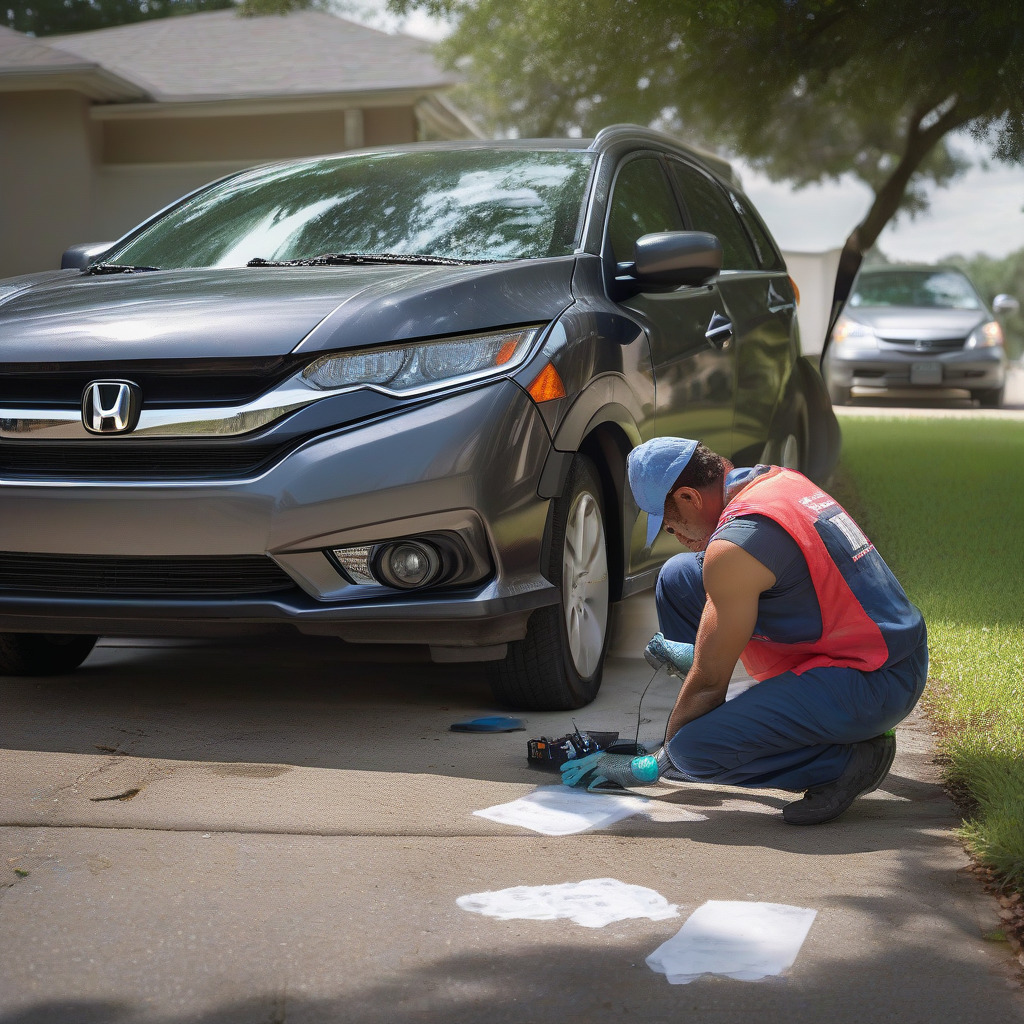
Oil changes. No lift needed; floor jack and stands work fine. Front and rear brake pad and rotor replacement — high-volume mobile job, completely safe on jack stands for most passenger vehicles. Battery replacement (more on why this matters in Houston below). Alternator replacement is accessible on most vehicles without a lift. Serpentine belts, ignition coils, sensors, thermostats, radiator hoses — all accessible from the engine bay on most vehicles. Starter motor replacement is labor-intensive but doable in a driveway. Spark plugs are straightforward on most four-cylinders; some V6 and V8 configurations with rear-bank plugs can be brutal even at a shop.
Shop-required:
Exhaust work requires welding, cutting, and a car safely elevated for a sustained period. Any internal transmission work — a fluid change is technically possible, but a mobile mechanic who offers to do transmission repair in your driveway is overselling their setup. Wheel alignment requires an alignment rack, period. State inspection and emissions testing are legally off the table. Timing belt or chain replacement is possible in theory; in a driveway with the precision required, rarely practical. Strut replacement is mobile-possible, but the alignment that must follow requires a shop visit anyway.
AC refrigerant service gets its own paragraph because it’s the single most common point of failure between Houston drivers and mobile mechanics. When your AC dies in August, booking a mobile mechanic seems efficient. Here’s the problem: most mobile mechanics can’t legally or practically finish the job. Refrigerant handling requires EPA Section 608 certification and a recovery machine that captures old refrigerant instead of venting it — a federal violation if skipped. Many mobile operators lack the equipment or the certification or both. A mechanic without recovery equipment will either decline on arrival after charging a diagnostic fee or do the work improperly. When your AC needs refrigerant service, take it to a shop. Confirm before you drop the car that they have certified technicians and proper recovery equipment.
Battery replacement is the best mobile mechanic use case in Houston, and the reason is specific to this city. Cold weather kills batteries by reducing capacity. Heat kills them differently — by accelerating chemical degradation of the internal plates. Houston’s summers are genuinely brutal on batteries in a way that catches people off guard. A three-year-old battery that tested fine in April can fail by July. A mobile mechanic with a load tester can come to your driveway, test the battery under simulated load, confirm whether it needs replacement, and swap it on the spot — 45 minutes, no shop trip. That’s the job mobile service is actually built for.
Step 4: Get the Price Right Before Anyone Touches the Car
Mobile mechanic pricing in Houston is more competitive than most drivers expect. The intuition is that convenience costs extra, and sometimes it does. But mobile overhead is genuinely lower — no building lease, no lift depreciation, no service writers on salary. That gap shows up in the numbers.
Field-reported Houston rates for five common jobs, across independent mobile operators, platform services, independent shops, and dealerships:
| Job | Mobile (Independent) | Mobile (Platform) | Independent Shop | Dealership |
|---|---|---|---|---|
| Conventional oil change | $65–$85 | $79–$99 | $55–$80 | $90–$130 |
| Front brake pads + rotors | $180–$250 | $220–$290 | $250–$380 | $400–$600 |
| Battery replacement (mid-range) | $160–$210 | $175–$230 | $170–$240 | $250–$400 |
| Alternator replacement | $350–$500 | $400–$550 | $420–$600 | $650–$950 |
| Spark plugs (4-cyl) | $120–$180 | $140–$200 | $150–$220 | $250–$380 |
Rates verified with operators and shops in Houston proper, Katy, and Sugar Land. Parts costs vary by vehicle; table reflects mid-range passenger vehicles. Platform rates include YourMechanic and Wrench at time of reporting.
Independent mobile mechanics often beat independent shops on brakes and alternators because the labor differential is real — same hourly rate or less, and they’re typically estimating hours more efficiently when they’re not juggling a full shop floor. Platform operators (YourMechanic, Wrench) price higher than independents because the platform takes a cut, but they offer standardized vetting, cleaner booking, and clearer warranty terms. Those are real advantages worth paying for if you don’t want to do credential verification yourself.
Oil changes are the one category where mobile service rarely wins on price. Chain shops — Jiffy Lube, Take 5, Valvoline — run discount pricing that mobile operators can’t match structurally. If cheapest oil change is the goal, drive to a chain. If leaving home isn’t an option, the mobile rate is reasonable.
Step 5: Get a Written Estimate Before Work Starts
A written estimate is not optional. Any mobile mechanic unwilling to provide one before starting work should not be hired.
It needs to include an itemized parts list with OEM versus aftermarket designation for each component. You have a right to know what goes in your car, and aftermarket parts are often fine — but that choice should be yours. The estimate should spell out the labor rate per hour and estimated hours for the job. The total should either be firm or clearly marked as subject to change; a not-to-exceed figure gives you protection, an open-ended estimate doesn’t.
Warranty terms must be specific. How many months or miles, and what’s the actual process for a claim? Standard mobile mechanic warranties run 12 months/12,000 miles on parts and labor. Anything shorter is below average. The estimate should include the mechanic’s full legal name, business name, phone number, and a business address. A mechanic with no business address has no fixed accountability point.
Texas sales tax applies to parts. A quote that omits it will produce a higher final bill. Get written language that if additional work is discovered mid-job, the mechanic will contact you for approval before proceeding. Spell out payment terms.
Large upfront cash payments before work begins are the biggest red flag in mobile mechanic transactions. A deposit for parts on a larger job — alternator, starter — is reasonable. Several hundred dollars cash before a wrench is lifted is not. Refusal to provide a business address is the second major red flag.
Step 6: Check Whether Your Location Actually Works
This is something almost no coverage of mobile mechanics addresses, and it matters for a significant share of Houston drivers.
Many of Houston’s deed-restricted communities prohibit automotive repair work on residential property. West University Place, Bellaire, and Bunker Hill Village all have restrictions that cover this. Enforcement is inconsistent, but the restrictions exist. Large apartment complexes managed by Camden, Greystar, and similar companies frequently include lease language prohibiting mechanical work in their parking lots — and property managers do enforce it when they spot a mechanic’s van.
Check your HOA rules or lease before booking. If your property restricts it, options include street parking if available, or asking a nearby commercial property owner for permission. Many experienced mobile mechanics have navigated this before and have suggestions for their specific area — it’s worth asking.
Dense neighborhoods — Montrose, Midtown, EaDo, the Heights — create van-parking complications worth confirming in advance. A mechanic who needs a clear work zone may struggle on a street where parallel parking is the only option.
Houston’s geography creates a second issue: service area coverage. A mobile mechanic based in Katy isn’t realistically going to serve The Woodlands on short notice. Some operators list “Houston” but mean a specific quadrant of the metro. The drive from Pearland to Spring is not trivial, and operators who cover it may charge a travel fee or not show at all. Confirm the actual service area before you book.
Step 7: Three Houston Mobile Mechanics Readers Have Actually Used
The following profiles are based on Google Maps reviews (4.7 stars or higher, 50 or more reviews), direct reporting, credential verification via ase.com/verify, and interviews with readers who used each operator. Insurance documentation was reviewed where operators agreed to share it.
Joe Cisneros, JC Mobile Auto Repair — Inner Loop and Near Northwest
Joe Cisneros runs JC Mobile Auto Repair in Houston, concentrated in the Inner Loop and near northwest — Montrose, Garden Oaks, Oak Forest. He holds ASE certifications in Brakes (A5) and Electrical/Electronic Systems (A6), both verified at ase.com/verify at time of reporting. He carries general liability insurance with garage liability coverage and provided a Certificate of Insurance when requested.
When a job scope changes mid-work, Cisneros calls the customer with a verbal revised quote before touching anything additional, then follows up with a written update via text. Readers who used him confirmed this. That’s more than you’ll get from a lot of shops, where the call comes after the work is done. Warranty terms are 12 months/12,000 miles on parts and labor.
One reader reported a warranty claim on a brake job where a caliper he’d replaced seized within eight months. Cisneros returned and replaced it at no charge, no argument.
He works solo and books 48–72 hours out. He doesn’t regularly serve suburbs north of Beltway 8 or the Energy Corridor. Confirm the service area when you call.
Marcus Webb, Webb Mobile Mechanics — Katy/Sugar Land Corridor
Marcus Webb operates out of Katy, serving Fort Bend County and western Harris County — Katy, Sugar Land, Missouri City, and parts of southwest Houston. He holds ASE Master Technician status, meaning he’s passed all eight core automotive tests, verified at ase.com/verify. He carries a commercial auto policy on his work vehicle plus general liability, and shared both certificates.
On scope changes, Webb uses a written authorization form before expanding beyond the original work order. It’s a small thing, but it signals someone who’s thought through the business end of this work rather than winging it. Warranty terms are 12 months/12,000 miles on most jobs, 24 months on major repairs like alternator or starter. Readers in the Katy area praised his communication and his willingness to explain the work rather than just perform it.
His rates on brake and alternator jobs run slightly higher than some Houston proper independents — readers attributed it to parts costs at suburban suppliers and reasonable travel time. That’s an honest tradeoff for drivers in his corridor who want a well-credentialed operator rather than whoever happens to be available.
He’s not useful for Inner Loop or Heights residents. His footprint is specific and he doesn’t pretend otherwise.
Platform Option: YourMechanic — East Houston and Baytown Corridor
YourMechanic assigns jobs to local contracted technicians. You can’t call the individual mechanic in advance to verify their credentials directly, but you can ask the platform to confirm certifications before the appointment — and should.
CityDesk confirmed through YourMechanic’s customer service that technicians assigned to East Houston and Baytown-area jobs (zip codes 77023, 77011, 77015 and adjacent) include ASE-certified technicians with A5 and A6 credentials. Insurance coverage runs through YourMechanic’s commercial policy covering all platform work. Mid-job scope changes go through the app as a separate order — documented, but slow. One reader reported waiting 25 minutes for the platform to process a scope change while the mechanic stood next to her car. Not a dealbreaker, but worth knowing.
Warranty terms are 12 months/12,000 miles, claims handled through their customer service portal rather than directly with the technician. Readers had mixed experiences: one described a smooth process; one needed two follow-up calls to resolve a parts warranty claim.
Here’s the honest version of the platform tradeoff: YourMechanic and Wrench offer lower booking friction, standardized warranty language, and a clear escalation path if something goes wrong. You pay more than you would with a good independent, and you give up the ability to vet the specific technician beforehand. For drivers who don’t want to do the credential verification work themselves, that’s a defensible trade. If you’re willing to make a few phone calls and run the ASE lookup, a well-credentialed independent will typically give you more direct accountability for less money.
The Seasonal Angle: When Mobile Service Is Most and Least Useful in Houston
Houston’s climate creates a specific seasonal pattern worth knowing before you schedule anything.
April and May — before the sustained heat of June through September — are the best months for preventive mobile work: battery load test, belt inspection, cooling system hose inspection, radiator coolant flush if overdue. All mobile-appropriate, none requiring a lift, and all genuinely predictive of summer failures. A battery that tests weak in May will almost certainly strand you in July. Catching it early with a mobile technician’s load tester is significantly cheaper than an emergency tow in the middle of a heat advisory.
What to handle at a shop before summer: if your AC isn’t blowing cold, get it to a certified shop before June. Most mobile operators can’t properly complete refrigerant service, and you don’t want to be negotiating this during a 97°F week when every shop in Houston is booked three days out. The same heat-driven urgency applies to your home systems — HVAC replacement costs in Houston in summer 2026 follow a nearly identical seasonal squeeze, worth knowing if you’re facing both at once.
One Houston-specific note that experienced mobile operators mention more than mechanics in other markets: post-Harvey electrical problems. Vehicles flood-damaged in 2017 are still on Houston roads in larger numbers than you’d expect, and they can develop electrical gremlins years later as corroded connectors finally fail. Intermittent sensor issues, lighting problems, body control module faults that don’t track with the vehicle’s age — these are worth mentioning to any mechanic doing diagnostic work on a car with a Houston history. Several experienced mobile operators here ask about flood history before starting any electrical diagnostic job. It’s a reasonable question. If your mechanic doesn’t ask it, volunteer the information anyway.
October and November are a reasonable window for non-urgent maintenance deferred through the summer. Schedules loosen, and the cooler temperatures make driveway work more comfortable for everyone involved.
The absence of a Texas licensing framework doesn’t make mobile mechanics suspect — it makes personal vetting essential. Run the ASE check. Ask for the insurance certificate. Get the written estimate with all the required elements. Confirm your location allows the work. Four steps, none complicated, and the operators worth hiring won’t push back on any of them.